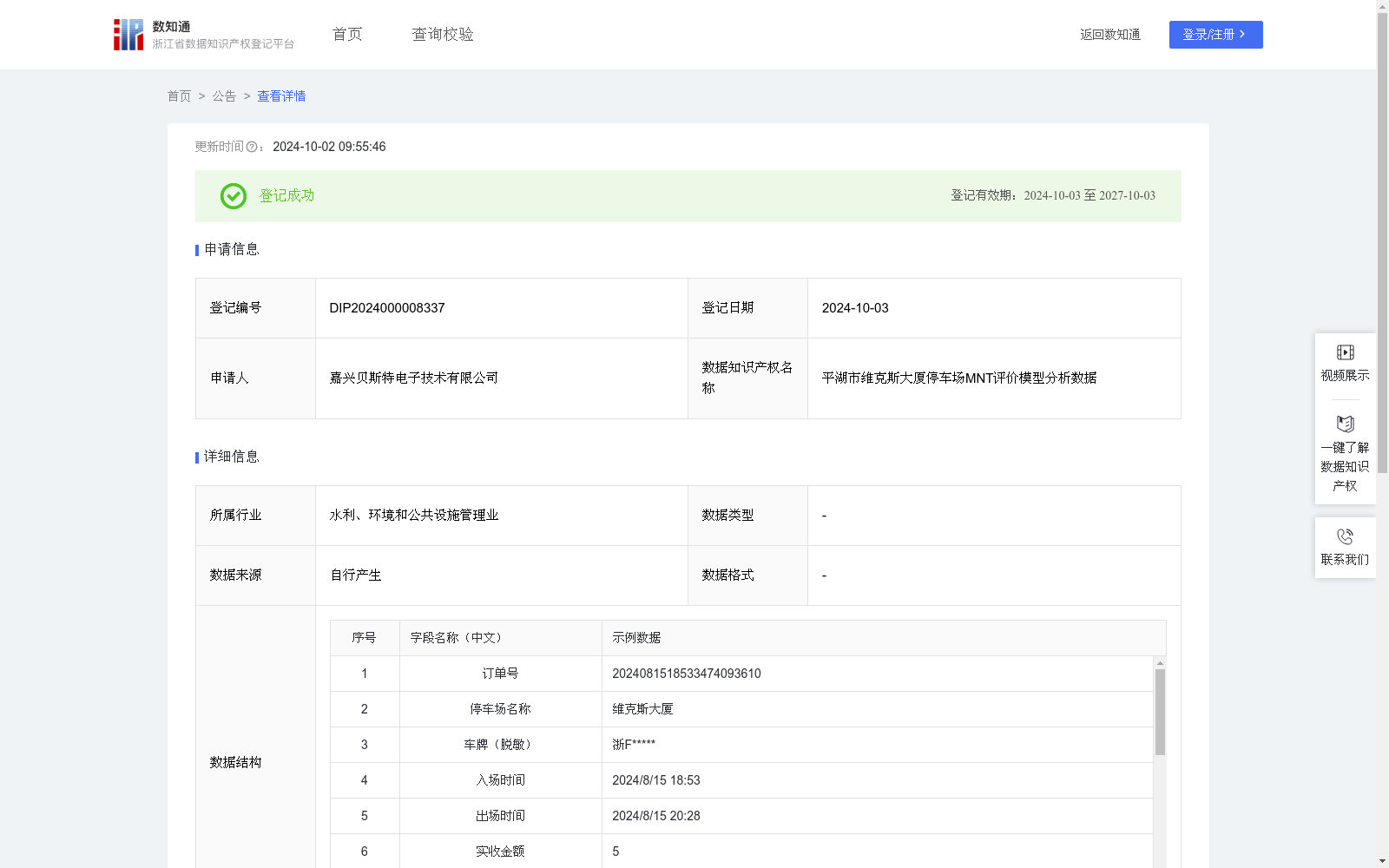
平湖市维克斯大厦停车场MNT评价模型分析数据
收藏资源简介:
随着城市化进程的加快,汽车保有量急剧增加,停车场作为城市交通系统的重要组成部分,其经营与管理显得尤为关键。通过建立停车场MNT模型看清停车场的经营情况,从而指定不同的策略,提升城市交通环节运行效率。一、提升场地规划与建设的科学性:通过停车场MNT模型,可以快速识别出价值较高和需要扶持的停车场,长期价值较高的停车场可扩大场地,满足市民出行需求并提升收入。长期价值较低停车场可适当缩减场地压降成本、增加充电车位提升差异化竞争优势。二、提升低收费停车场经营收入:通过分析停车场0元收费占比,可对预警停车场采取一定措施如推荐包月包年等优惠策略,吸引客流提升经营收入。 一、数据采集:原始数据来自市场监督局采集数据,包含停车场名称、车牌号、出入场时间、停车费实收金额、状态等原始数据字段,并对车牌号等敏感信息进行加密处理。 二、算法规则: 通过比较本停车场和市场监督局下所有停车场一段时间内平均收费金额、停车次数、平均停车时长数据,建立停车场MNT评价模型,并根据停车场0元收费占比进行预警。 1、车辆单次停车时长=出场时间-入场时间; 2、该停车场平均收费金额=该停车场停车费实收金额合计/停车次数,高于市场监督局下所有停车场平均收费金额的赋M,否则赋m; 3、该停车场停车次数高于高于市场监督局下所有停车场平均停车次数的赋N,否则赋n; 4、该停车场平均停车时长=该停车场停车时长合计/停车次数,高于市场监督局下所有停车场平均停车市场的赋T,否则赋t; 5、再根据MNT模型分层规则,将停车场分为4个层级,分别为重要价值(MNT)、重要发展(mNT、MnT、MNt)、一般价值(Mnt、mNt、mnT)、重点扶持(mnt),不同层级指定不同的经营策略; 6、0元收费占比=该停车场停车费0元订单数/总订单数,占比超85%进行预警,标记为需经营优化停车场。
Against the backdrop of accelerating urbanization and the sharp growth in vehicle ownership, parking lots as a critical component of urban transportation systems have become increasingly pivotal to their operation and management. Establishing the parking lot MNT model to gain insights into their operational status enables the formulation of tailored strategies to enhance the operational efficiency of urban transportation links. 1. Enhancing the scientificity of site planning and construction: The parking lot MNT model can quickly identify high-value parking lots and those requiring support. For parking lots with high long-term value, their site scale can be expanded to meet citizens' travel demands and increase revenue. For parking lots with low long-term value, appropriately downsizing the site to cut costs and adding charging parking spaces can help enhance their differentiated competitive advantages. 2. Boosting operational revenue of low-fee parking lots: By analyzing the proportion of zero-fee parking transactions in parking lots, targeted measures such as recommending monthly/annual subscription preferential policies can be adopted for warning-flagged parking lots to attract more customers and improve operational revenue. ### Data Collection and Algorithm Rules 1. Data Collection: Raw data is collected from the State Administration for Market Regulation (SAMR), including core raw data fields such as parking lot name, license plate number, entry/exit time, actual parking fee collected, and operational status. Sensitive information like license plate numbers is encrypted during data processing. 2. Algorithm Rules: The parking lot MNT evaluation model is built by comparing the average charging amount, number of parking instances, and average parking duration of a target parking lot with the corresponding metrics of all parking lots under SAMR over a specified period. Warnings are triggered based on the proportion of zero-fee parking transactions of the target lot. 1. Single-vehicle parking duration = Exit time - Entry time; 2. Average charging amount of a parking lot = Total actual parking fees collected / Number of parking instances. If this value exceeds the average charging amount of all parking lots under SAMR, the lot is assigned a score of *M*; otherwise, assigned *m*; 3. Number of parking instances of the target lot: if it exceeds the average number of parking instances of all parking lots under SAMR, assign a score of *N*; otherwise, assign *n*; 4. Average parking duration of the parking lot = Total parking duration / Number of parking instances. If this value exceeds the average parking duration of all parking lots under SAMR, assign a score of *T*; otherwise, assign *t*; 5. According to the hierarchical rules of the MNT model, parking lots are divided into four tiers: Important Value (MNT), Important Development Potential (mNT, MnT, MNt), General Value (Mnt, mNt, mnT), and Key Support Target (mnt). Tailored operational strategies are formulated for each tier; 6. Proportion of zero-fee charging = Number of zero-fee parking orders / Total number of orders. If the proportion exceeds 85%, issue a warning and mark the parking lot as one requiring operational optimization.