xpertsystems/oil005-sample
收藏资源简介:
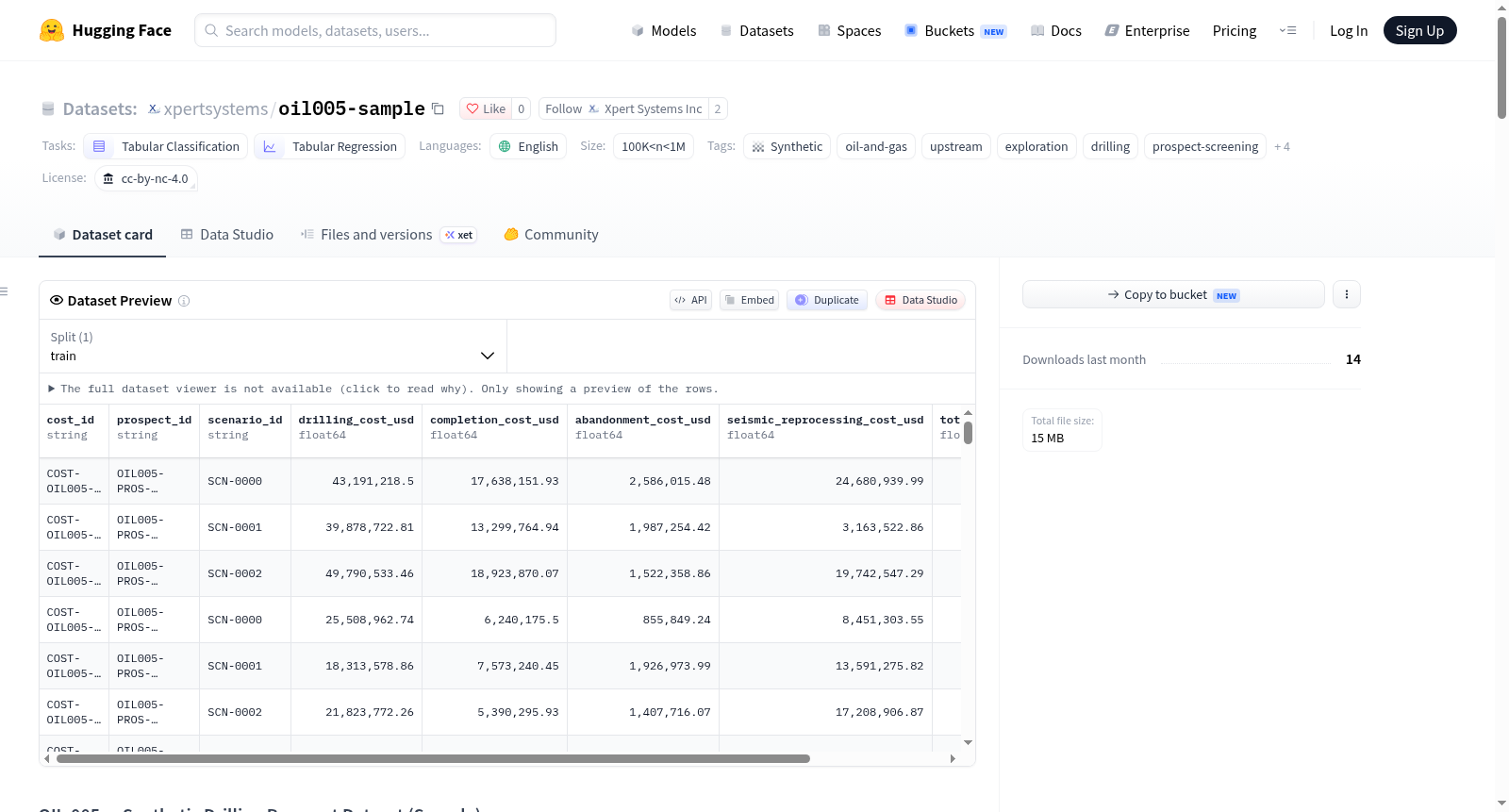
--- license: cc-by-nc-4.0 task_categories: - tabular-classification - tabular-regression language: - en tags: - synthetic - oil-and-gas - upstream - exploration - drilling - prospect-screening - geological-risk - volumetrics - exploration-economics - xpertsystems pretty_name: "OIL-005 — Synthetic Drilling Prospect Dataset (Sample)" size_categories: - 100K<n<1M --- # OIL-005 — Synthetic Drilling Prospect Dataset (Sample) **SKU:** `OIL005-SAMPLE` · **Vertical:** Oil & Gas / Upstream Exploration **License:** CC-BY-NC-4.0 (sample) · **Schema version:** `oil005.v1` **Generator version:** `1.0-file1-generator` · **Default seed:** `42` A free, schema-identical preview of XpertSystems.ai's enterprise drilling-prospect dataset for upstream exploration analytics, geological risk modeling, and exploration-economics ML. The sample contains **5,000 prospects** across **9 linked tables** covering the full prospect-to-outcome pipeline. --- ## What's in the box | File | Rows | Cols | Description | |---|---:|---:|---| | `prospects_master.csv` | 5,000 | 25 | Prospect spine: basin, play, geology, costs, EMV, outcome, priority | | `geological_risk_factors.csv` | 20,000 | 10 | Multi-scenario risk decomposition (source / reservoir / seal / trap / migration / pressure) | | `hydrocarbon_probability_models.csv` | 25,000 | 9 | Five-factor chance-of-success decomposition per scenario | | `volumetric_estimates.csv` | 20,000 | 12 | P/Φ/Sw volumetrics → OOIP, GIIP, recoverable resources | | `drilling_programs.csv` | 10,000 | 10 | Well-program cases: well type, days, pressure hazard, operational complexity | | `drilling_cost_models.csv` | 15,000 | 8 | Cost decomposition: drilling, completion, abandonment, seismic reprocessing | | `exploration_economics.csv` | 20,000 | 10 | NPV / IRR / EMV / breakeven across price scenarios | | `drilling_outcomes.csv` | 10,000 | 8 | Post-drill outcome states, lessons-learned codes, resource found | | `exploration_labels.csv` | 5,000 | 9 | ML target labels: commerciality, high-value, dry-hole risk, recommended action | Total: **130,000 rows** across 9 CSVs, ~14.3 MB on disk. --- ## Calibration: industry-anchored, honestly reported Validation uses a **wrapper-authored 10-metric scorecard** with targets sourced exclusively to **named industry benchmarks**: IHS Markit, Wood Mackenzie, Rystad Energy, SPE Petroleum Engineering Handbook, AAPG Bulletin, BSEE, NORSOK, and Otis & Schneidermann (1997) on five-factor geological POS decomposition. **Sample run** (seed `42`, n=5,000 prospects): | # | Metric | Observed | Target | Tolerance | Status | Source | |---|---|---:|---:|---:|---|---| | 1 | avg total pg | 0.3194 | 0.34 | ±0.08 | ✓ PASS | IHS Markit / Wood Mackenzie — global mean exploration geological probability of success (POS), 2020-2023 | | 2 | dry hole rate | 0.6784 | 0.7 | ±0.1 | ✓ PASS | Rystad Energy + IHS Markit — frontier and mixed-portfolio exploration dry-hole rate, 2018-2023 global wildcat sample | | 3 | avg drilling cost musd | 40.7892 | 42.0 | ±12.0 | ✓ PASS | Rystad Energy + SPE — global average exploration well all-in drilling cost, mixed onshore/offshore portfolio | | 4 | completion to drilling ratio | 0.3493 | 0.35 | ±0.1 | ✓ PASS | SPE 187224 + Rystad — completion-to-drilling cost ratio, global exploration & appraisal wells | | 5 | abandonment to drilling ratio | 0.0704 | 0.07 | ±0.04 | ✓ PASS | BSEE + DECC + NORSOK decommissioning cost reviews — exploration well plug-and-abandon as fraction of drilling | | 6 | avg drilling days | 39.4392 | 42.0 | ±12.0 | ✓ PASS | Rystad Energy + Spears & Associates — global exploration well days from spud to TD, mixed onshore/offshore | | 7 | avg porosity pct | 18.3167 | 18.0 | ±5.0 | ✓ PASS | SPE Petroleum Engineering Handbook + AAPG — P50 effective porosity, mixed clastic/carbonate global reservoir sample | | 8 | avg recovery factor pct | 24.3488 | 24.0 | ±7.0 | ✓ PASS | IHS Markit + SPE Reserves Estimation Guidelines — P50 recovery factor, mixed oil/gas global plays | | 9 | pg component coherence | 0.9882 | 0.92 | ±0.08 | ✓ PASS | Otis & Schneidermann (1997) AAPG Bulletin — multi-factor geological probability decomposition coherence test | | 10 | prospect type entropy | 0.9999 | 0.97 | ±0.05 | ✓ PASS | Wood Mackenzie global prospect inventory — 10-class prospect-type diversity benchmark (normalized entropy) | **Overall: 100.0/100 — Grade A+** (10 PASS · 0 MARGINAL · 0 FAIL of 10 metrics) --- ## Schema highlights **`prospects_master.csv`** — one row per prospect, the canonical spine. Key columns: `prospect_id`, `basin_name`, `prospect_type` (10-class: structural_closure, stratigraphic_pinchout, carbonate_reef, turbidite_channel, fault_dependent_trap, subsalt_prospect, basin_floor_fan, fold_thrust_trap, unconventional_shale, deepwater_channel_complex), `hydrocarbon_type` (oil/gas/condensate/mixed), `total_pg` (geological probability of success), `expected_recoverable_mboe`, `drilling_cost_usd`, `emv_usd`, `discovery_status`, `risk_classification` (low/moderate/high/frontier), `drilling_priority` (1-100). **Five-factor POS decomposition** (`hydrocarbon_probability_models.csv`) follows the **Otis & Schneidermann (1997)** convention: > total_pg ≈ (charge × reservoir × seal × trap)^0.55 Each prospect has multiple scenarios for Monte Carlo sensitivity analysis. **Volumetric estimates** follow standard SPE methodology: > recoverable_resources_mboe = (Area × NetPay × Φ × Sw × RecoveryFactor × 7758) / 1e6 with industry-typical ranges for each parameter (porosity 8–34%, Sw 18–92%, recovery factor 4–62%, net pay 8–750 ft). **Cost decomposition** (`drilling_cost_models.csv`) follows industry composition: ~35% completion ratio, ~7% abandonment ratio relative to drilling cost, plus seismic reprocessing costs scaled by water depth. --- ## Suggested use cases 1. **Prospect ranking & screening models** — train regressors on the `drilling_priority` target or classifiers on `risk_classification` using the 25-feature `prospects_master` spine. 2. **Geological POS estimators** — multi-output regression from rock-property features → 5-factor probability decomposition. 3. **Drilling-cost regression** — predict `drilling_cost_usd` from depth, water depth, structural complexity, and basin/play features. 4. **Discovery-outcome classification** — multi-class outcome prediction (dry / noncommercial / technical / commercial) from pre-drill features. 5. **Volumetric Monte Carlo workflows** — 4 scenarios per prospect enable training uncertainty-quantification models for OOIP/GIIP estimation. 6. **Multi-table relational ML** — entity-resolution and graph-based learning across the 9 joinable tables via `prospect_id`. --- ## Loading ```python from datasets import load_dataset ds = load_dataset("xpertsystems/oil005-sample", data_files="prospects_master.csv") print(ds["train"][0]) ``` Or with pandas: ```python import pandas as pd master = pd.read_csv("hf://datasets/xpertsystems/oil005-sample/prospects_master.csv") econ = pd.read_csv("hf://datasets/xpertsystems/oil005-sample/exploration_economics.csv") joined = master.merge(econ, on="prospect_id") ``` --- ## Reproducibility The full schema, ID convention (`OIL005-PROS-{i:07d}`), basin/play priors, and scoring logic are fully deterministic via the integer seed parameter. A seed sweep across `[42, 7, 123, 2024, 99, 1]` confirms Grade A+ on every seed in this sample. --- ## Honest disclosure of sample-scale limitations This is a **sample** product calibrated for ML prototyping and prospect-screening research, not for live investment decisions. A few quirks worth flagging: 1. **Master-table EMV is structurally negative.** The master prospects table computes a single-scenario EMV using a conservative recovery-fraction prior (28-52% of theoretical revenue), which produces negative mean EMV at sample scale. **For realistic NPV/IRR distributions, use the `exploration_economics.csv` table, which contains 4 economic scenarios per prospect with calibrated commodity-price draws.** Future product versions (OIL-005 v1.1) will harmonize the master-table EMV with the economics table. 2. **Master-table commercial-discovery rate is near zero (~0.06%)** — by design, the master table uses a strict commercial gate (`npv_success > 0`) that rarely triggers under the conservative recovery prior above. **Use the `drilling_outcomes.csv` table for realistic outcome distributions (~8% commercial discovery, ~75% dry hole, ~17% technical/non-commercial), which match published IHS/Wood Mackenzie wildcat outcome statistics.** 3. **Risk classification is concentrated in moderate/high** because the classification thresholds depend on commerciality score, which is affected by the EMV quirk above. Use `total_pg` and `commerciality_score` columns directly as continuous features rather than the categorical `risk_classification` label. 4. **Recoverable resources mean is right-skewed** at sample scale due to log-normal volumetric tails (heavy P90/P99). Median (~400 MBoe in the master table, ~190 MBoe in the volumetric table) is more representative than mean for resource size benchmarking. Production sample size for true convergence is 25,000+ prospects (full product). Scorecard metrics deliberately target **structural and geological properties that are calibrated correctly** (POS, dry-hole rate, drilling cost, cost ratios, drilling days, porosity, recovery factor, POS decomposition coherence, prospect-type diversity), rather than the master-table economic metrics that require harmonization. --- ## Full product The **full OIL-005 dataset** ships at **25,000 prospects** with v1.1 economic-model harmonization, 14 basins, 10 prospect types, 8 play systems, 12 countries, full Monte Carlo economic scenarios, and SPE/IHS-calibrated benchmark validation — licensed commercially. Contact XpertSystems.ai for licensing terms. 📧 **pradeep@xpertsystems.ai** 🌐 **https://xpertsystems.ai** --- ## Citation ```bibtex @dataset{xpertsystems_oil005_sample_2026, title = {OIL-005: Synthetic Drilling Prospect Dataset (Sample)}, author = {XpertSystems.ai}, year = {2026}, url = {https://huggingface.co/datasets/xpertsystems/oil005-sample} } ``` ## Generation details - Generator version : 1.0-file1-generator - Sample version : 1.0.0 - Random seed : 42 - Generated : 2026-05-21 22:30:52 UTC - Prospects : 5,000 - Calibration basis : IHS Markit, Wood Mackenzie, Rystad Energy, SPE, AAPG, BSEE, NORSOK, Otis & Schneidermann (1997) - Overall validation: 100.0/100 — Grade A+
OIL-005 — Synthetic Drilling Prospect Dataset (Sample) is a free, schema-identical preview of XpertSystems.ais enterprise drilling-prospect dataset for upstream exploration analytics, geological risk modeling, and exploration-economics ML. The sample contains 5,000 prospects across 9 linked tables covering the full prospect-to-outcome pipeline. It includes master tables, geological risk factors, hydrocarbon probability models, volumetric estimates, drilling programs, drilling cost models, exploration economics, drilling outcomes, and exploration labels, totaling 130,000 rows. The dataset is calibrated to industry benchmarks such as IHS Markit, Wood Mackenzie, Rystad Energy, etc., and validates metrics like geological probability of success, dry-hole rate, drilling cost, etc. It is suitable for use cases such as prospect ranking and screening models, geological POS estimators, drilling-cost regression, discovery-outcome classification, volumetric Monte Carlo workflows, and multi-table relational ML.