pixcell
收藏资源简介:
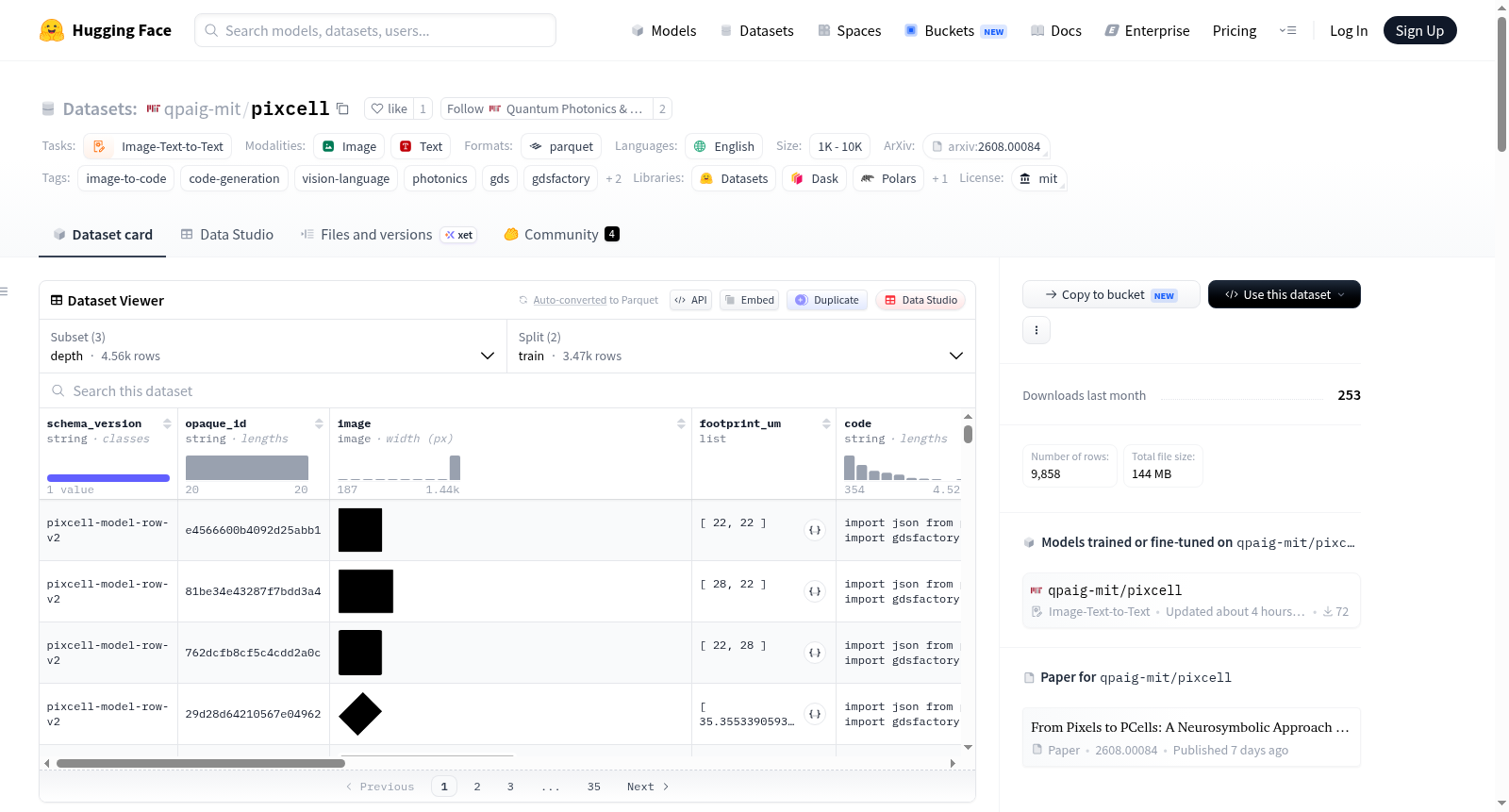
PixCell 数据集是一个经过验证的图像到代码课程数据集,旨在将光子几何重建为仅使用原始 GDSFactory Python 程序。数据集包含高可见度的组件图像、物理足迹和经过审计的程序代码。它由三个配置组成:`depth`(默认配置,包含 4560 个样本,用于监督训练和参数恢复)、`core`(包含 738 个样本,是一个紧凑的 L0 到 L4 课程,包含 547 个锚点和 191 个支持行)和 `references`(包含 4560 个样本,提供目标栅格、校准、谱系和验证器元数据)。`core` 是 `depth/train` 的精确子集,`references` 与 `depth` 共享相同的训练/验证分割,并通过 `opaque_id` 连接。每个样本的字段包括:模型观察字段(`image`、`footprint_um`)、监督目标字段(`code`)、采样和课程字段(`level`、`curriculum_order`、`representation_id`、`leakage_group_id`、`variation_role`、`realization_slot`、`is_core`)以及评估器参考字段(与 `references` 中的匹配行)。数据集不存储每行的提示,训练代码将图像和足迹与所选编程合同结合。采样字段用于组织批次,仅当训练管道明确包含时才可见。图像保留拓扑和轴内比例,足迹提供物理宽度和高度。`references` 配置提供几何评估器使用的规范物理长宽比栅格和校准,不应放入模型提示中。数据集的训练集包含 3468 个样本(来自 738 个核心行,加上 546 个表示的五个额外设置),验证集包含 1092 个样本(每个扩展表示的两个保留设置)。课程分为五个级别:L0(原始目录、构造函数模式、方向和缩放)、L1(放置、变换、对齐、连接、重复和路由)、L2(关系装配、链、分支、数组和径向库)、L3(多区域结构、重复介质、缺陷和循环组织)、L4(耦合器、MMI、干涉仪、谐振器、交叉、光栅、腔体和转换器)。所有发布的样本都经过确定性编译和执行、原始策略检查、结构检查、校准几何比较、足迹一致性和工件哈希的验证。数据集针对单层光子布局的几何重建,光学性能和代工厂鉴定由下游设备评估处理。版本 2.0.0 是破坏性模式发布,使 `depth` 成为默认配置,移除了重复的行指令,并将目标栅格和校准移入 `references`。
The PixCell dataset is a validated image-to-code curriculum dataset designed to reconstruct photonic geometries using only raw GDSFactory Python programs. The dataset contains high-visibility component images, physical footprints, and audited program code. It consists of three configurations: `depth` (default configuration, 4560 samples for supervised training and parameter recovery), `core` (738 samples, a compact L0 to L4 curriculum with 547 anchors and 191 support rows), and `references` (4560 samples providing target grids, calibrations, lineages, and validator metadata). `core` is an exact subset of `depth/train`, and `references` shares the same train/validation split with `depth`, connected via `opaque_id`. Each sample includes fields: model observation fields (`image`, `footprint_um`), supervised target field (`code`), sampling and curriculum fields (`level`, `curriculum_order`, `representation_id`, `leakage_group_id`, `variation_role`, `realization_slot`, `is_core`), and evaluator reference fields (matching rows in `references`). The dataset does not store prompts per row; training code combines images and footprints with a selected programming contract. Sampling fields are used for batch organization and are visible only when explicitly included in the training pipeline. Images preserve topology and in-axis scaling, while footprints provide physical width and height. The `references` configuration provides canonical physical aspect ratio grids and calibrations used by the geometry evaluator, which should not be placed in model prompts. The datasets training set contains 3468 samples (from 738 core rows plus five additional settings per 546 representations), and the validation set contains 1092 samples (two held-out settings per extended representation). The curriculum is divided into five levels: L0 (primitive catalog, constructor patterns, orientation, and scaling), L1 (placement, transformation, alignment, connection, repetition, and routing), L2 (relational assembly, chains, branches, arrays, and radial libraries), L3 (multi-region structures, repeating media, defects, and cyclic organizations), L4 (couplers, MMIs, interferometers, resonators, crossovers, gratings, cavities, and converters). All published samples have been validated through deterministic compilation and execution, primitive policy checks, structural checks, calibration geometry comparisons, footprint consistency, and artifact hashing. The dataset targets geometric reconstruction of single-layer photonic layouts; optical performance and foundry qualification are handled by downstream device evaluation. Version 2.0.0 is a breaking release that makes `depth` the default configuration, removes duplicate row directives, and moves target grids and calibrations into `references`.
PixCell 数据集详情
数据集概述
PixCell 是一个经过验证的图像到代码(image-to-code)课程数据集,用于将光子学几何结构重建为仅使用图元的 GDSFactory Python 程序。数据集的每一行包含一个高可见度的组件图像、其物理尺寸(footprint)以及经过审计的程序代码。
- 许可证:MIT
- 语言:英文
- 任务类别:图像-文本到文本(image-text-to-text)
- 大小规模:1K < 样本数 < 10K
- 标签:图像到代码、代码生成、视觉-语言、光子学、GDS、GDSFactory、合成数据、课程学习
数据集配置
| 配置名称 | 样本数 | 用途 |
|---|---|---|
depth |
4,560(训练集 3,468,验证集 1,092) | 默认语料,用于监督训练和参数恢复 |
core |
738 | 紧凑的 L0 至 L4 课程,包含 547 个锚点和 191 个支撑行 |
references |
4,560(训练集 3,468,验证集 1,092) | 目标栅格、校准、谱系和验证器元数据 |
core 是 depth/train 的精确子集。references 与 depth 采用相同的训练/验证划分,并通过 opaque_id 进行关联。
训练契约
| 角色 | 字段 |
|---|---|
| 模型观测 | image、footprint_um |
| 监督目标 | code |
| 采样与课程 | level、curriculum_order、representation_id、leakage_group_id、variation_role、realization_slot、is_core |
| 评估参考 | references 中匹配的行 |
- 数据集不存储逐行提示词,训练代码需结合图像和物理尺寸与所选编程契约。
references配置提供几何评估器使用的标准物理纵横比栅格和校准数据,不应放入模型提示词中。opaque_id是从 v1 源 ID 派生的稳定连接键,非匿名化机制。
数据划分设计
| 划分 | 构建方式 | 样本数 |
|---|---|---|
train |
738 个核心行加上 546 个表示的五个附加设置 | 3,468 |
validation |
每个扩展表示的两个预留设置 | 1,092 |
验证用于衡量已知表示内的参数恢复能力,每个表示均出现在训练集中。
课程结构
| 级别 | 样本数 | 表示数 | 内容 |
|---|---|---|---|
| L0 | 177 | 93 | 图元目录、构造函数模式、方向和缩放 |
| L1 | 215 | 127 | 放置、变换、对齐、连接、重复和布线 |
| L2 | 118 | 99 | 关系装配、链、分支、阵列和径向组 |
| L3 | 120 | 120 | 多区域结构、重复介质、缺陷和循环组织 |
| L4 | 108 | 108 | 耦合器、MMI、干涉仪、谐振器、交叉、光栅、腔和转换器 |
验证机制
已发布的行通过以下验证:
- 确定性编译和执行
- 仅图元源代码策略
- 结构检查
- 校准几何比较
- 物理尺寸一致性
- 工件哈希
数据集目标为单层光子学布局的几何重建,光学性能和代工厂认证由下游器件评估处理。
发布清单将每个分片绑定到冻结的源摘要:
core e1c509dca337ce485efcb2b35101a052e06b12331b63a2f21a36c93b3682ea89 depth 676c49134d4d044c7d84426cf8eeecf09302e74ca4aa548956f14b7631a4d80b
源、发布工具和训练配方可在 PixCell v2.0.0 源发布 获取。
版本说明
- 使用配置
depth并指定修订版本v2.0.0来固定此版本。 - 原始
core-v1和depth-v1版本仍可在对应的 Hugging Face 修订版本中获取。 - 版本 2.0.0 为破坏性架构更新:将
depth设为默认配置,移除重复的逐行指令,并将目标栅格和校准移入references。
引用信息
方法引用:
bibtex @misc{agarwal2026pixcell, title = {From Pixels to {PCells}: A Neurosymbolic Approach to Photonic Component Creation}, author = {Aadarsh Agarwal and Kenaish Al Qubaisi and Dirk Englund}, year = {2026}, eprint = {2608.00084}, archivePrefix = {arXiv}, primaryClass = {cs.CV}, doi = {10.48550/arXiv.2608.00084}, url = {https://arxiv.org/abs/2608.00084} }
数据集版本引用:
bibtex @dataset{agarwal2026pixcell_dataset, title = {PixCell Dataset: Representation-First Image-to-Code Curriculum}, author = {Aadarsh Agarwal and Kenaish Al Qubaisi and Dirk Englund}, year = {2026}, version = {2.0.0}, url = {https://huggingface.co/datasets/qpaig-mit/pixcell} }