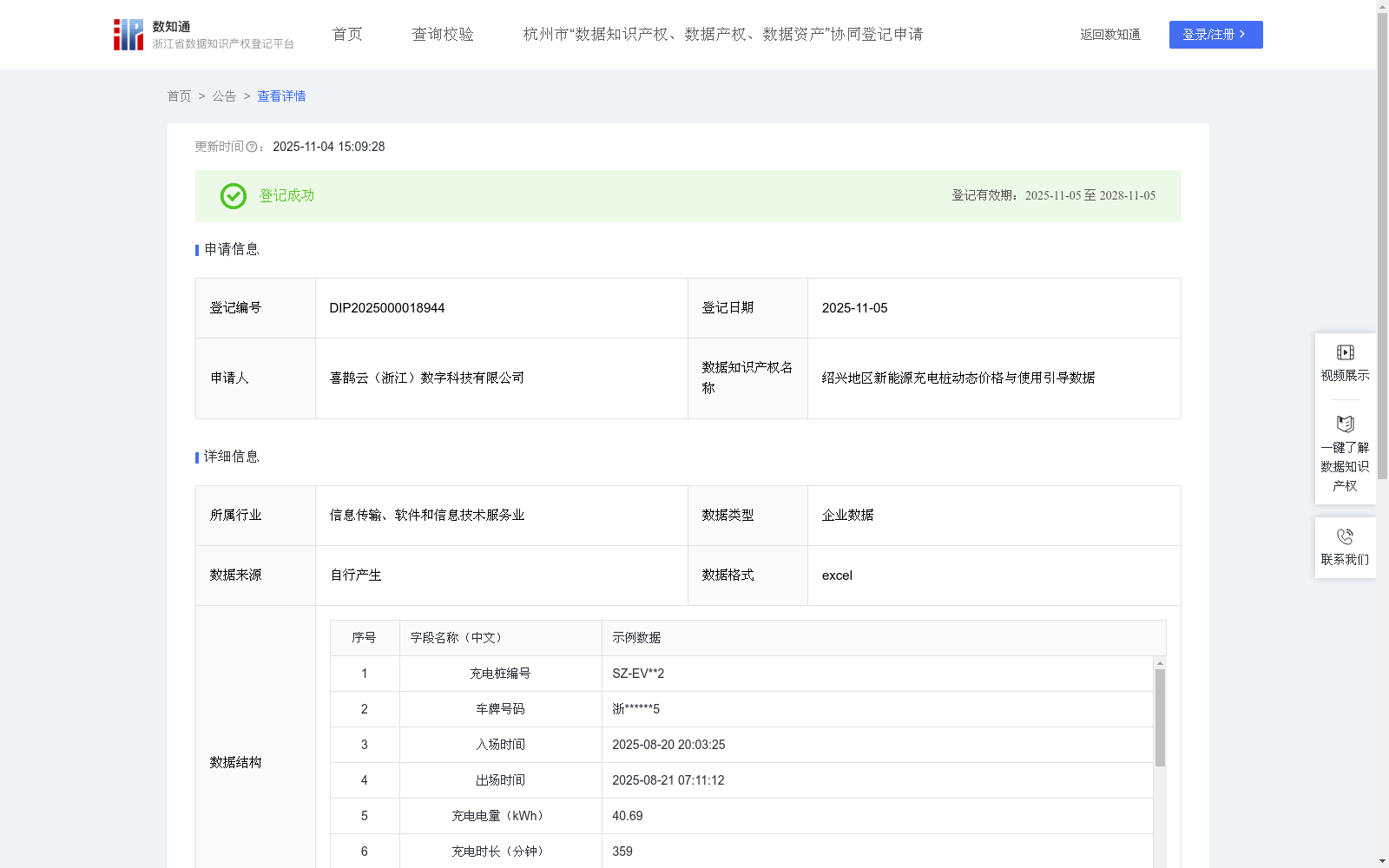
绍兴地区新能源充电桩动态价格与使用引导数据
收藏资源简介:
该数据用于分析绍兴地区新能源充电桩的夜间充电行为及动态价格响应,重点关注夜间高峰充电模式、充电时长和空闲时段的使用情况。运营方可以基于这些数据优化充电价格策略,提升非高峰期利用率,同时通过系统推荐向用户推送空闲车位和充电桩。第三方充电APP或导航系统可利用该数据向用户提供充电引导,减少排队等待,提高用户体验。政府部门可参考该数据分析夜间新能源车辆对城市电网负荷的影响,并制定智慧城市电力管理方案及新能源设施布局策略,为电网调度和公共服务提供决策依据。1.数据采集:收集新能源充电桩入场出场时间、充电电量、充电时长、用户类型及历史使用次数等数据; 2.数据处理:计算充电时长T(出场时间减入场时间)、充电电量E,并标记夜间高峰n和空闲时段f。 3.算法加工:优先级指数P计算公式如下: P = (0.30 × T(充电时长) + 0.25 × n(夜间高峰标记) + 0.15 × f(空闲标记) + 0.20 × r(历史使用次数) + 0.10 × p(动态价格系数)) × s(系统推荐系数) T(充电时长)越长,表示用户夜间充电需求较大,P值增加。 n=1表示夜间高峰,增加指数权重,引导系统重点关注。 f=1表示空闲时段,降低指数以提示利用率不高。 r(历史使用次数)越高,说明用户使用习惯稳定,提高推荐优先级。 p(动态价格系数)根据实时电网负荷和运营策略调整价格权重。 s(系统推荐系数)用于综合调整推荐指数,确保动态调度合理性。 4.数据分类分级: 根据P值将充电推荐优先级划分为高、中、低三类: P ≥ 60 高优先级,系统主动推荐该充电桩给用户; 40 ≤ P < 60 中优先级,部分推荐或提示优惠信息; P < 40 低优先级,仅用于内部运营分析。
This dataset is designed to analyze nighttime charging behavior and dynamic price response of new energy vehicle (NEV) charging piles in Shaoxing Area, with a focus on nighttime peak charging patterns, charging duration, and utilization of idle time periods. Charging pile operators can leverage this data to optimize pricing strategies, improve utilization during non-peak hours, and push notifications of idle parking spots and charging piles to users via system recommendations. Third-party charging applications or navigation systems can utilize this dataset to provide charging guidance for users, reducing queuing wait times and enhancing user experience. Government departments can refer to this data analysis to evaluate the impact of nighttime NEVs on urban power grid load, formulate smart city power management plans and new energy facility layout strategies, providing decision-making support for grid dispatching and public services. 1. Data Collection: Collect data including the entry and exit timestamps of vehicles at charging piles, charged energy, charging duration, user type, and historical usage counts. 2. Data Processing: Calculate the charging duration T (exit timestamp minus entry timestamp) and charged energy E, and mark nighttime peak periods with n and idle periods with f. 3. Algorithm Processing: The priority index P is formulated as follows: P = (0.30 × T (charging duration) + 0.25 × n (nighttime peak flag) + 0.15 × f (idle period flag) + 0.20 × r (historical usage count) + 0.10 × p (dynamic price coefficient)) × s (system recommendation coefficient) A longer charging duration T indicates a stronger user nighttime charging demand, which increases the P value. When n=1, it denotes a nighttime peak period, adding weight to the index to guide the system to focus on such scenarios. When f=1, it denotes an idle period, reducing the index to signal low utilization. A higher historical usage count r reflects a more stable user usage habit, which elevates the recommendation priority. The dynamic price coefficient p adjusts the price weight based on real-time grid load and operational strategies. The system recommendation coefficient s is used to comprehensively adjust the recommendation index to ensure the rationality of dynamic dispatching. 4. Data Classification and Grading: The charging recommendation priority is divided into three categories based on the P value: - High priority: P ≥ 60, the system will actively recommend the charging pile to users; - Medium priority: 40 ≤ P < 60, provide partial recommendation or prompt preferential information; - Low priority: P < 40, only used for internal operation analysis.