
BCIT Traffic Complexity
收藏OpenNeuro2022-05-03 更新2026-03-14 收录
下载链接:
https://openneuro.org/datasets/ds004123
下载链接
链接失效反馈官方服务:
资源简介:
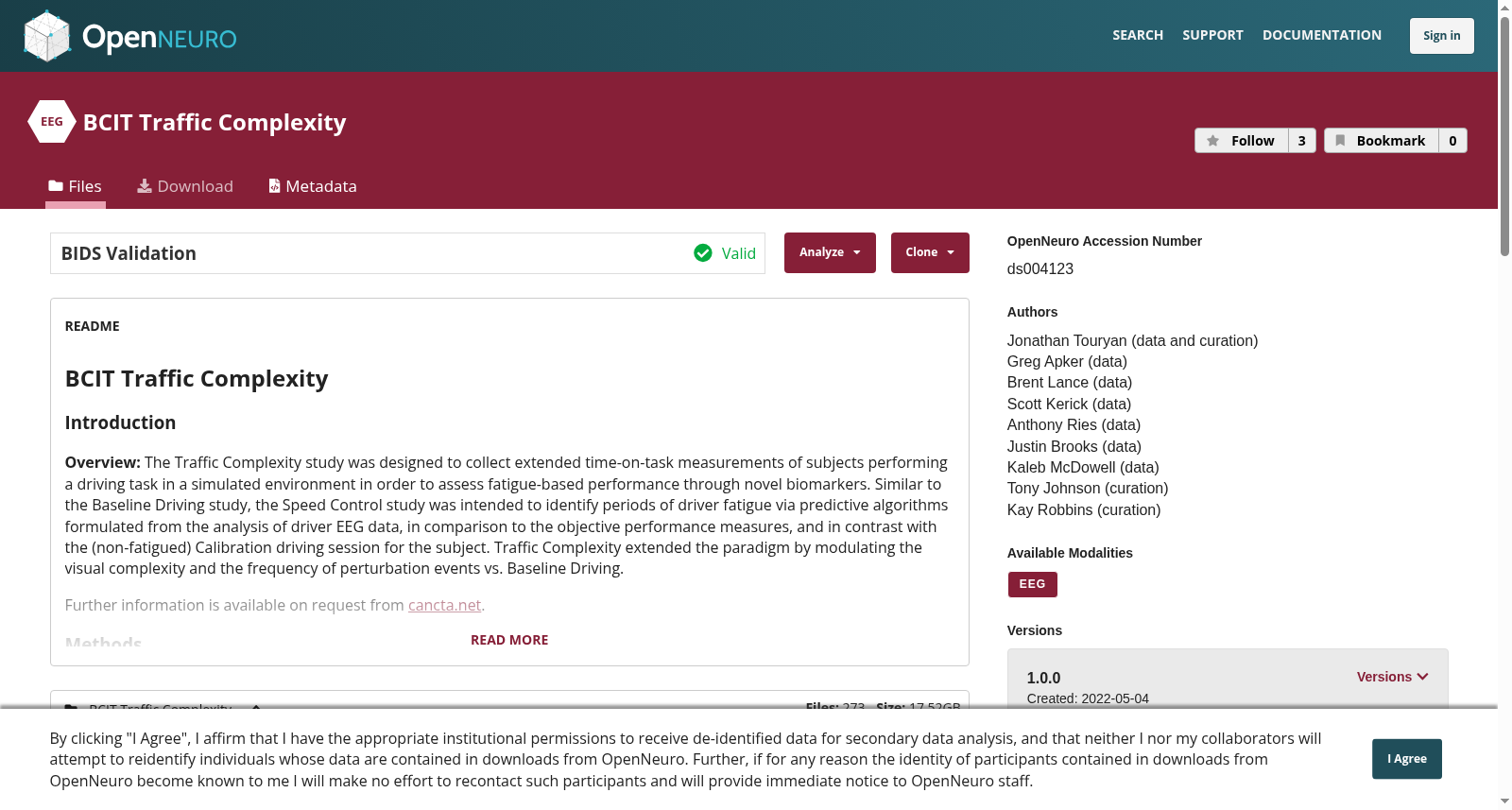
## BCIT Traffic Complexity
### Introduction
**Overview:** The Traffic Complexity study was designed to collect extended time-on-task measurements of
subjects performing a driving task in a simulated environment in order to assess fatigue-based performance
through novel biomarkers. Similar to the Baseline Driving study, the Speed Control study was intended to
identify periods of driver fatigue via predictive algorithms formulated from the analysis of driver EEG data,
in comparison to the objective performance measures, and in contrast with the (non-fatigued)
Calibration driving session for the subject. Traffic Complexity extended the paradigm by modulating
the visual complexity and the frequency of perturbation events vs. Baseline Driving.
Further information is available on request from [cancta.net](https://cancta.net).
### Methods
**Subjects:** Volunteers from the local community recruited through advertisements.
**Apparatus:** Driving simulator with steering wheel and brake / foot pedals (Real Time Technologies; Dearborn, MI);
Video Refresh Rate (VRR) = 900 Hz; Vehicle data log file Sampling Rate (SR) = 100 Hz);
EEG (BioSemi 64 (+8) channel systems with 4 eye and 2 mastoid channels recorded; SR=2048 Hz);
Eye Tracking (Sensomotoric Instruments (SMI); REDEYE250).
**Initial setup:** Upon arrival to the lab, subjects were given an introduction to the primary study
for which they were recruited and provided informed consent and provided demographics information.
This was followed by a practice session, to acclimate the subject to the driving simulator.
The driving practice task lasted 10-15 min, until asymptotic performance in steering and speed control
was demonstrated and lack of motion sickness was reported.
Subjects were then outfitted and prepped for eye tracking and EEG acquisition.
**Task organization:** Subjects would perform the Baseline Driving task and the Traffic Complexity task,
with counter-balancing used across subjects as to which of them came first.
The Baseline Driving run was 45 minutes of continuous driving, with subjects responsible
for speed and steering control. Both driving tasks were conducted on the same simulated long,
straight road. The Baseline run was done in a visually sparse environment, and the Traffic Complexity
runs included pedestrians and other traffic. In each case, the subject was instructed to stay
within the boundaries of the right-most lane, and to drive at the posted speed limits.
The vehicle was periodically subject to lateral perturbing forces, which could be applied to either
side of the vehicle, pushing the vehicle out of the center of the lane; and the subject was instructed
to execute corrective steering actions to return the vehicle to the center of the lane.
**Independent variables:** Visual Complexity (high vs. low), Perturbation Frequency (high vs. low).
**Dependent variables:** Reaction times to perturbations, continuous performance based on vehicle
log (steering wheel angle, lane position, heading error, etc.), Task-Induced Fatigue Scale (TIFS),
Karolinska Sleepiness Scale (KSS), Visual Analog Scale of Fatigue (VAS-F).
**Note:** Questionnaire data is available upon request from [cancta.net](https://cancta.net).
**Additional data acquired:** Participant Enrollment Questionnaire, Subject Questionnaire for Current Session,
Simulator Sickness Questionnaire.
**Experimental Locations:** Teledyne Corporation, Durham, NC.
**Note 1:** This dataset has a corresponding dataset in the BCIT Calibration Driving ds004118 which has the
15 minute driving task performed prior to this one.
**Note 2:** This dataset has a corresponding dataset in the BCIT Baseline Driving ds004120 which was a
longer driving task in a sparse environment.
## BCIT交通复杂度数据集
### 简介
**研究概况:** 本交通复杂度研究旨在收集受试者在模拟环境中完成驾驶任务的延长任务执行时长测量数据,以通过新型生物标志物评估疲劳相关的绩效变化。与基准驾驶(Baseline Driving)研究类似,速度控制(Speed Control)研究旨在通过分析驾驶员脑电(Electroencephalogram, EEG)数据构建预测算法,识别驾驶员疲劳时段,并与客观绩效指标进行对比,同时区别于受试者的非疲劳状态校准驾驶(Calibration driving)环节。交通复杂度(Traffic Complexity)研究则通过相较于基准驾驶任务调整视觉复杂度与扰动事件的频率,拓展了该研究范式。
如需获取更多信息,可联系cancta.net(https://cancta.net)。
### 实验方法
**受试者:** 通过广告招募的本地社区志愿者。
**实验设备:** 搭载方向盘与制动/脚踏踏板的驾驶模拟器(Real Time Technologies;密歇根州迪尔伯恩市);视频刷新率(Video Refresh Rate, VRR)=900Hz;车辆数据日志采样率(Sampling Rate, SR)=100Hz;脑电采用BioSemi 64(+8)通道系统,同步记录4个眼电通道与2个乳突通道,采样率=2048Hz;眼动追踪设备采用Sensomotoric Instruments(SMI)REDEYE250。
**初始准备流程:** 受试者抵达实验室后,首先接受本次研究的说明,签署知情同意书并填写人口统计学信息。随后进行驾驶练习环节,以使受试者适应驾驶模拟器。驾驶练习时长为10至15分钟,直至受试者在转向与速度控制方面达到渐近操作水平,且报告无运动不适。之后为受试者佩戴设备,准备眼动追踪与脑电数据采集。
**任务组织:** 受试者需完成基准驾驶任务与交通复杂度任务,任务顺序采用被试间平衡设计。基准驾驶任务为连续45分钟的驾驶,受试者需负责速度控制与转向操作。两项驾驶任务均在同一条模拟长直道路上进行。基准驾驶环节的视觉环境较为简洁,而交通复杂度任务环节则包含行人与其他交通参与者。所有环节中,受试者均被要求保持在最右侧车道内行驶,并遵守道路限速规定。
车辆会周期性受到侧向扰动作用力,可施加于车辆任意一侧,将车辆推离车道中心;受试者需执行修正转向操作,将车辆驶回车道中心。
**自变量:** 视觉复杂度(高vs.低)、扰动频率(高vs.低)。
**因变量:** 对扰动的反应时、基于车辆日志的连续绩效指标(方向盘角度、车道位置、航向误差等)、任务诱导疲劳量表(Task-Induced Fatigue Scale, TIFS)、卡罗林斯卡嗜睡量表(Karolinska Sleepiness Scale, KSS)、疲劳视觉模拟量表(Visual Analog Scale of Fatigue, VAS-F)。
**注:** 问卷数据可通过cancta.net(https://cancta.net)申请获取。
**额外采集数据:** 受试者入组问卷、当次实验受试者问卷、模拟器不适问卷(Simulator Sickness Questionnaire)。
**实验地点:** 北卡罗来纳州达勒姆市Teledyne公司。
**注1:** 本数据集对应BCIT校准驾驶数据集(ds004118),该数据集包含本实验前开展的15分钟驾驶任务。
**注2:** 本数据集对应BCIT基准驾驶数据集(ds004120),该数据集为在简洁视觉环境中开展的更长时长的驾驶任务。
创建时间:
2022-05-03
搜集汇总
数据集介绍
背景与挑战
背景概述
BCIT Traffic Complexity是一个EEG数据集,专注于模拟驾驶任务中疲劳性能的评估,通过调节视觉复杂性和扰动频率来扩展基线研究。数据集包含29名参与者的高分辨率脑电图数据(64通道,2048 Hz采样率),并整合了驾驶模拟器日志和眼动追踪信息,用于分析反应时间、车辆控制性能及疲劳量表等因变量。
以上内容由遇见数据集搜集并总结生成


