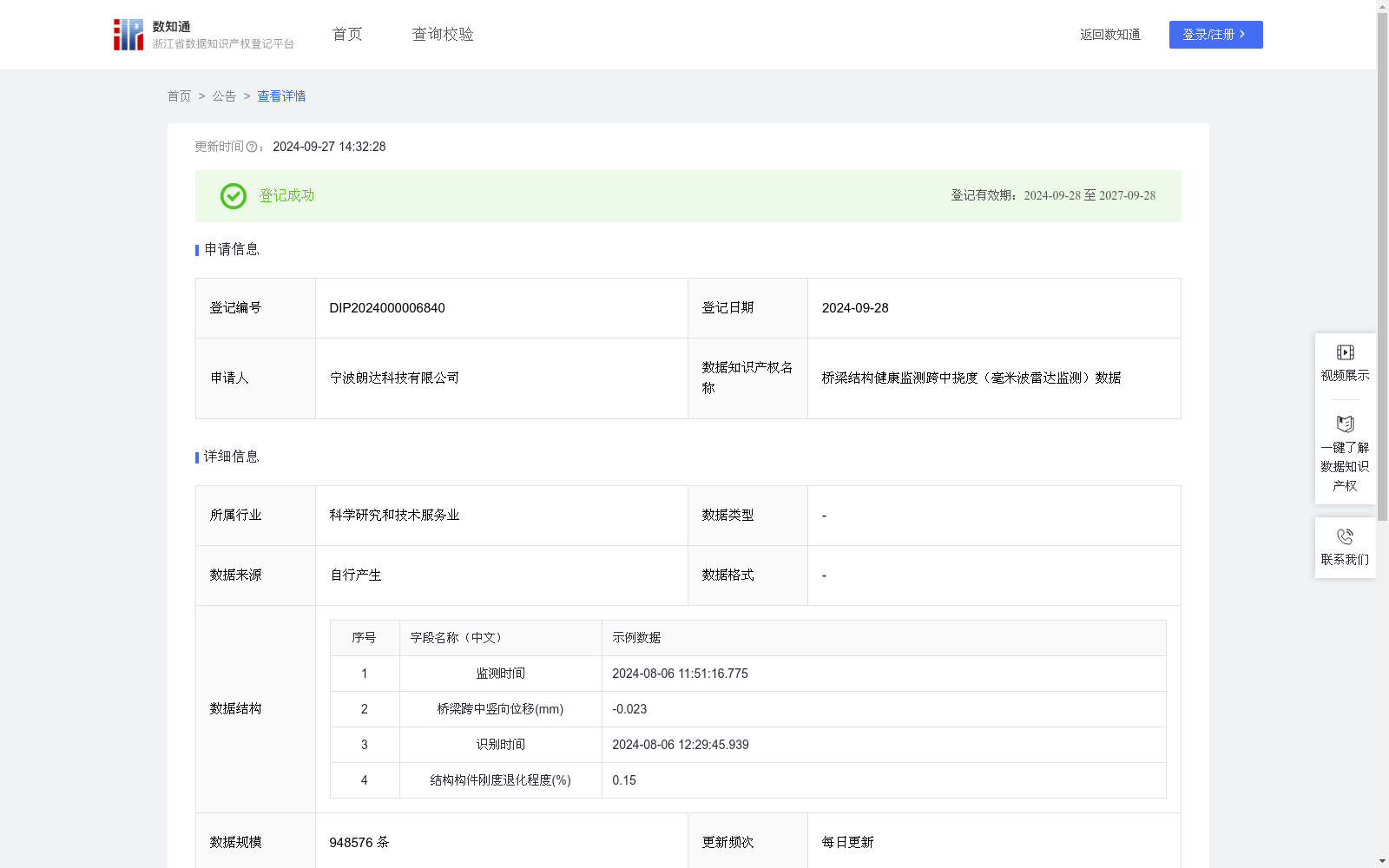
桥梁结构健康监测跨中挠度(毫米波雷达监测)数据
收藏资源简介:
桥梁结构健康监测在桥梁安全运行过程中扮演着重要角色,尤其是在监测桥梁跨中挠度方面。通过连续监测获取到如“监测时间,桥梁跨中竖向位移,识别时间,结构构件刚度退化程度等的数据。这些数据对于评估桥梁的结构安全性和稳定性至关重要。一旦发现挠度异常或刚度退化程度加剧,系统会立即通知养护单位进行复核检测,以确保桥梁的安全运行,及时预防潜在的风险。1、数据采集:桥梁跨中竖向位移计算:通过毫米波雷达发送与接收电磁波信号,根据电磁波的相位变化计算目标点位的瞬态位移,得到桥梁跨中竖向位移。2、首先通过实测竖向位移对桥梁有限元数值模型进行修正,使有限元模型的物理特性与实际结构相似,再利用车桥耦合数值仿真计算桥梁各构件刚度退化的不同工况,如退化构件位置、程度等变量,形成数值域的刚度退化识别模型的训练数据集,最后搭建刚度退化识别模型架构进行模型训练,应用到实际结构的刚度退化识别。结构构件刚度由结构力学定义为,即材料弹性模量与构件截面惯性矩的乘积,退化程度为的损失率,如退化程度为5%,剩余构件刚度为。结构构件刚度退化程度划分为三级,轻微损伤的退化程度为5%以内,中等损伤5%~15%,严重损伤为15%~30%。然后输入桥梁跨中竖向位移到模型中计算桥梁各构件刚度退化情况,如若某构件刚度退化情况较为严重,通知养护单位进行复核检测(无人机检测)。
Bridge structural health monitoring plays a crucial role in the safe operation of bridges, particularly in monitoring mid-span deflection. Continuous monitoring yields datasets including monitoring time, vertical mid-span displacement of the bridge, identification time, and structural member stiffness degradation degree, among others. These datasets are critical for evaluating the structural safety and stability of bridges. Once abnormal deflection or aggravated stiffness degradation is detected, the system will immediately notify the maintenance unit for rechecking and testing, so as to ensure the safe operation of the bridge and timely prevent potential risks. 1. Data Collection: Calculation of vertical mid-span displacement of the bridge: The millimeter-wave radar transmits and receives electromagnetic wave signals, and calculates the transient displacement of the target point based on the phase change of the electromagnetic waves, thereby obtaining the vertical mid-span displacement of the bridge. 2. First, the bridge finite element numerical model is corrected using the measured vertical displacement, so that the physical characteristics of the finite element model match those of the actual structure. Then, the vehicle-bridge coupling numerical simulation is used to calculate different working conditions of stiffness degradation for each bridge component, including variables such as the position and degree of degraded components, to form the training dataset for the stiffness degradation identification model in the numerical domain. Finally, the architecture of the stiffness degradation identification model is constructed for model training, which is then applied to the stiffness degradation identification of actual structures. Structural member stiffness is defined in structural mechanics as the product of the material's elastic modulus and the cross-sectional moment of inertia of the member. The degradation degree refers to the stiffness loss rate. For example, a degradation degree of 5% means the remaining stiffness of the member is 95% of the initial value. The stiffness degradation degree of structural members is divided into three levels: minor damage with a degradation degree within 5%, moderate damage with a degradation degree ranging from 5% to 15%, and severe damage with a degradation degree ranging from 15% to 30%. Then, the vertical mid-span displacement of the bridge is input into the model to calculate the stiffness degradation status of each bridge component. If the stiffness degradation of a certain component is severe, the maintenance unit will be notified for rechecking and testing (unmanned aerial vehicle detection).