SVGenius
收藏资源简介:
SVGenius是一个全面评估大型语言模型(LLMs)在SVG理解、编辑和生成方面的能力的基准数据集。该数据集由来自24个应用领域的真实世界数据构建,包含2,377个查询,涵盖8个任务类别和18个评估指标。SVGenius旨在解决现有SVG处理基准的局限性,如覆盖范围有限、缺乏复杂性分层和评估范式碎片化等问题。通过系统性复杂性分层和全面评估,SVGenius为开发更强大的矢量图形模型和推动自动化图形设计应用提供了关键见解。
SVGenius is a benchmark dataset that comprehensively evaluates the capabilities of large language models (LLMs) in SVG understanding, editing, and generation. This dataset is constructed from real-world data across 24 application domains, containing 2,377 queries, covering 8 task categories and 18 evaluation metrics. SVGenius aims to address the limitations of existing SVG processing benchmarks, such as limited coverage, lack of complexity stratification, and fragmented evaluation paradigms. Through systematic complexity stratification and comprehensive evaluation, SVGenius provides critical insights for developing more powerful vector graphics models and advancing automated graphic design applications.
SVGenius: Benchmarking LLMs in SVG Understanding, Editing and Generation
基本信息
- 作者: Siqi Chen, Xinyu Dong, Haolei Xu, Xingyu Wu, Fei Tang, Hang Zhang, Yuchen Yan, Linjuan Wu, Wenqi Zhang, Guiyang Hou, Yongliang Shen, Weiming Lu, Yueting Zhuang
- 机构: 浙江大学
- 状态: 预印本,正在审核中
- 对应作者: Yongliang Shen
- 资源链接:
- HuggingFace
- arXiv
- GitHub (即将更新)
概述
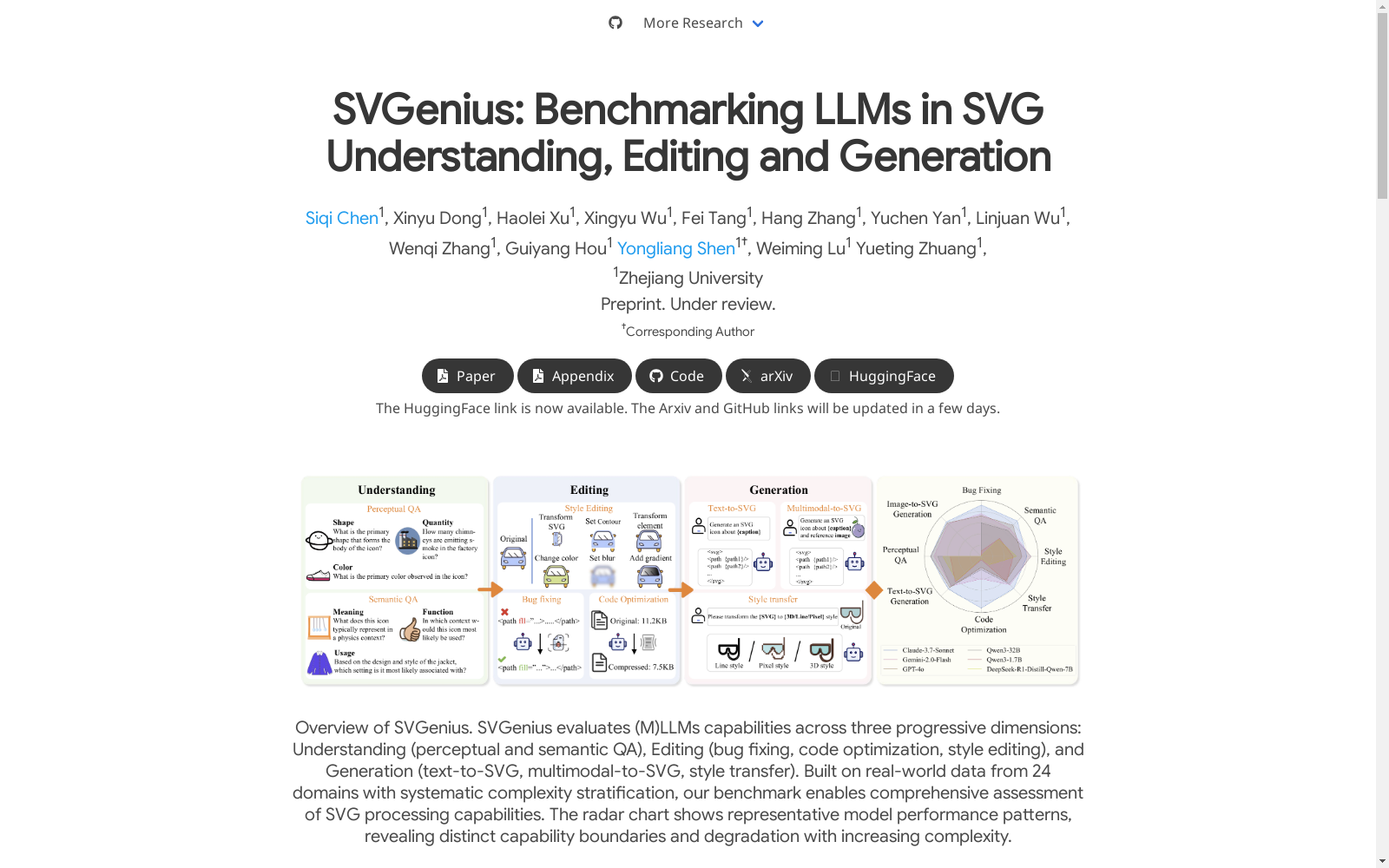
SVGenius评估(M)LLMs在三个渐进维度上的能力:
- 理解(感知和语义问答)
- 编辑(错误修复、代码优化、样式编辑)
- 生成(文本到SVG、多模态到SVG、样式转移)
数据集基于24个领域的真实数据,具有系统的复杂性分层,能够全面评估SVG处理能力。
摘要
- 数据集规模: 2,377个查询
- 评估维度: 理解、编辑、生成
- 任务类别: 8个
- 评估指标: 18个
- 评估模型: 24个主流模型,涵盖不同规模、架构、训练范式和可访问性级别
数据集构建与验证
- 数据来源: 超过100K真实世界SVG,涵盖24个领域
- 预处理: 经过严格的预处理和人工语义验证
- 最终样本: 927个结构和语义良好的样本
- 复杂性分层:
- 使用路径计数、控制点和命令多样性等标准化指标
- 分为简单、中等和复杂三个层级
- 最终选取300个代表性SVG进行平衡评估
结果
- 评估模型: 22个多样化的(M)LLM
- 主要发现:
- 专有模型整体领先,但随着复杂性增加性能显著下降
- 推理增强训练在复杂理解和生成任务中表现优于纯缩放
- 开源模型具有可扩展性优势,但受限于架构和训练约束
- 所有模型都表现出系统性性能下降模式
引用
bibtex @misc{chen2025svgeniusbenchmarkingllmssvg, title={SVGenius: Benchmarking LLMs in SVG Understanding, Editing and Generation}, author={Siqi Chen and Xinyu Dong and Haolei Xu and Xingyu Wu and Fei Tang and Hang Zhang and Yuchen Yan and Linjuan Wu and Wenqi Zhang and Guiyang Hou and Yongliang Shen and Weiming Lu and Yueting Zhuang}, year={2025}, eprint={2506.03139}, archivePrefix={arXiv}, primaryClass={cs.CV}, url={https://arxiv.org/abs/2506.03139}, }