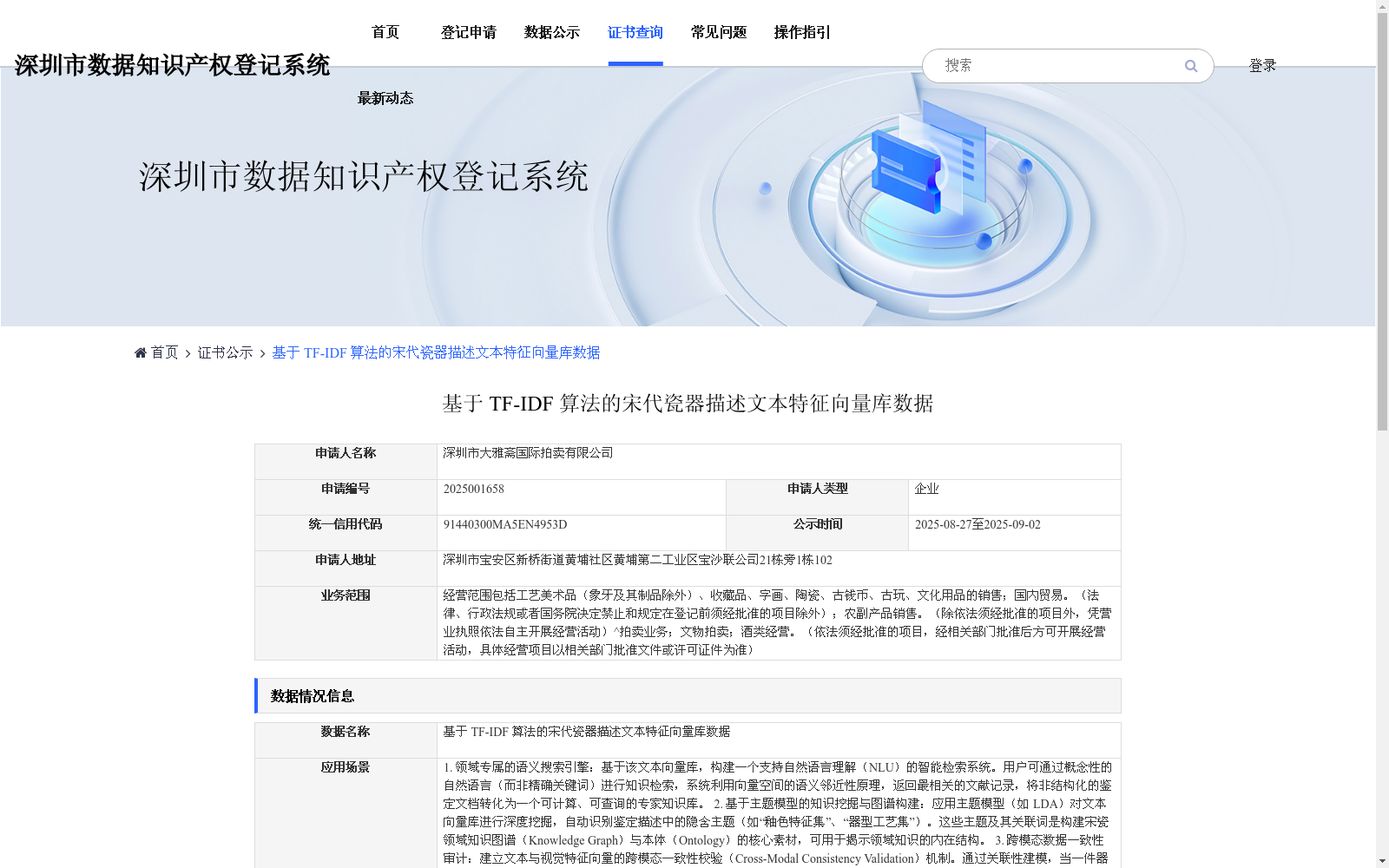
基于 TF-IDF 算法的宋代瓷器描述文本特征向量库数据
收藏资源简介:
1. 领域专属的语义搜索引擎:基于该文本向量库,构建一个支持自然语言理解(NLU)的智能检索系统。用户可通过概念性的自然语言(而非精确关键词)进行知识检索,系统利用向量空间的语义邻近性原理,返回最相关的文献记录,将非结构化的鉴定文档转化为一个可计算、可查询的专家知识库。 2. 基于主题模型的知识挖掘与图谱构建:应用主题模型(如 LDA)对文本向量库进行深度挖掘,自动识别鉴定描述中的隐含主题(如“釉色特征集”、“器型工艺集”)。这些主题及其关联词是构建宋瓷领域知识图谱(Knowledge Graph)与本体(Ontology)的核心素材,可用于揭示领域知识的内在结构。 3. 跨模态数据一致性审计:建立文本与视觉特征向量的跨模态一致性校验(Cross-Modal Consistency Validation)机制。通过关联性建模,当一件器物的文本描述与其视觉特征出现显著统计学偏差时,系统可进行异常检测与预警,从而保障数据资产的准确性与逻辑自洽性。
1. Domain-specific semantic search engine: Based on this text vector library, an intelligent retrieval system supporting Natural Language Understanding (NLU) is constructed. Users can perform knowledge retrieval via conceptual natural language rather than precise keywords. The system utilizes the principle of semantic proximity in vector space to return the most relevant literature records, transforming unstructured authentication documents into a computable and queryable expert knowledge base. 2. Topic model-based knowledge mining and knowledge graph construction: Topic models (e.g., LDA) are applied to conduct in-depth mining on the text vector library, automatically identifying latent topics in authentication descriptions such as "glaze color feature set" and "shape and craft feature set". These topics and their associated terms are core materials for building the Song porcelain domain Knowledge Graph and Ontology, which can be used to reveal the inherent structure of domain knowledge. 3. Cross-modal data consistency audit: A Cross-Modal Consistency Validation mechanism for text and visual feature vectors is established. Through correlation modeling, when there is a significant statistical deviation between the textual description of an artifact and its visual features, the system can carry out anomaly detection and early warning, thereby ensuring the accuracy and logical consistency of data assets.