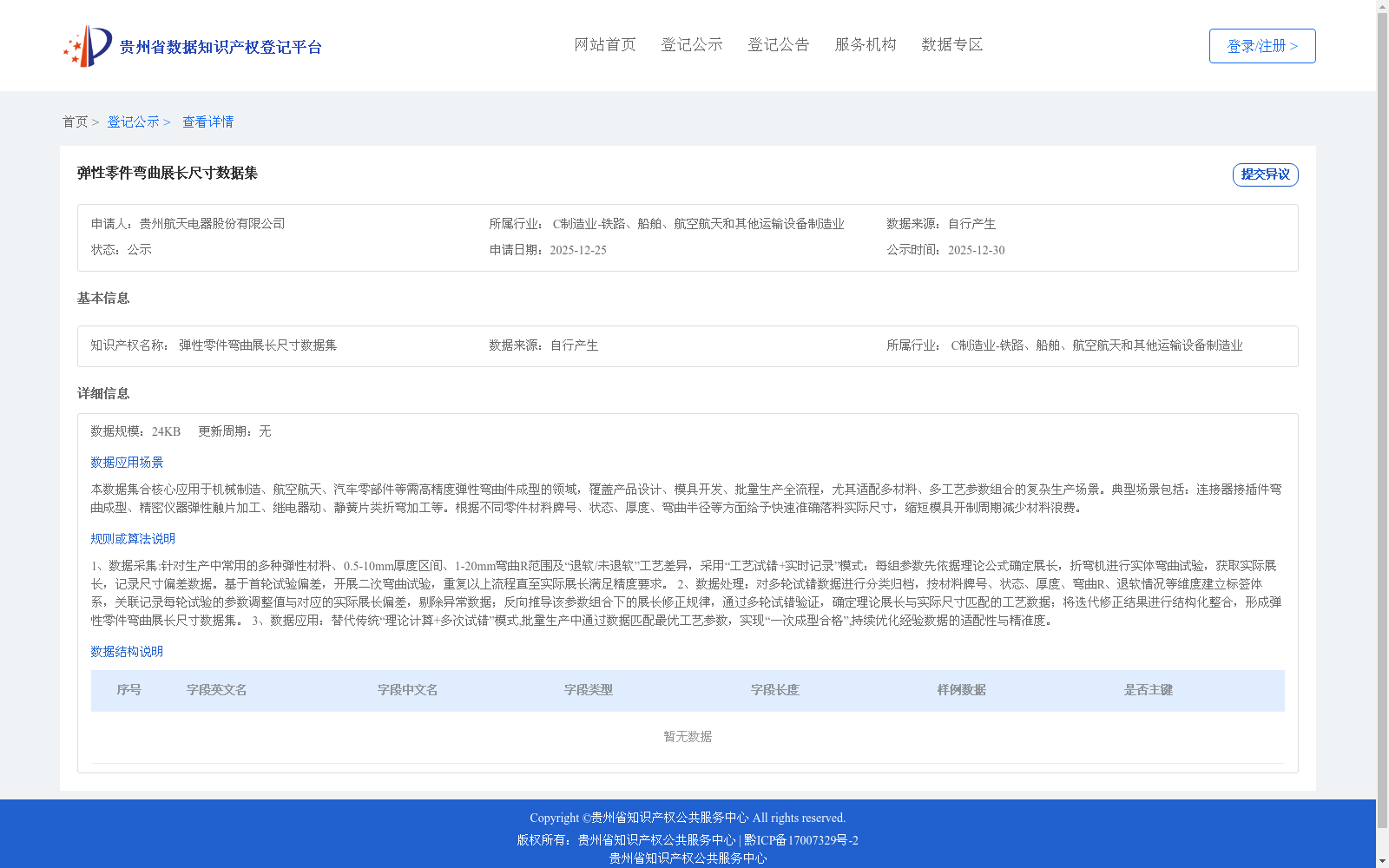
弹性零件弯曲展长尺寸数据集
收藏资源简介:
1、数据采集:针对生产中常用的多种弹性材料、0.5-10mm厚度区间、1-20mm弯曲R范围及“退软/未退软”工艺差异,采用“工艺试错+实时记录”模式:每组参数先依据理论公式确定展长,折弯机进行实体弯曲试验,获取实际展长,记录尺寸偏差数据。基于首轮试验偏差,开展二次弯曲试验,重复以上流程直至实际展长满足精度要求。 2、数据处理:对多轮试错数据进行分类归档,按材料牌号、状态、厚度、弯曲R、退软情况等维度建立标签体系,关联记录每轮试验的参数调整值与对应的实际展长偏差,剔除异常数据;反向推导该参数组合下的展长修正规律,通过多轮试错验证,确定理论展长与实际尺寸匹配的工艺数据;将迭代修正结果进行结构化整合,形成弹性零件弯曲展长尺寸数据集。 3、数据应用:替代传统“理论计算+多次试错”模式,批量生产中通过数据匹配最优工艺参数,实现“一次成型合格”,持续优化经验数据的适配性与精准度。
1. Data Collection: Targeting multiple elastic materials commonly used in production, with thickness ranging from 0.5 mm to 10 mm, bending radius ranging from 1 mm to 20 mm, and differences in "annealed/unannealed" processes, the "process trial-and-error + real-time recording" approach was adopted. For each parameter set, the developed length was first determined based on theoretical formulas, then physical bending tests were performed on a bending machine to obtain the actual developed length, and dimensional deviation data was recorded. Based on the deviation observed in the first round of tests, a second bending test was conducted, and this process was repeated until the actual developed length met the required accuracy. 2. Data Processing: Classify and archive the multi-round trial-and-error data, establish a labeling system according to dimensions including material grade, material condition, thickness, bending radius, annealing status and other factors, associate and record the parameter adjustment values and corresponding actual developed length deviations of each test round, and remove abnormal data. Reverse-derive the developed length correction law for this parameter combination, determine the process data that matches the theoretical developed length with actual dimensions through multi-round trial-and-error verification, and structurally integrate the iterative correction results to form a dimensional dataset for bending developed lengths of elastic parts. 3. Data Application: Replace the traditional "theoretical calculation + multiple trial-and-error" mode. During mass production, match the optimal process parameters through the dataset to achieve "one-time forming and qualification", and continuously optimize the adaptability and accuracy of empirical data.