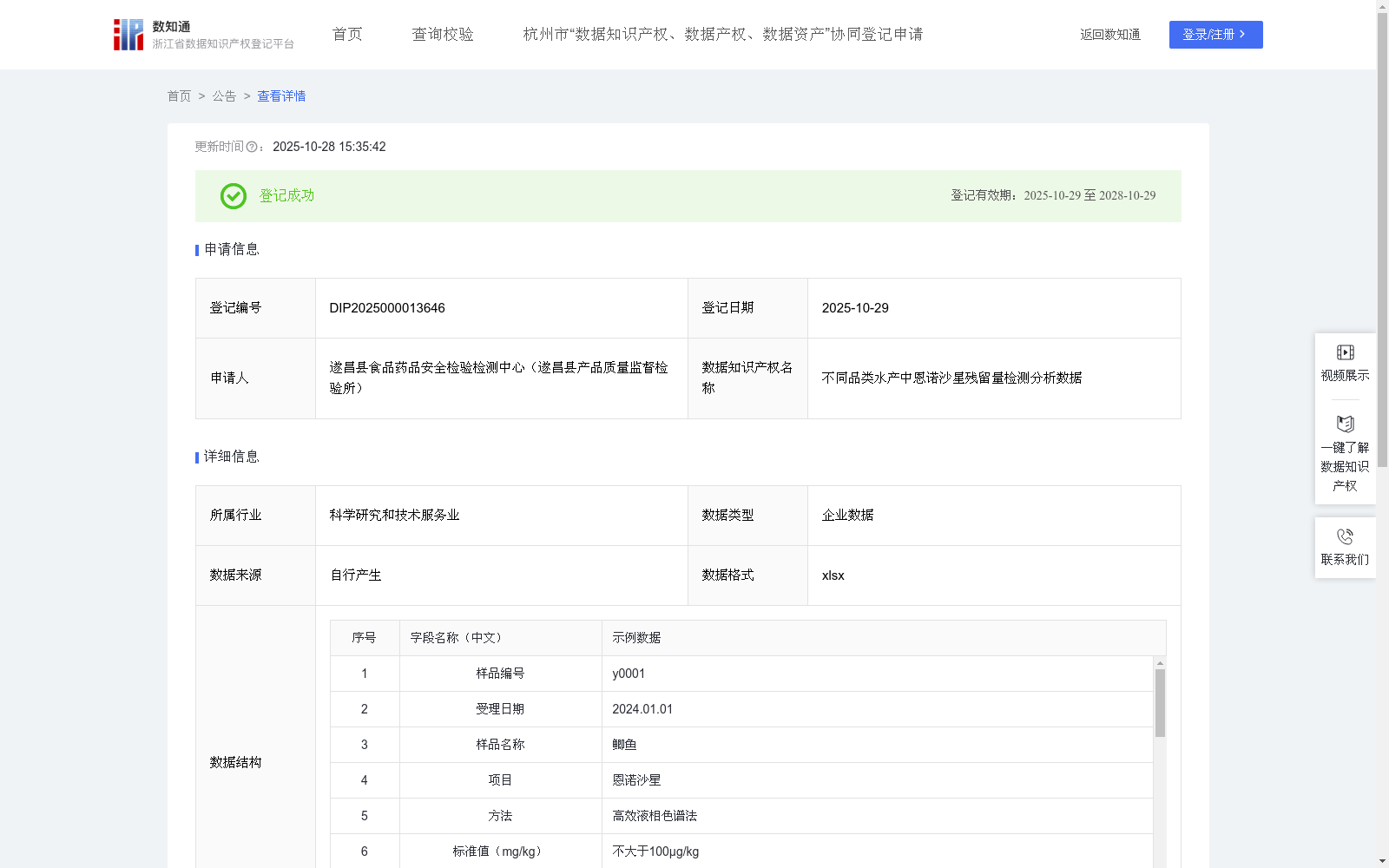
不同品类水产中恩诺沙星残留量检测分析数据
收藏资源简介:
恩诺沙星残留是水产品的主要安全问题之一,水产品中恩诺沙星残留也常有检出,恩诺沙星药物在水产养殖中主要作为防治细菌性感染疾病,通过抑制细菌DNA回旋酶的活性,阻断细菌的广谱抗菌作用。如果长期食用恩诺沙星残留产品会对人体健康造成危害,如引起头晕、头痛、睡眠不良、胃肠道刺激或不适等症状,大剂量或长期摄入还可能引起肝损害。因此通过对水产品中恩诺沙星残留的检测分析,能够进一步了解水产品各品类恩诺沙星残留情况和风险情况。通过合格率了解易超标的风险品种,通过不合格占比了解年度重点监管品类,从而加强对水产品恩诺沙星残留情况的关注,为养殖业合理使用药品具有指导意义,也为监管单位进行恩诺沙星残留专项监管提供数据支持。1、数据采集:根据要求采集水产样品并进行样品制备,依据检测方法进行定量分析,获得检测结果值。2、数据处理:通过定量分析获得结果值,依据GB 31650-2019 《食品安全国家标准 食品中兽药最大残留限量》设定标准值,当结果值≤标准值时,判定合格;否则判定不合格;该细类当年合格率=该细类当年检测合格批次数A/该细类当年检测批次N*100%,保留两位小数;总不合格数M为当年水产品恩诺沙星不合格数之和,该细类不合格占比=该细类不合格数X/总不合格数M*100%,保留两位小数;该品种不合格占比=该品种不合格数Y/总不合格数M*100%,保留两位小数。当该细类当年合格率≥98%时,风险评价=LR,当98%>该细类当年合格率≥95%时,风险评价=MR,当该细类当年合格率<95%时,风险评价=HR。3、数据应用:对水产品中恩诺沙星残留进行检测分析,可以了解不同品类恩诺沙星残留情况,通过风险评价了解易超标的风险品种,通过不合格占比了解年度监管品类不合格总体情况,从而加强对水产品恩诺沙星残留情况的关注,为养殖业合理使用药品具有指导意义,也为监管单位进行恩诺沙星残留专项监管提供数据支持。
Enrofloxacin residues are one of the primary food safety concerns in aquatic products, and such residues are commonly detected in these products. Enrofloxacin is mainly used to prevent and treat bacterial infectious diseases in aquaculture, exerting broad-spectrum antibacterial effects by inhibiting the activity of bacterial DNA gyrase. Long-term consumption of products containing enrofloxacin residues can pose risks to human health, such as causing symptoms including dizziness, headache, poor sleep quality, gastrointestinal irritation and discomfort. High-dose or long-term ingestion may also cause liver damage. Therefore, detection and analysis of enrofloxacin residues in aquatic products can help further understand the residue status and risk levels of enrofloxacin across different aquatic product categories. We can identify high-risk varieties prone to exceeding residue limits through qualified rates, and pinpoint key annual supervision categories based on unqualified proportions, thereby strengthening attention to enrofloxacin residues in aquatic products. This provides guidance for the rational use of veterinary drugs in aquaculture, as well as data support for regulatory authorities to carry out special supervision on enrofloxacin residues. 1. Data Collection: Collect aquatic samples and prepare them according to requirements, then perform quantitative analysis following standard detection methods to obtain test result values. 2. Data Processing: Obtain result values through quantitative analysis, and set the standard limit based on GB 31650-2019 National Food Safety Standard: Maximum Residue Limits for Veterinary Drugs in Foods. A sample is judged as qualified if the result value ≤ the standard limit, otherwise it is unqualified. The annual qualified rate of a sub-category is calculated as (number of qualified batches A of the sub-category in the current year / total number of tested batches N of the sub-category in the current year) × 100%, rounded to two decimal places. The total number of unqualified cases M is the sum of all enrofloxacin-related unqualified aquatic product samples in the current year. The unqualified proportion of a sub-category is calculated as (number of unqualified cases X of the sub-category / total unqualified cases M) × 100%, rounded to two decimal places. The unqualified proportion of a specific variety is calculated as (number of unqualified cases Y of the variety / total unqualified cases M) × 100%, rounded to two decimal places. Risk assessment is categorized as follows: LR when the annual qualified rate of the sub-category ≥ 98%, MR when 98% > annual qualified rate of the sub-category ≥ 95%, and HR when the annual qualified rate of the sub-category < 95%. 3. Data Application: Detection and analysis of enrofloxacin residues in aquatic products can reveal the enrofloxacin residue status across different product categories. Through risk assessment, we can identify high-risk varieties prone to exceeding residue limits, and understand the overall unqualified situation of annual key supervision categories via unqualified proportions. This will enhance attention to enrofloxacin residues in aquatic products, provide guidance for the rational use of veterinary drugs in aquaculture, and offer data support for regulatory authorities to conduct special supervision on enrofloxacin residues.