ER-REASON
收藏资源简介:
ER-REASON是一个旨在评估基于大型语言模型(LLM)的临床推理和决策能力的数据集,特别是在急诊室(ER)这种高风险环境中。该数据集包含来自3984名患者的数据,包括25174条去标识化的纵向临床记录,涵盖了出院摘要、进度笔记、病史和体检记录、咨询记录、超声心动图报告、影像笔记和急诊医生记录等。数据集还包含72位医生撰写的完整理由,解释了推理过程,这些理由模拟了住院医师培训过程中使用的教学方法,通常在急诊室记录中缺失。该数据集旨在解决现有基准测试未能充分捕捉现实世界临床决策复杂性和模糊性的问题,并提供了对LLM生成的临床推理与医生撰写的临床推理之间差距的评价,突出了未来研究的必要性以缩小这一差距。
ER-REASON is a purpose-built dataset for evaluating the clinical reasoning and decision-making abilities of large language models (LLMs), particularly within high-stakes emergency room (ER) environments. This dataset contains data derived from 3,984 patients, including 25,174 de-identified longitudinal clinical records spanning discharge summaries, progress notes, medical and physical examination records, consultation notes, echocardiography reports, imaging notes, emergency physician documentation, and additional relevant clinical materials. It also includes complete rationales written by 72 physicians that explain the underlying clinical reasoning process, simulating the instructional approaches utilized in residency training programs—content that is frequently absent from standard emergency room records. ER-REASON is designed to address a key shortcoming of existing benchmark datasets: their failure to adequately capture the complexity and ambiguity inherent in real-world clinical decision-making. Furthermore, it provides an assessment of the disparity between clinical reasoning generated by LLMs and that authored by human physicians, highlighting the critical need for future research to narrow this gap.
ER-Reason数据集概述
数据集简介
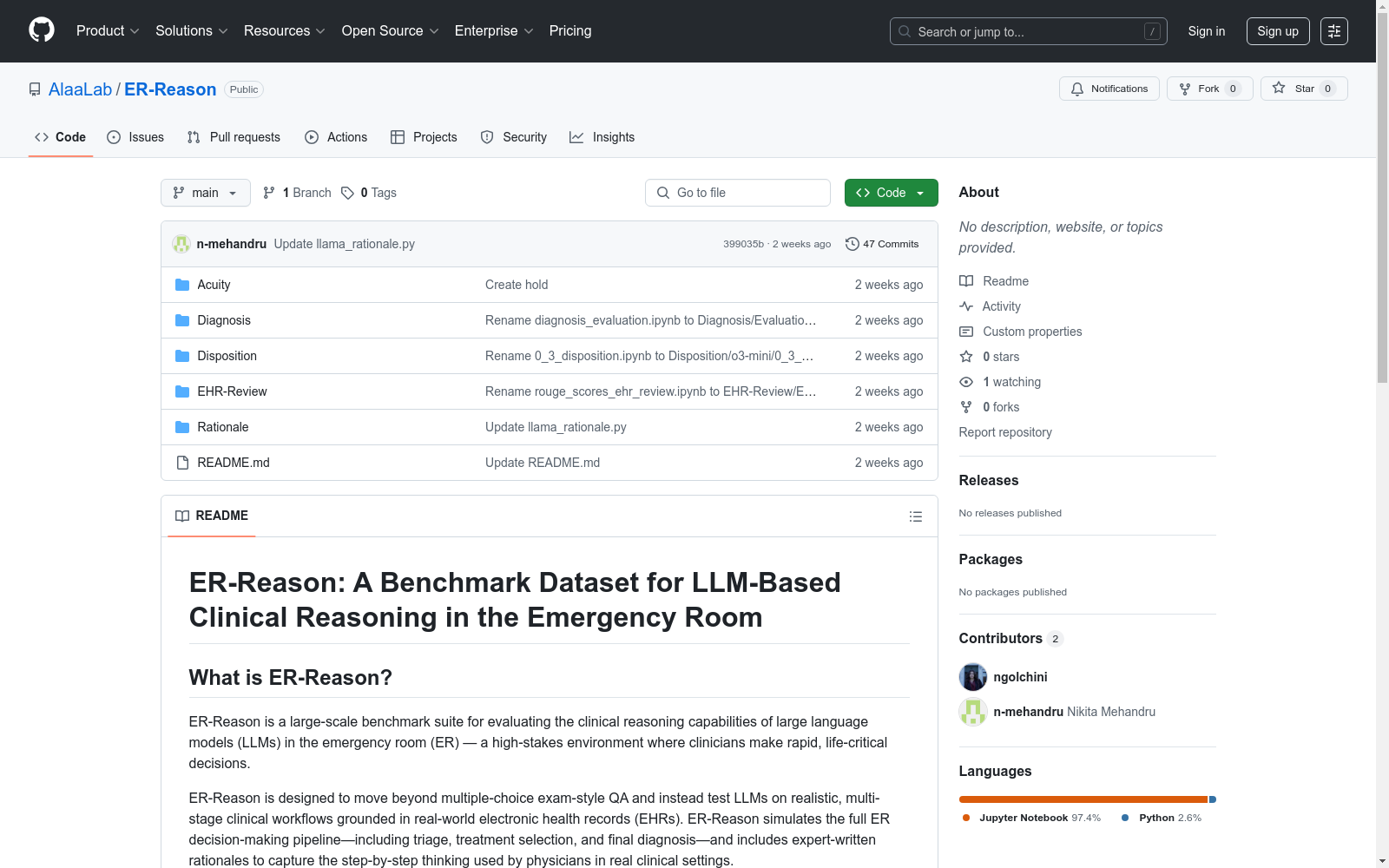
ER-Reason是一个用于评估大型语言模型(LLM)在急诊室(ER)临床推理能力的大规模基准测试套件。该数据集模拟真实的急诊决策流程,包含多阶段临床工作流程和专家撰写的推理过程。
核心特性
数据规模与类型
- 包含3,984名患者的25,174份去标识化纵向临床记录
- 临床记录类型:
- 出院摘要
- 病程记录
- 病史与体格检查(H&P)
- 会诊记录
- 影像学报告
- 超声心动图报告
- 急诊科医生记录
临床推理标注
- 72份由医师撰写的临床决策推理说明
- 推理过程模拟住院医师级别的临床教学
临床任务设计
任务围绕实际急诊护理流程设计:
- 分诊接诊
- 电子健康记录(EHR)审查
- 初步评估
- 治疗计划
- 处置计划(入院、出院、ICU)
- 最终诊断
模型兼容性
- 支持评估以下模型:
- LLaMA 3.2-3B-Instruct
- GPT-4o
- GPT-3.5 Turbo
- O3-Mini
评估任务
- 紧急程度分类:根据症状和临床病史判断患者紧急程度
- EHR摘要:总结患者临床病史的关键方面
- 推理生成:创建与医师思维一致的临床决策推理
- 诊断推断:基于EHR数据和症状推断最可能的诊断
- 处置预测:预测患者应入院、出院或转入ICU