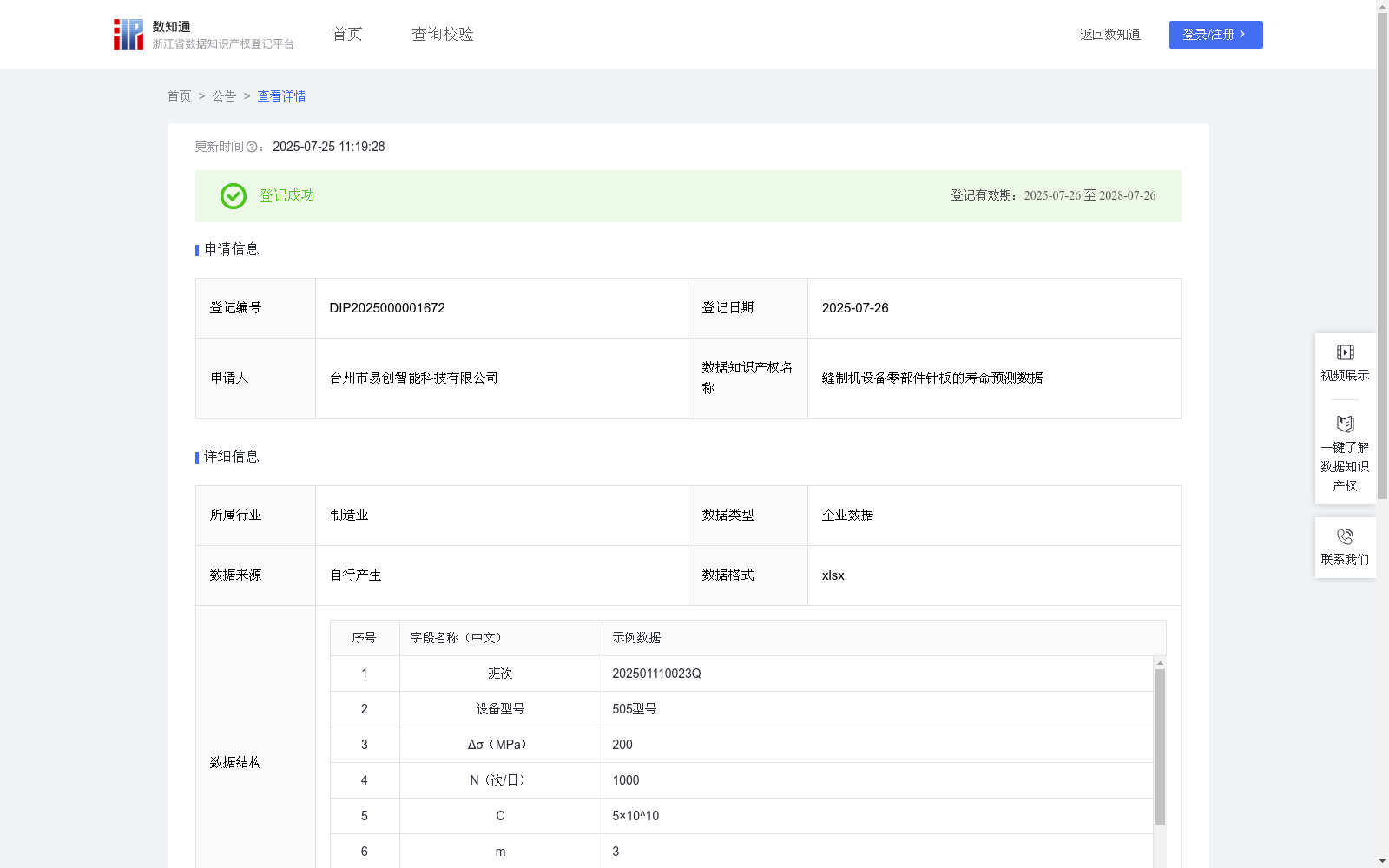
缝制机设备零部件针板的寿命预测数据
收藏资源简介:
针板寿命预测指通过分析其材料特性、工作载荷及磨损状态,预估该部件在持续交变应力下达到失效临界点的剩余使用周期,本寿命预测数据具有以下应用场景:根据寿命预测动态调整维护周期,降低停机损失;通过分析C和m的波动,反向追溯材料供应商或加工工艺缺陷;将寿命数据纳入零部件全生命周期成本模型,优化采购预算;向客户提供针板寿命实时监测报告,作为设备可靠性承诺的凭证;与上下游共享寿命预测数据,推动供应商改进材料性能。数据收集:数据采集通过嵌入式传感器、设备运行日志、实验试检测,对不同班次不同型号的缝制机设备实时采集缝制机的各个运行参数数据,对缝制机设备采集到的数据进行降噪、清洗、加工后进行处理。 数据处理:采集的数据包括有以下:Δσ:针板工作应力幅值,通过传感器采集;N:针板单日平均使用频次,基于设备运行日志统计;C:材料疲劳系数,由实验室测试获得;m:应力指数,与材料特性相关;b:频次衰减系数,根据历史失效数据拟合。针板寿命预测公式的构建基于材料疲劳理论、实际工况数据和历史失效统计,通过多学科交叉验证形成寿命预测公式,预测寿命L= C/(Δσ ^ m)*(N ^ b),通过采集到的输入量从而可计算出预测寿命L值。数据运用:根据预测寿命L值对零部件针板产品进行分级:优秀(L值大于等于6000小时),良好(L值在4000-6000小时内),差(L值小于等于4000小时)。
Needle plate remaining useful life prediction refers to estimating the remaining service cycle of the component when it reaches the failure critical point under continuous alternating stress by analyzing its material properties, working load and wear status. This life prediction dataset has the following application scenarios: 1. Dynamically adjust maintenance cycles based on life prediction results to reduce downtime losses; 2. Analyze fluctuations in C and m to reversely trace defects in material suppliers or processing technologies; 3. Incorporate life data into the full life cycle cost model of components to optimize procurement budgets; 4. Provide customers with real-time monitoring reports of needle plate life as evidence of equipment reliability commitments; 5. Share life prediction data with upstream and downstream partners to promote suppliers to improve material performance. Data Collection: Data is collected through embedded sensors, equipment operation logs and experimental testing. Real-time collection of various operating parameter data of sewing machines of different models across different shifts is conducted, and the collected data is processed after denoising, cleaning and processing. Data Processing: The collected data includes the following items: Δσ: Working stress amplitude of the needle plate, collected via sensors; N: Average daily usage frequency of the needle plate, counted based on equipment operation logs; C: Material fatigue coefficient, obtained through laboratory tests; m: Stress index, related to material properties; b: Frequency attenuation coefficient, fitted based on historical failure data. The needle plate life prediction formula is constructed based on material fatigue theory, actual working condition data and historical failure statistics, and finalized through interdisciplinary verification. The prediction formula is L = C/(Δσ^m) * (N^b), and the predicted service life L can be calculated using the collected input parameters. Data Application: Needle plate components are classified based on the predicted life L value: - Excellent (L value ≥ 6000 hours), - Good (4000 hours ≤ L value < 6000 hours), - Poor (L value ≤ 4000 hours).