LLMOwlR
收藏资源简介:
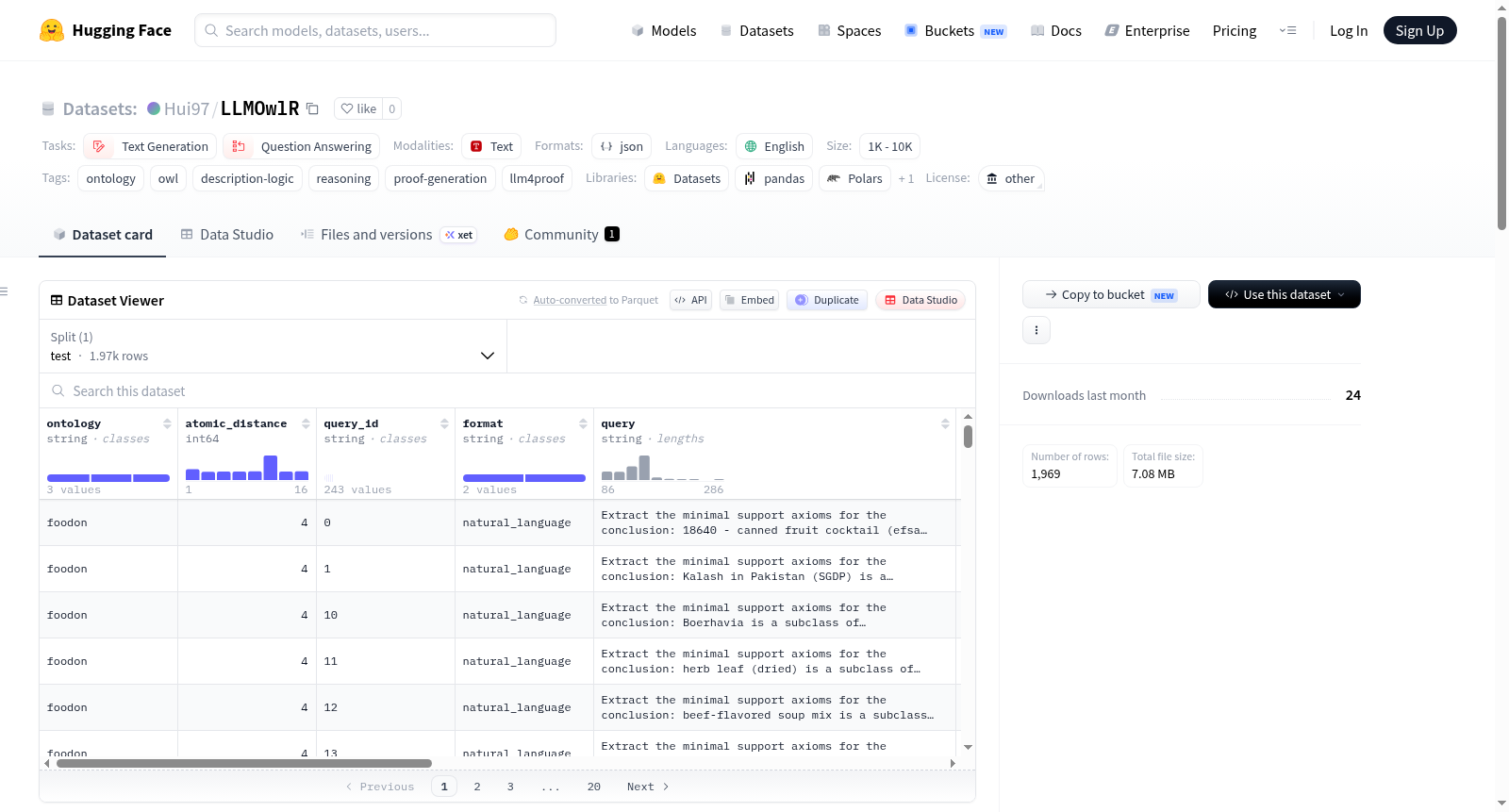
LLM4Proof提示学习数据集是一个用于生成和评估OWL(Web Ontology Language)本体证明的提示学习样本集合。数据集来源于LLMOwlR/LLM4Proof代码仓库中的`prompt_learning_dataset.zip`文件。每个样本包含一个推理查询、一个打乱顺序的候选公理列表,以及正确公理在列表中的索引;查询以自然语言和OWL形式化语言两种变体独立存储。数据集由三个本体子集(foodon、go-plus和snomedCT)组成,总计1969个样本,仅作为test分割提供,用户可通过`ontology`字段筛选子集。关键指标`atomic_distance`(原子距离)用于选择目标结论,基于论文中的启发式估计,衡量推理长度,定义为原子概念间最短直接包含链的长度,值越大表示推理越复杂。数据以JSONL格式存储,主要字段包括:`ontology`(本体子集标识)、`atomic_distance`(证明距离区间,foodon和go-plus使用4,6,8,10,12,14,16,snomedCT使用1和11)、`query_id`(原始查询ID)、`format`(格式类型,自然语言或owl)、`query`(提示查询文本)、`axioms`(打乱的候选公理列表)、`correct_axiom_indices`(正确公理索引)、`correct_axioms`(解析出的正确公理文本)和`source_path`(原始路径)。元数据存储在`metadata/dataset_summary.json`文件中。该数据集适用于文本生成、问答等任务,特别针对本体推理、描述逻辑和证明生成的研究与应用。
The LLM4Proof prompt learning dataset is a collection of prompt learning samples for generating and evaluating OWL (Web Ontology Language) ontology proofs. It originates from the `prompt_learning_dataset.zip` file in the LLMOwlR/LLM4Proof code repository. Each sample includes a reasoning query, a shuffled list of candidate axioms, and the indices of correct axioms within that list; queries are stored as independent rows in two variants: natural language and OWL formal language. The dataset consists of three ontology subsets (foodon, go-plus, and snomedCT), totaling 1969 samples, provided only as a test split, and users can filter subsets via the `ontology` field. A key metric, `atomic_distance` (atomic distance), is used to select target conclusions, based on a heuristic estimation from the paper to measure reasoning length, defined as the length of the shortest direct inclusion chain between atomic concepts, with larger values indicating more complex reasoning. Data is stored in JSONL format, with main fields including: `ontology` (subset identifier), `atomic_distance` (proof distance intervals, using 4,6,8,10,12,14,16 for foodon and go-plus, and 1 and 11 for snomedCT), `query_id` (original query ID), `format` (format type, natural_language or owl), `query` (prompt query text), `axioms` (shuffled candidate axiom list), `correct_axiom_indices` (indices of correct axioms), `correct_axioms` (parsed correct axiom text), and `source_path` (original path). Metadata is stored in the `metadata/dataset_summary.json` file. This dataset is suitable for tasks such as text generation and question answering, particularly for research and applications related to ontology reasoning, description logic, and proof generation.
数据集概述:LLM4Proof Prompt Learning Dataset
- 数据集名称:LLM4Proof Prompt Learning Dataset
- 作者/来源:源自 LLMOwlR/LLM4Proof 仓库中的
prompt_learning_dataset.zip工件 - 语言:英文
- 许可证:其他(
other) - 任务类别:文本生成、问答
- 标签:本体论、OWL、描述逻辑、推理、证明生成、LLM4Proof
数据集内容与结构
该数据集包含用于生成和评估 OWL 本体证明的提示学习样本。每行包含:
- 推理查询(
query) - 打乱顺序的候选公理列表(
axioms) - 最小支持公理索引(
correct_axiom_indices)及其解析文本(correct_axioms) - 自然语言和 OWL 格式的变体作为独立行存在
核心字段
| 字段 | 说明 |
|---|---|
ontology |
本体子集名称(foodon、go-plus、snomedCT) |
atomic_distance |
证明距离桶(foodon/go-plus:4,6,8,10,12,14,16;snomedCT:1,11) |
query_id |
源查询 ID |
format |
格式(natural_language 或 owl) |
query |
提示查询内容 |
axioms |
打乱顺序的候选支持公理 |
correct_axiom_indices |
黄金支持公理在 axioms 中的索引 |
correct_axioms |
黄金支持公理文本 |
source_path |
原始压缩包内的路径 |
数据划分与文件结构
- 配置:
default(单一配置) - 拆分:仅
test拆分,共 1,969 行 - 数据文件:
data/foodon.jsonl、data/go-plus.jsonl、data/snomedCT.jsonl - 元数据:
metadata/dataset_summary.json(独立于数据文件,避免被 Hugging Face 数据集查看器解析)
文件树
README.md data/ ├── foodon.jsonl ├── go-plus.jsonl └── snomedCT.jsonl metadata/ └── dataset_summary.json
原子距离(Atomic Distance)
atomic_distance 用于估计推理长度:对于推断的原子包含关系 A ⊑ B,表示连接 A 到 B 的最短直接包含链长度。直接包含的距离为 1,较大值通常表示更长或更复杂的推理。
加载与过滤示例
python from datasets import load_dataset
dataset = load_dataset("Hui97/LLMOwlR", split="test") foodon = dataset.filter(lambda row: row["ontology"] == "foodon")
引用信息
bibtex @inproceedings{yang2026large, title = {Large Language Model for OWL Proofs}, author = {Yang, Hui and Chen, Jiaoyan and Sattler, Uli}, booktitle = {Proceedings of the ACM Web Conference 2026}, pages = {3952--3963}, year = {2026}, publisher = {ACM}, doi = {10.1145/3774904.3792395}, url = {https://doi.org/10.1145/3774904.3792395} }