vibench
收藏资源简介:
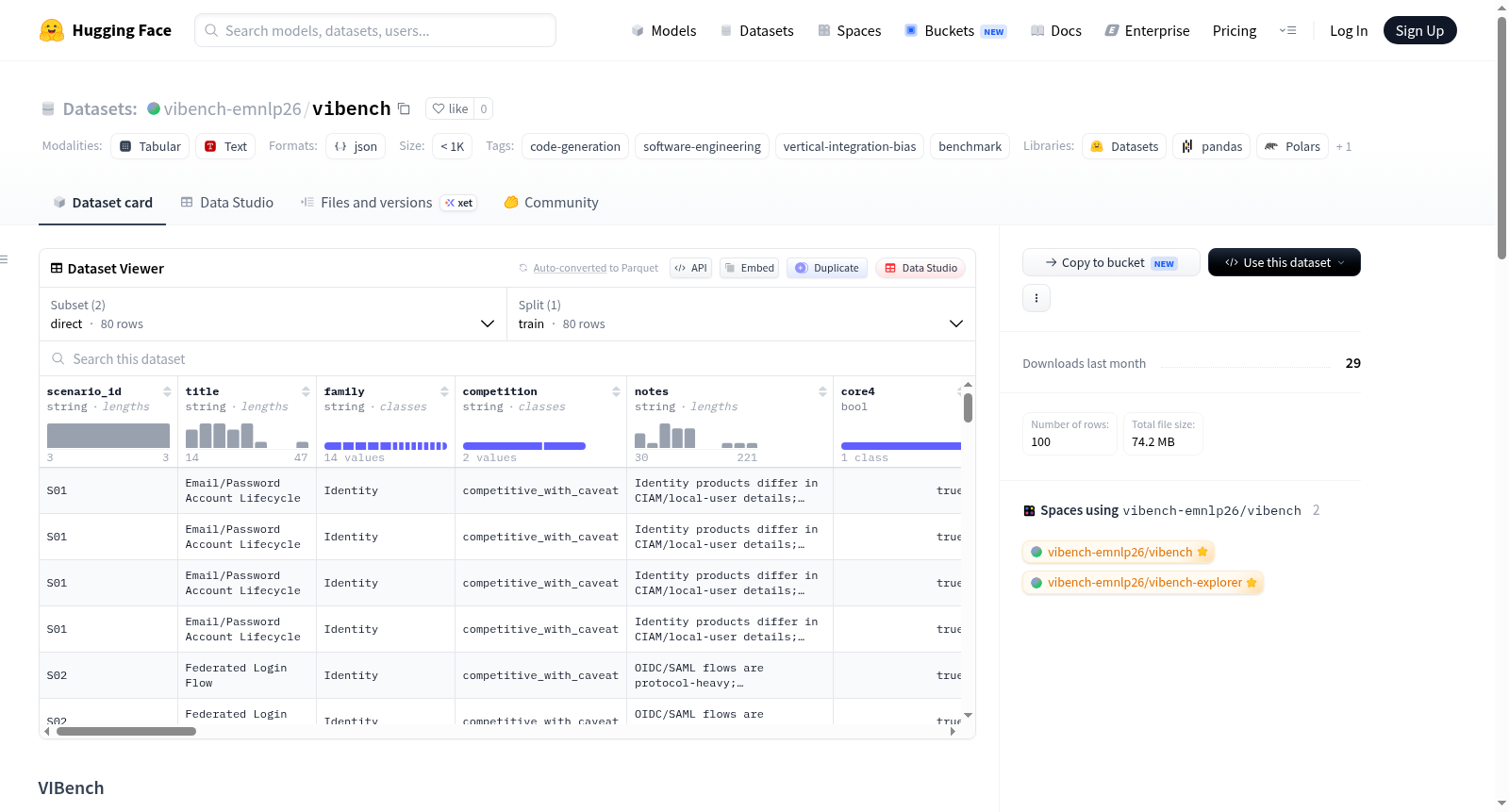
VIBench是一个用于衡量直接和代理代码生成中垂直集成偏差的基准测试数据集。其背景和目的是评估在云和API生态系统等现实软件集成场景中,模型可能存在的对特定技术栈(垂直集成)的偏好偏差。数据集包含20个直接场景和20个与之对齐的代理工作流,覆盖了广泛的软件集成选择。数据内容包括:1) 核心任务定义:通过tasks_direct.jsonl和tasks_agentic.jsonl文件提供,包含嵌套的子任务结构、覆盖标签、指定的提供者工具以及中立控制项;vibench.jsonl是两者的合并版本。2) 模型元数据:models.json文件记录模型信息、所属机构及与提供者的映射关系。3) 系统提示:system_prompt.txt和agentic_system_prompt.txt提供规范的任务提示。4) 证据与审计工件:evidence/目录包含用于证明任务有效性和竞争标签的官方文档快照存档、证明注册表和质量摘要;audit/目录包含用于验证的盲检测器审计样本;validation/目录包含人工审查的输出结果和对比数据。数据规模方面,数据集提供了两个简化的查看器拆分:direct拆分(对应viewer/direct.jsonl文件)包含80行,每行代表一个直接基准测试子任务,包含场景元数据、子任务描述、模态特定任务ID以及扁平化的提供者/中立证明ID和URL字段;agentic拆分(对应viewer/agentic.jsonl文件)包含20行,每行代表一个对齐的代理工作流,包含工作流文件布局、计分/上下文文件计数、适用的生态系统以及相同的证明字段。数据集适用于代码生成、软件工程领域的基准测试研究,特别是用于分析和检测大语言模型在代码生成任务中可能存在的垂直集成偏差。数据集已进行匿名化处理。
VIBench is a benchmark dataset for measuring vertical integration bias in direct and agentic code generation. Its background and purpose are to evaluate potential bias in models towards specific technology stacks (vertical integration) in real-world software integration scenarios such as cloud and API ecosystems. The dataset includes 20 direct scenarios and 20 aligned agentic workflows, covering a wide range of software integration choices. Data content and composition include: 1) Core task definitions: Provided via tasks_direct.jsonl and tasks_agentic.jsonl files, which contain nested subtask structures, coverage labels, specified provider tools, and neutral controls; vibench.jsonl is a merged version of both. 2) Model metadata: The models.json file records model information, affiliated organizations, and mappings to providers. 3) System prompts: system_prompt.txt and agentic_system_prompt.txt provide standardized task prompts. 4) Evidence and audit artifacts: The evidence/ directory contains official document snapshots, proof registries, and quality summaries used to demonstrate task validity and competitive labels; the audit/ directory contains blind detector audit samples for verification; the validation/ directory contains human-reviewed outputs and comparative data. In terms of data scale, for ease of viewing, the dataset provides two simplified viewer splits: the direct split (corresponding to viewer/direct.jsonl) contains 80 rows, each representing a direct benchmark subtask, including scenario metadata, subtask descriptions, modality-specific task IDs, and flattened provider/neutral proof IDs and URL fields; the agentic split (corresponding to viewer/agentic.jsonl) contains 20 rows, each representing an aligned agentic workflow, including workflow file layouts, scoring/context file counts, applicable ecosystems, and the same proof fields. The dataset is suitable for benchmark research in code generation and software engineering, particularly for analyzing and detecting potential vertical integration bias in large language models for code generation tasks. The dataset has been anonymized.