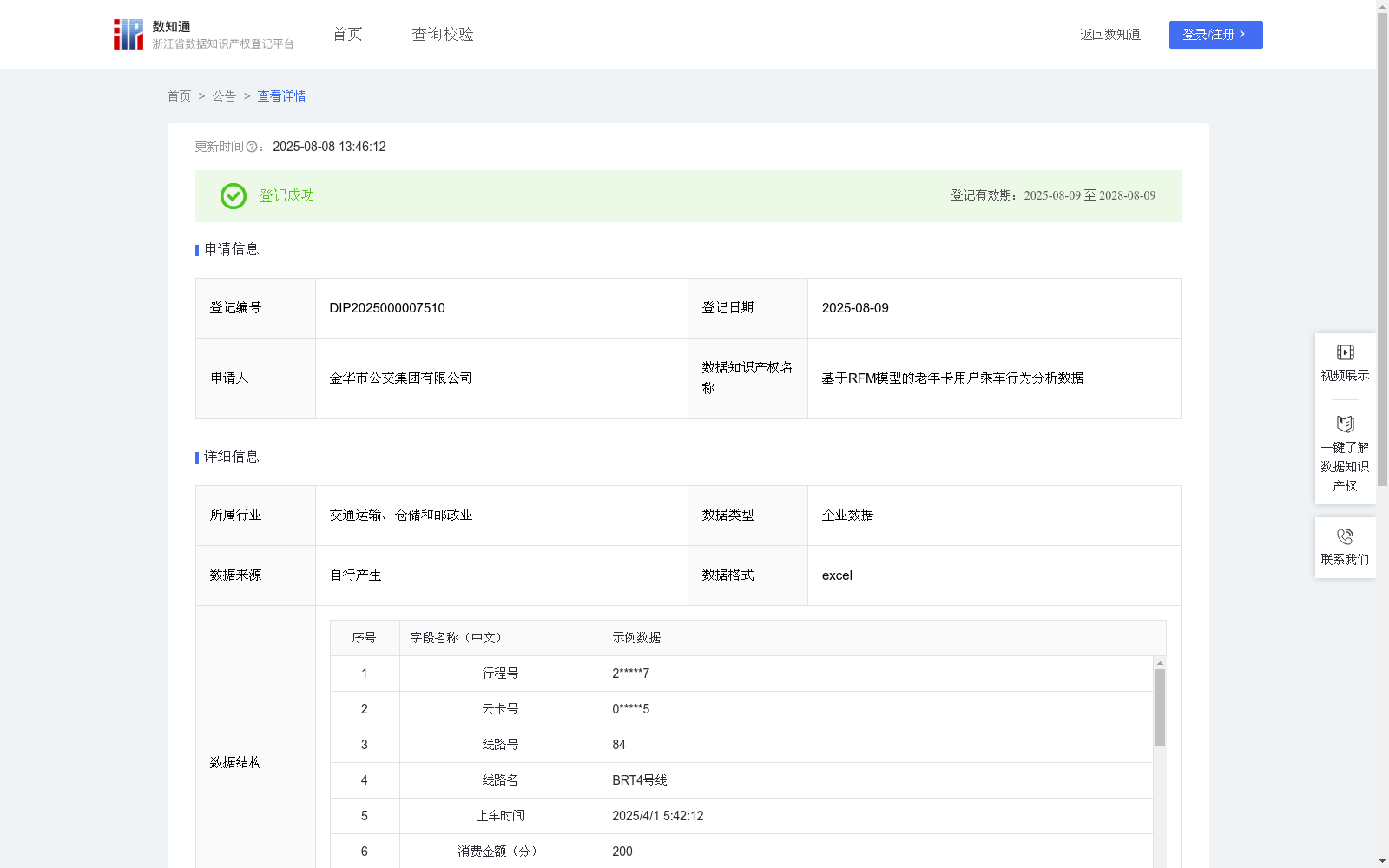
基于RFM模型的老年卡用户乘车行为分析数据
收藏资源简介:
采集老年卡用户的乘坐公交车消费行为数据,通过这些数据,能够执行精细化的客户关系管理。根据客户的最近一次消费时间间隔(R)、最近一段时间内消费频次(F)和最近一段时间内消费金额(M),采用RFM模型对进行价值评级,从而识别出高价值客户和核心客户。针对不同价值类型的客户提供个性化服务,比如为高价值客户提供VIP服务或积分奖励,提升忠诚度;针对基础客户,结合天气、节假日推送优惠券或单次折扣,刺激重新乘车;对核心客户设计阶梯式优惠,逐步提升消费黏性。1、数据采集:采集2025年4月老年卡用户的乘坐公交车消费行为数据:行程号、云卡号、线路好、线路名、上车时间等字段;2、数据处理:对采集到的数据进行清洗、分类汇总,对行程号、云卡号、手机号进行匿名化处理;3、数据加工:从原始数据中提取出最近一次消费时间(R)、最近一段时间消费频次(F)、最近一段时间消费金额(M)(最近一段时间指2025年4月期间),根据RFM模型计分法对用户进行分层管理,RFM计分规则如下:30≤R<35为5分,35≤R<45 为4分,45≤R<50为3分,50≤R<60 为2分,60<R 为1分;0≤M≤50 为1分,50<M≤100 为2分,100<M≤200 为3分,200<M≤300为 4分,300<M 为5分;0≤F≤30 为1分,30<F≤70 为2分,70<F≤100 为3分,100<F≤150 为4分,150<F为5分;计算每条数据的RFM综合得分X,根据公司要求对客户进行分层,1≤X≤5 为基础客户,5<X≤10 为核心客户,10<X 为高价值客户;;4、数据应用:采用RFM模型对进行价值评级,从而识别出高价值客户和核心客户、基础客户。
This dataset collects bus ride consumption behavior data of senior card users, enabling refined customer relationship management. Using the RFM model, value rating is conducted based on three metrics: recency of customer's last consumption (R), consumption frequency within a recent period (F), and total consumption amount within the same period (M), to identify high-value customers and core customers. Personalized services are tailored for customers of different value tiers: VIP services or point rewards are provided to high-value customers to enhance their loyalty; coupons or one-time discounts are pushed to basic customers combined with weather and holiday information to stimulate repeated bus rides; tiered discounts are designed for core customers to gradually increase their consumption stickiness. The dataset construction process includes four stages: 1. Data Collection: Bus ride consumption behavior data of senior card users in April 2025 is collected, including fields such as trip ID, cloud card number, line number, line name, boarding time, etc. 2. Data Preprocessing: The collected data is cleaned, categorized and aggregated, and anonymization processing is performed on the trip ID, cloud card number and mobile phone number fields. 3. Data Enrichment and Stratification: The recency of last consumption (R), consumption frequency (F) and consumption amount (M) within the reference period (April 2025) are extracted from the raw data. The RFM scoring rules are specified as follows: - R scoring: 5 points for 30 ≤ R < 35, 4 points for 35 ≤ R < 45, 3 points for 45 ≤ R < 50, 2 points for 50 ≤ R < 60, 1 point for R ≥ 60 - M scoring: 1 point for 0 ≤ M ≤ 50, 2 points for 50 < M ≤ 100, 3 points for 100 < M ≤ 200, 4 points for 200 < M ≤ 300, 5 points for M > 300 - F scoring: 1 point for 0 ≤ F ≤ 30, 2 points for 30 < F ≤ 70, 3 points for 70 < F ≤ 100, 4 points for 100 < F ≤ 150, 5 points for F > 150 The comprehensive RFM score X for each user is calculated, and customers are stratified according to company requirements: basic customers for 1 ≤ X ≤ 5, core customers for 5 < X ≤ 10, and high-value customers for X > 10. 4. Data Application: The RFM model is used to conduct value rating, so as to identify high-value customers, core customers and basic customers.