A dataset of underwater obstacle profile image of Qiandao Lake, China 2024-2025
收藏资源简介:
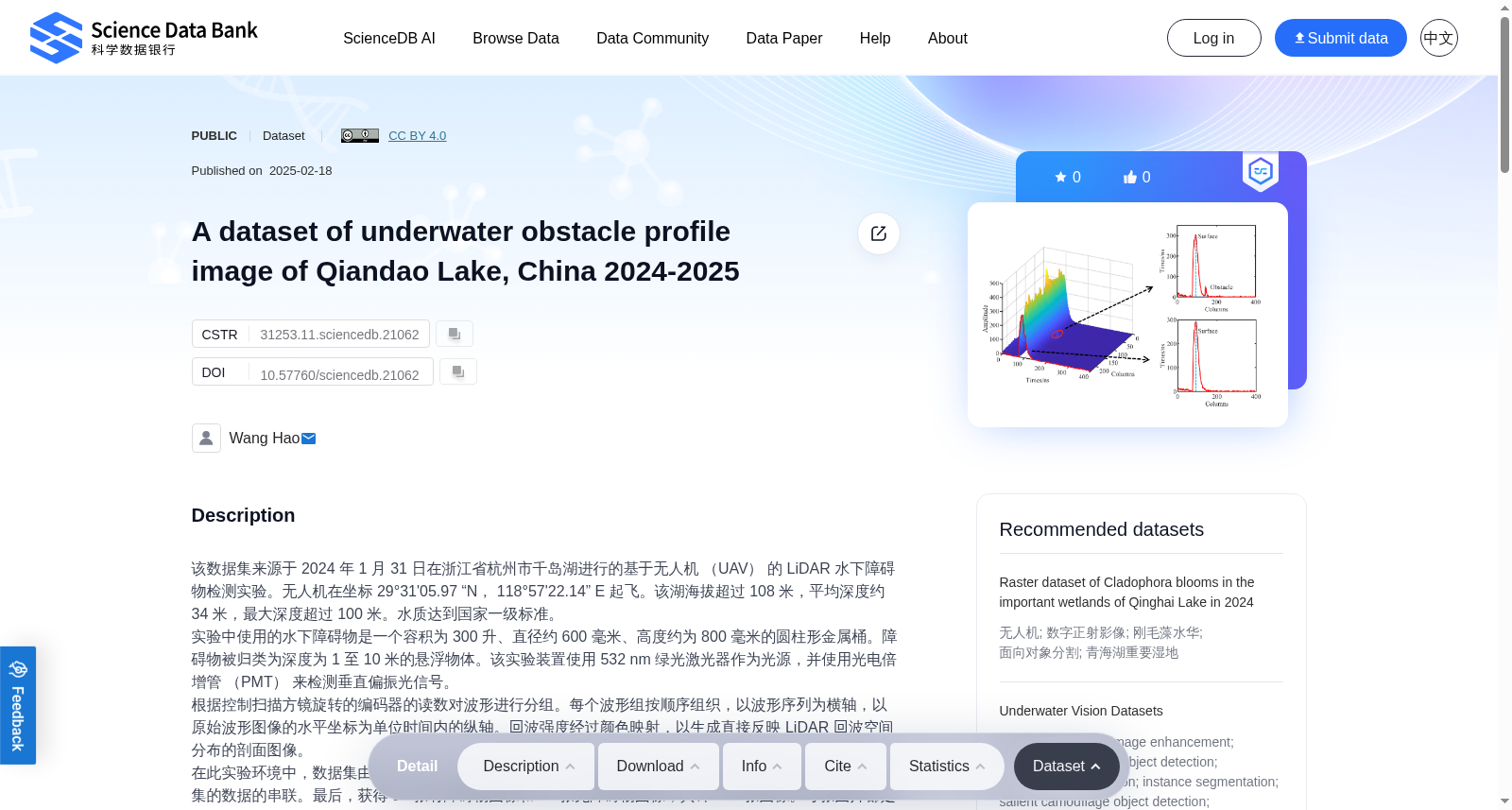
该数据集来源于 2024 年 1 月 31 日在浙江省杭州市千岛湖进行的基于无人机 (UAV) 的 LiDAR 水下障碍物检测实验。无人机在坐标 29°31'05.97 “N, 118°57'22.14” E 起飞。该湖海拔超过 108 米,平均深度约 34 米,最大深度超过 100 米。水质达到国家一级标准。实验中使用的水下障碍物是一个容积为 300 升、直径约 600 毫米、高度约为 800 毫米的圆柱形金属桶。障碍物被归类为深度为 1 至 10 米的悬浮物体。该实验装置使用 532 nm 绿光激光器作为光源,并使用光电倍增管 (PMT) 来检测垂直偏振光信号。根据控制扫描方镜旋转的编码器的读数对波形进行分组。每个波形组按顺序组织,以波形序列为横轴,以原始波形图像的水平坐标为单位时间内的纵轴。回波强度经过颜色映射,以生成直接反映 LiDAR 回波空间分布的剖面图像。在此实验环境中,数据集由主机上的 bin 文件软件处理,以执行波形分析和从有障碍物和无障碍物区域收集的数据的串联。最后,获得 91 张有障碍物图像和 74 张无障碍物图像,共计 165 张图像。每张图片都是 png 格式,大小从 20kb 到 130kb 不等。
This dataset originates from an unmanned aerial vehicle (UAV)-based LiDAR underwater obstacle detection experiment conducted at Qiandao Lake, Hangzhou, Zhejiang Province on January 31, 2024. The UAV took off at coordinates 29°31'05.97"N, 118°57'22.14"E. This lake has an elevation of over 108 meters, an average depth of approximately 34 meters, and a maximum depth exceeding 100 meters. Its water quality meets the national Grade I standard. The underwater obstacle used in the experiment is a cylindrical metal bucket with a volume of 300 liters, a diameter of about 600 mm, and a height of approximately 800 mm. The obstacle is classified as a suspended object at a depth of 1 to 10 meters. The experimental setup employed a 532 nm green laser as the light source, and used a photomultiplier tube (PMT) to detect vertically polarized light signals. Waveforms were grouped based on the readings from the encoder that controls the rotation of the scanning plane mirror. Each waveform group is organized sequentially, with the waveform sequence as the horizontal axis, and the horizontal coordinate of the original waveform image as the vertical axis within unit time. Echo intensity was color-mapped to generate profile images that directly reflect the spatial distribution of LiDAR echoes. In this experimental environment, the dataset was processed by bin file software on the host computer to perform waveform analysis and concatenation of data collected from areas with and without obstacles. Finally, 91 images with obstacles and 74 images without obstacles were obtained, totaling 165 images. Each image is in PNG format, with file sizes ranging from 20 KB to 130 KB.