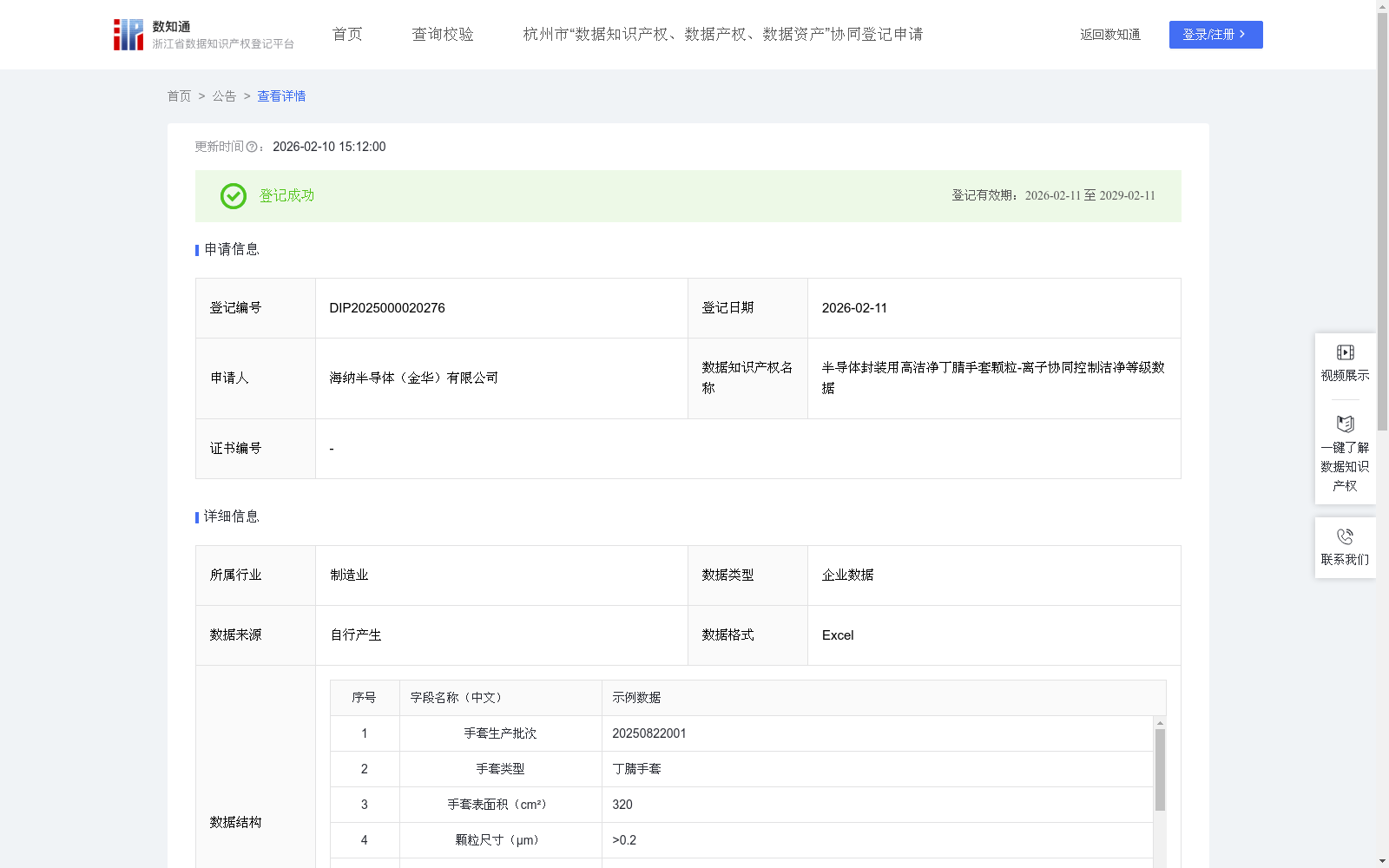
半导体封装用高洁净丁腈手套颗粒-离子协同控制洁净等级数据
收藏资源简介:
适用于半导体封装领域(如芯片引脚焊接、封装壳组装、金丝键合等核心环节)的质量控制与风险防控,适用对象为高洁净丁腈手套生产企业、半导体封装厂商及第三方半导体材料质量评估机构。其核心作用是通过 “颗粒 - 离子双维度” 标准化洁净度数据,验证丁腈手套是否适配半导体封装对 “低颗粒污染、低离子腐蚀” 的严苛要求,解决因手套表面颗粒脱落导致芯片接触不良、离子残留引发电路氧化等问题,为半导体封装环节的手套选型、批次质量抽检及手套生产工艺优化提供精准量化依据,可直接降低半导体封装过程中的不良品率(预计降低 8%-12%),保障芯片封装良率与长期可靠性,提升半导体封装领域材料质量管控水平。1.数据来源:数据来源于半导体级高洁净丁腈手套专项检测体系 —— 按 BS ISO23464:2020 (E) 半导体适配标准,选取 2 个平行高洁净丁腈手套样品(覆盖生产批次首、中、尾段),用液体颗粒仪(检测精度 0.1μm)测试 > 0.1μm/0.2μm 颗粒数,ICP-MS(检测限 ppb 级)测试 Na⁺/Mg²⁺/K⁺等金属离子,IC-940 测试 F⁻/Cl⁻/NO₃⁻/SO₄²⁻等阴离子,同步采集空白组数据。 2.数据处理:采用 “动态阈值筛选法”,基于 BS ISO23464:2020 (E) 及半导体封装行业特殊要求,自动过滤设备波动、采样偏差导致的无效数据(如颗粒数瞬时骤增、离子浓度超出 3 倍标准差);对筛选后的数据进行半导体场景化格式标准化,统一字段命名、单位标注及数值精度,形成可直接对接半导体封装质量系统的结构化数据。 3.数据计算: 实际颗粒数(cts/cm²)=(样品颗粒数 - 空白颗粒数)× 稀释系数(10)÷ 丁腈手套表面积; 实际离子浓度(μg/cm²)=(样品离子均值 - 空白均值)× 稀释系数 × 浸泡液体积(0.5L)× 转化系数(10⁻³) ÷ 丁腈手套表面积。 转化系数:ppt转化至ug/L系数为1/1000 数据应用: 洁净等级判定:颗粒数<1000cts/cm²,且离子浓度符合半导体封装限制(其中Na⁺<0.05μg/cm²、Mg²⁺<0.004μg/cm²、K⁺<0.05μg/cm²、F⁻<0.05μg/cm²、Cl⁻<2.0μg/cm²、Br⁻<0.1μg/cm²、NO₃⁻<2.0μg/cm²、PO₄³⁻<1.5μg/cm²、SO₄²⁻<1.5μg/cm²),判定为 “符合”;单项指标超标则降级。
This dataset is intended for quality control and risk prevention in semiconductor packaging fields, covering core processes such as chip pin soldering, package shell assembly, and gold wire bonding. Its target users include high-cleanliness nitrile glove manufacturers, semiconductor packaging vendors, and third-party semiconductor material quality assessment institutions. Its core role is to verify whether nitrile gloves meet the stringent requirements of "low particle contamination and low ion corrosion" for semiconductor packaging through standardized cleanliness data from the dual dimensions of particles and ions. It addresses issues including poor chip contact caused by particle shedding on glove surfaces and circuit oxidation induced by residual ions, providing accurate and quantitative basis for glove selection, batch quality sampling inspection, and production process optimization in semiconductor packaging. It can directly reduce the defective product rate in semiconductor packaging (estimated to decrease by 8%-12%), ensure the yield and long-term reliability of chip packaging, and improve the material quality control level in the semiconductor packaging industry. 1. Data Source: The data is derived from a special detection system for semiconductor-grade high-cleanliness nitrile gloves. In accordance with BS ISO23464:2020 (E) semiconductor adaptation standard, two parallel high-cleanliness nitrile glove samples (covering the start, middle, and end stages of production batches) are selected. A liquid particle counter (detection accuracy: 0.1μm) is used to test the number of particles >0.1μm/0.2μm; Inductively Coupled Plasma Mass Spectrometry (ICP-MS, detection limit: ppb level) is used to test metal ions such as Na⁺, Mg²⁺, and K⁺; IC-940 is used to test anions such as F⁻, Cl⁻, NO₃⁻, and SO₄²⁻. Blank group data is collected synchronously. 2. Data Processing: The "dynamic threshold screening method" is adopted. Based on BS ISO23464:2020 (E) and the special requirements of the semiconductor packaging industry, invalid data caused by equipment fluctuations and sampling deviations (such as instantaneous sharp increase in particle count, ion concentration exceeding 3 times the standard deviation) are automatically filtered. The screened data is standardized in a semiconductor scenario-specific format, with unified field names, unit labels, and numerical precision, forming structured data that can be directly connected to semiconductor packaging quality systems. 3. Data Calculation: Actual particle count (cts/cm²) = (Sample particle count - Blank particle count) × Dilution factor (10) ÷ Nitrile glove surface area; Actual ion concentration (μg/cm²) = (Sample ion mean - Blank ion mean) × Dilution factor × Immersion solution volume (0.5L) × Conversion factor (10⁻³) ÷ Nitrile glove surface area. Conversion factor: The coefficient for converting ppt to ug/L is 1/1000. Data Application: Cleanliness grade determination: If the particle count is less than 1000 cts/cm² and the ion concentrations meet the semiconductor packaging limits (Na⁺ < 0.05 μg/cm², Mg²⁺ < 0.004 μg/cm², K⁺ < 0.05 μg/cm², F⁻ < 0.05 μg/cm², Cl⁻ < 2.0 μg/cm², Br⁻ < 0.1 μg/cm², NO₃⁻ < 2.0 μg/cm², PO₄³⁻ < 1.5 μg/cm², SO₄²⁻ < 1.5 μg/cm²), the grade is judged as "Compliant". If any single indicator exceeds the limit, the grade will be downgraded.