DavidYz/TACK_Tunnel_Data
收藏资源简介:
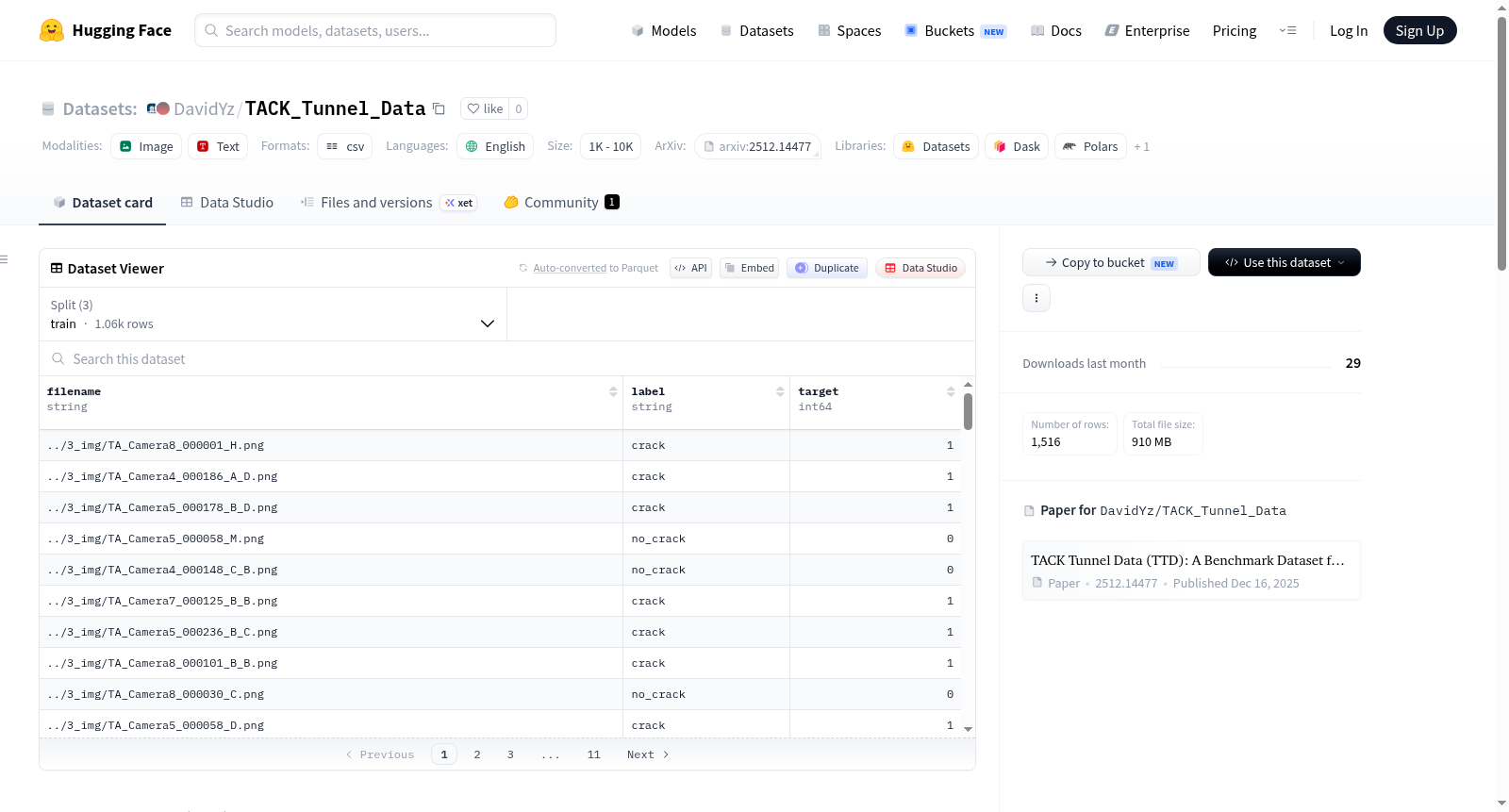
--- language: - en pretty_name: TTD --- # TACK Tunnel Data (TTD): A Benchmark Dataset for Deep Learning-Based Defect Detection in Tunnels Tunnels are essential elements of transportation infrastructure, but are increasingly affected by ageing and deterioration mechanisms such as cracking. Regular inspections are required to ensure their safety, yet traditional manual procedures are time-consuming, subjective, and costly. Recent advances in mobile mapping systems and Deep Learning (DL) enable automated visual inspections. However, their effectiveness is limited by the scarcity of tunnel datasets. This is the official repository of a new publicly available dataset containing annotated images of three different tunnel linings, capturing typical defects: cracks, leaching, and water infiltration. The dataset is designed to support supervised, semi-supervised, and unsupervised DL methods for defect detection and segmentation. Its diversity in texture and construction techniques also enables investigation of model generalization and transferability across tunnel types. By addressing the critical lack of domain-specific data, this dataset contributes to advancing automated tunnel inspection and promoting safer, more efficient infrastructure maintenance strategies. ## Dataset Description Data are collected from three tunnels (Tunnel A, Tunnel B, Tunnel C) using a mobile mapping system equipped with high-resolution cameras. The three tunnels exhibit different surfaces due to the construction methods used, as visible in Figure 1. <p align="left"> <img src="figures/figure1.png" width="600"/> </p> <p align="left"> <em>Figure 1: Example of high-resolution images depicting the surface of the three tunnels.</em> </p> The dataset includes three classes of defects from each tunnel. In total, 785 images with cracks, 197 images with water and 316 images with leaching (Table 1). <p align="left"> <img src="figures/table1.png" width="600"/> </p> <p align="left"> <em>Table 1: Description of the complete dataset, divided into three tunnel types and three classes.</em> </p> For each image, a segmentation mask is provided. Masks were generated manually using the SuperAnnotate platform. For any additional detail and technical validation of the dataset, please refer to the preprint https://arxiv.org/abs/2512.14477. ## Citation If you use this dataset in your research, please cite: ```bibtex @misc{sjölander2025tacktunneldatattd, title={TACK Tunnel Data (TTD): A Benchmark Dataset for Deep Learning-Based Defect Detection in Tunnels}, author={Andreas Sjölander and Valeria Belloni and Robel Fekadu and Andrea Nascetti}, year={2025}, eprint={2512.14477}, archivePrefix={arXiv}, primaryClass={cs.CV}, url={https://arxiv.org/abs/2512.14477}, }
--- language: - 英语 pretty_name: TTD --- # TACK隧道数据集(TTD):面向隧道深度学习缺陷检测的基准数据集 隧道是交通基础设施的核心组成部分,但日益受到老化和诸如开裂等劣化机制的影响。为保障隧道安全,需定期开展巡检工作,但传统人工巡检流程耗时耗力、主观性强且成本高昂。近年来,移动测绘系统与深度学习(Deep Learning)技术的进步推动了自动化视觉巡检的发展。然而,隧道领域专用数据集的匮乏限制了此类技术的实际应用效果。本仓库为全新公开数据集的官方托管仓库,该数据集包含三种不同隧道衬砌的标注图像,涵盖典型缺陷类型:开裂、渗碱与水害。本数据集旨在支持用于缺陷检测与分割的监督、半监督及无监督深度学习方法。其纹理与施工工艺的多样性,也为研究模型在不同隧道类型间的泛化性与迁移性提供了支撑。针对当前隧道领域专用数据严重不足的痛点,本数据集有助于推动自动化隧道巡检技术的发展,助力更安全、高效的基础设施运维策略落地。 ## 数据集说明 数据通过搭载高分辨率相机的移动测绘系统,从三座隧道(隧道A、隧道B、隧道C)采集获得。由于采用的施工工艺不同,三座隧道的衬砌表面各具特点,详见图1。 <p align="left"> <img src="figures/figure1.png" width="600"/> </p> <p align="left"> <em>图1:三座隧道衬砌表面的高分辨率图像示例。</em> </p> 本数据集涵盖每座隧道对应的三类缺陷。整体数据包含785张含开裂缺陷的图像、197张含水害缺陷的图像以及316张含渗碱缺陷的图像(详见表1)。 <p align="left"> <img src="figures/table1.png" width="600"/> </p> <p align="left"> <em>表1:完整数据集说明,按三种隧道类型与三类缺陷进行划分。</em> </p> 每张图像均配有分割掩码(segmentation mask),掩码通过SuperAnnotate平台手动标注生成。 如需了解数据集的更多细节与技术验证信息,请参阅预印本论文:https://arxiv.org/abs/2512.14477。 ## 引用 若您在研究中使用本数据集,请引用如下文献: bibtex @misc{sjölander2025tacktunneldatattd, title={TACK Tunnel Data (TTD): A Benchmark Dataset for Deep Learning-Based Defect Detection in Tunnels}, author={Andreas Sjölander and Valeria Belloni and Robel Fekadu and Andrea Nascetti}, year={2025}, eprint={2512.14477}, archivePrefix={arXiv}, primaryClass={cs.CV}, url={https://arxiv.org/abs/2512.14477}, }