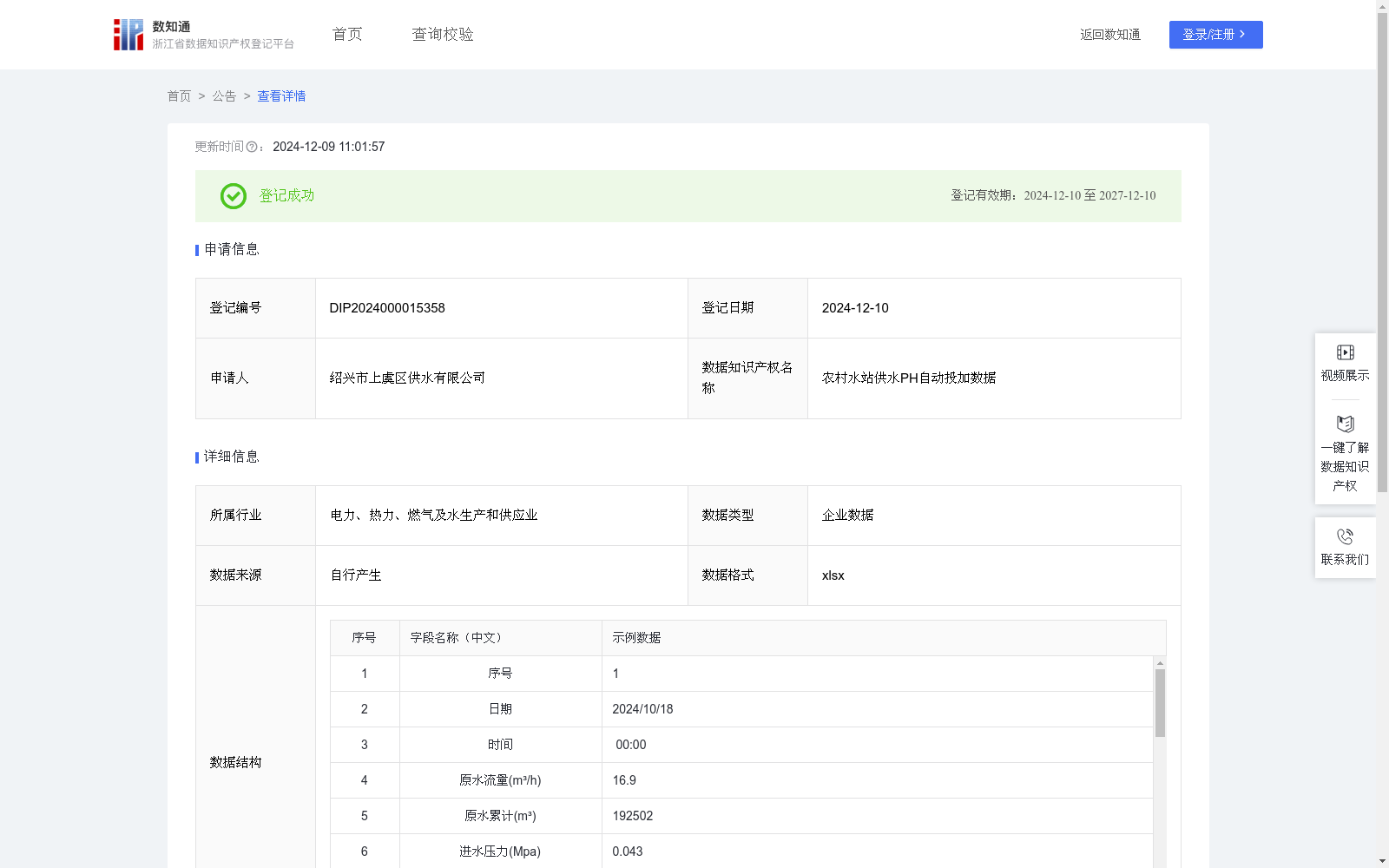
农村水站供水PH自动投加数据
收藏资源简介:
适用于提升农村水站的PH投加智能化控制精度,该数据综合考量了原水流量、累计量、进水压力、原水及出水浊度、出水PH值、余氯量以及PH投加流量等关键参数,作为训练和优化算法的基础,以提高PH调节过程的智能化控制精度,优化供水PH投加策略。同时,以实时出水水质监测数据作为反馈,进一步确保了供水水质的合规性与安全性。通过智能PH投加管理模型,农村饮用水系统能够实现对PH调节的精细化与高效化控制,有效降低化学药剂的消耗与水资源浪费,进一步保障了农村水站出水水质的安全。通过农饮水水站供水自动PH投加数据的实时监测与智能算法处理,实现供水PH值的精准调节与控制,优化药剂使用,保障水质稳定。 数据采集:利用农村水站内的各类传感器,如流量传感器、压力传感器、PH传感器及浊度传感器等,实时采集原水及出水的各项参数,包括原水流量、进水压力、原水及出水浊度、出水PH值以及PH投加流量等。 数据清洗:对采集到的数据集进行预处理,包括去除因设备故障或传输错误产生的异常数据,以及采用插值法或回归模型处理缺失值,确保数据集的完整性和准确性。 算法加工:基于清洗后的原水流量(m³/h), 出水PH, 原水累计(m³), 次钠投加流量(L/H), PAC投加流量(L/H),中间水箱液位(M)数据,运用XGBoost算法模型对PH投加过程进行建模与分析。通过拟合计算,预测并生成PH调节指令,以控制PH投加泵的工作状态。同时,实时采集出水PH值数据,与预设水质标准进行对比,动态调整PH投加量,确保出水水质持续稳定达标。
This dataset is developed to improve the intelligent control accuracy of pH dosing operations at rural water stations. It comprehensively covers key parameters including raw water flow rate, cumulative volume, inlet water pressure, raw and effluent turbidity, effluent pH value, residual chlorine concentration, and pH dosing flow rate, which serves as the foundational dataset for training and optimizing algorithms to enhance the intelligent control precision of pH regulation processes and optimize water supply pH dosing strategies. Meanwhile, real-time effluent water quality monitoring data is employed as feedback to further ensure the compliance and safety of water supply quality. Leveraging the intelligent pH dosing management model, rural drinking water systems can achieve precise and efficient control over pH regulation, effectively reducing the consumption of chemical agents and water resource waste, and further guaranteeing the safety of effluent water quality at rural water stations. Through real-time monitoring and intelligent algorithm processing of automatic pH dosing data for water supply at rural drinking water stations, precise regulation and control of water supply pH value can be realized, chemical agent usage is optimized, and water quality stability is maintained. Data Collection: Various sensors deployed in rural water stations, such as flow sensors, pressure sensors, pH sensors and turbidity sensors, are used to collect real-time parameters of raw water and effluent, including raw water flow rate, inlet water pressure, raw and effluent turbidity, effluent pH value, and pH dosing flow rate. Data Cleaning: Preprocessing is performed on the collected dataset, which involves removing abnormal data caused by equipment faults or transmission errors, and adopting interpolation methods or regression models to handle missing values, so as to ensure the integrity and accuracy of the dataset. Algorithm Processing: Based on the cleaned dataset including raw water flow rate (m³/h), effluent pH, raw water cumulative volume (m³), sodium hypochlorite dosing flow rate (L/H), PAC dosing flow rate (L/H), and liquid level of the intermediate water tank (M), the XGBoost algorithm model is applied to model and analyze the pH dosing process. Through fitting calculations, pH regulation instructions are predicted and generated to control the operating status of pH dosing pumps. Meanwhile, real-time effluent pH value data is collected and compared with preset water quality standards to dynamically adjust the pH dosing amount, ensuring that the effluent water quality continuously meets the specified standards stably.