青藏高原农牧业生产活动状况数据集之牲畜数量
收藏资源简介:
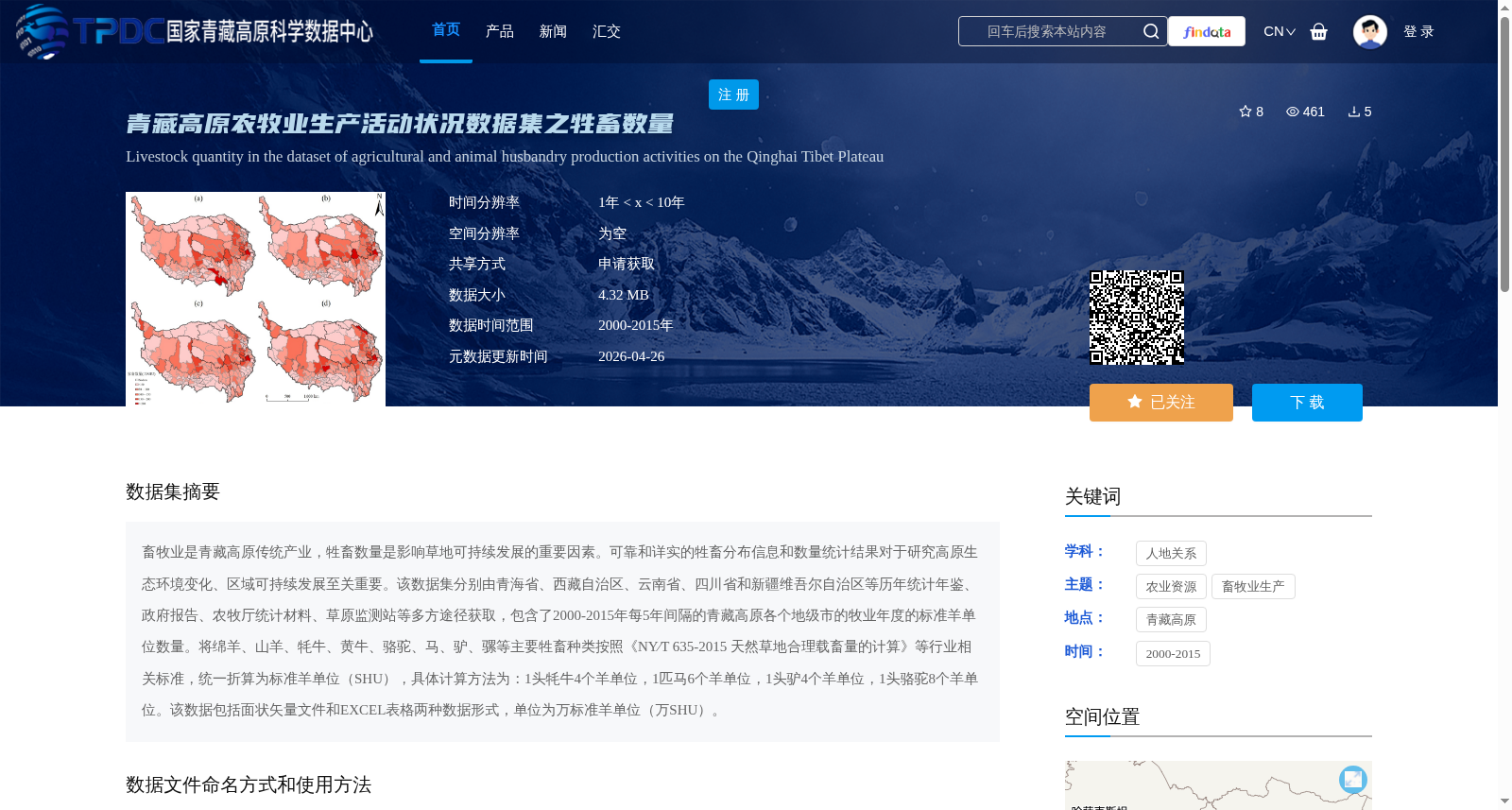
畜牧业是青藏高原传统产业,牲畜数量是影响草地可持续发展的重要因素。可靠和详实的牲畜分布信息和数量统计结果对于研究高原生态环境变化、区域可持续发展至关重要。该数据集分别由青海省、西藏自治区、云南省、四川省和新疆维吾尔自治区等历年统计年鉴、政府报告、农牧厅统计材料、草原监测站等多方途径获取,包含了2000-2015年每5年间隔的青藏高原各个地级市的牧业年度的标准羊单位数量。将绵羊、山羊、牦牛、黄牛、骆驼、马、驴、骡等主要牲畜种类按照《NY∕T 635-2015 天然草地合理载畜量的计算》等行业相关标准,统一折算为标准羊单位(SHU),具体计算方法为:1头牦牛4个羊单位,1匹马6个羊单位,1头驴4个羊单位,1头骆驼8个羊单位。该数据包括面状矢量文件和EXCEL表格两种数据形式,单位为万标准羊单位(万SHU)。
Animal husbandry is a traditional industry on the Qinghai-Tibet Plateau, and livestock population is a critical factor influencing the sustainable development of grasslands. Reliable and detailed livestock distribution information and quantitative statistics are of vital importance for researching changes in the plateau's ecological environment and regional sustainable development. This dataset was collected through multiple channels, including annual statistical yearbooks, government reports, statistical materials from agricultural and pastoral departments, and grassland monitoring stations from Qinghai Province, Tibet Autonomous Region, Yunnan Province, Sichuan Province, and Xinjiang Uygur Autonomous Region, among other regions. It contains the number of standard sheep units (SHU) in the annual livestock husbandry census of each prefecture-level city on the Qinghai-Tibet Plateau, at 5-year intervals between 2000 and 2015. Major livestock species including sheep, goat, yak, yellow cattle, camel, horse, donkey, and mule were uniformly converted to standard sheep units (SHU) in accordance with relevant industry standards such as the industry standard *NY/T 635-2015 Calculation of Rational Carrying Capacity of Natural Grassland*. The specific conversion coefficients are as follows: 1 yak = 4 standard sheep units, 1 horse = 6 standard sheep units, 1 donkey = 4 standard sheep units, and 1 camel = 8 standard sheep units. This dataset is provided in two formats: polygonal vector files and Excel spreadsheets, with the unit of ten thousand standard sheep units (10,000 SHU).