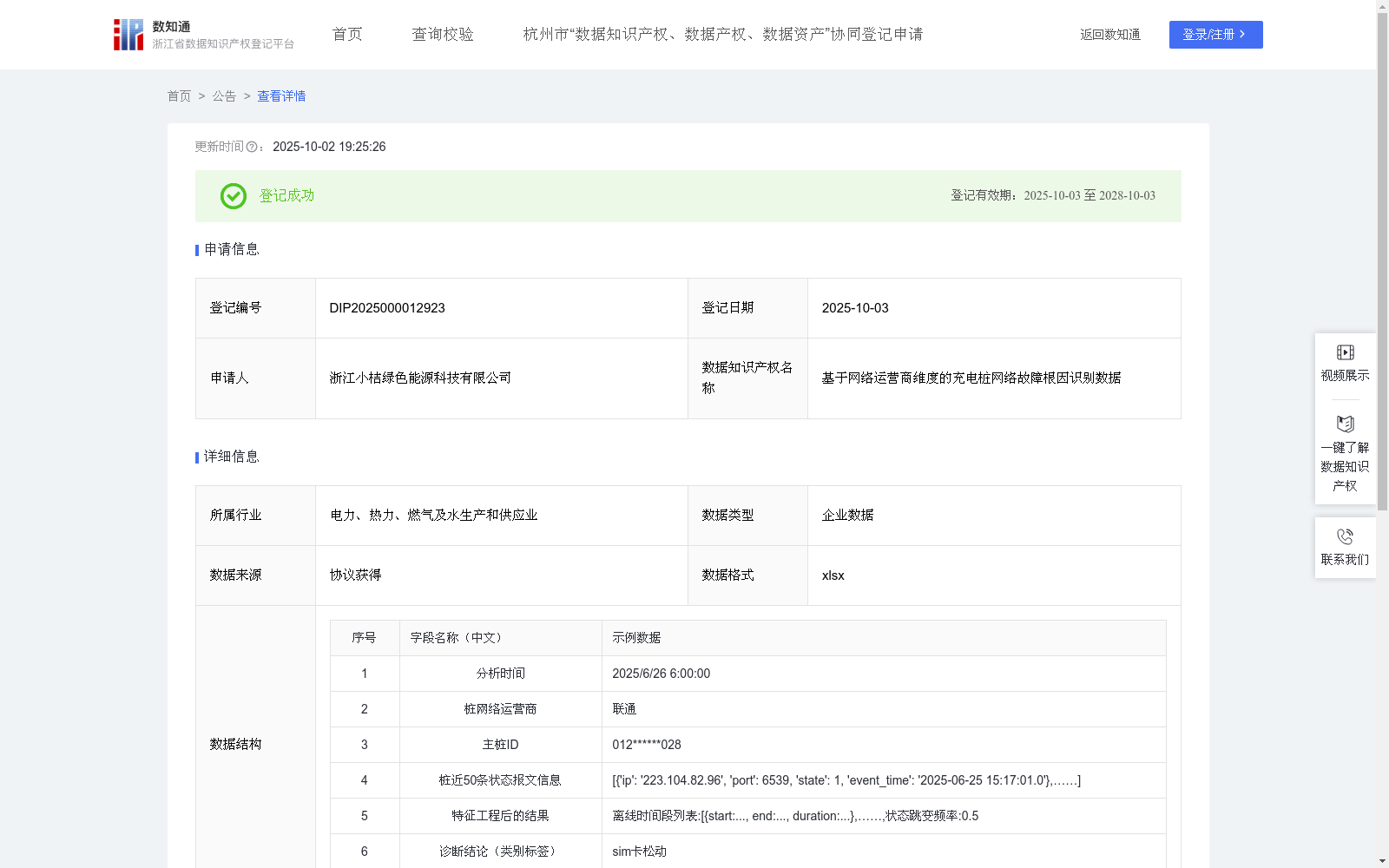
基于网络运营商维度的充电桩网络故障根因识别数据
收藏资源简介:
本数据集基于充电桩接入的网络运营商维度,结合设备状态报文序列,通过深度特征提取与聚类分析技术,实现对充电桩网络通信异常根因的自动识别与归因。具体应用场景如下: 1.对平台(即申请人)而言:可依据运营商维度的通信故障类型分布,精准定位网络故障瓶颈与重点影响区域,辅助制定针对性网络优化策略及跨运营商协调机制,提升整体网络稳定性和数据传输可靠性; 2.对场站商家而言:通过故障根因诊断标签,快速识别因网络运营商引发的异常问题,指导针对特定运营商环境优化设备配置和运维策略,减少因网络不畅导致的充电中断和客户投诉; 3.对政府而言:作为城市公共充电网络数字基础设施质量评估的重要指标,支持监测不同运营商在充电服务网络中的覆盖与稳定表现,助力政策制定与监管部门优化网络资源布局与服务保障措施。1.数据采集:原始数据经授权合法获取,按充电桩所接入的网络运营商维度采集充电桩网络通信异常相关字段,包括:分析时间、桩网络运营商、主桩ID、桩近50条状态报文信息。每条报文包含以下关键字段:桩状态(0表示离线,1表示正常)、上传时的IP地址(ip)、上传端口、上传时间。 2.特征提取:对状态报文信息进行解析,提取桩近50次报文中的通信状态序列、IP与端口变化、状态切换频次等,构建表征通信行为的数值特征。 3.特征建模:利用变分自编码器(VAE)对桩的通信特征进行建模,通过encoder提取每组样本的核心表示特征,用于描述其通信模式。 4.聚类分析:将VAE的输出特征与部分统计特征拼接后,使用k-means算法对设备进行聚类,初步划分不同的通信异常类型。 5.标签归因:对聚类结果进行线下验证确定故障原因,并作为诊断结论(类别标签)输出。
This dataset is developed based on the network operator dimension that charging piles access, combined with device status message sequences, and realizes the automatic identification and attribution of root causes of charging pile network communication anomalies through deep feature extraction and cluster analysis technologies. Specific application scenarios are as follows: 1. For the platform (i.e., the applicant): It can accurately locate network fault bottlenecks and key affected areas based on the distribution of communication fault types from the operator dimension, assist in formulating targeted network optimization strategies and cross-operator coordination mechanisms, and improve overall network stability and data transmission reliability; 2. For charging station merchants: They can quickly identify abnormal problems caused by network operators through fault root cause diagnosis tags, guide the optimization of device configurations and operation and maintenance strategies for specific operator environments, and reduce charging interruptions and customer complaints caused by poor network; 3. For the government: As an important indicator for the quality assessment of urban public charging network digital infrastructure, it supports monitoring the coverage and stability performance of different operators in the charging service network, and assists policy-making and regulatory authorities in optimizing network resource layout and service guarantee measures. 1. Data Collection: Original data is legally obtained with authorization. Fields related to charging pile network communication anomalies are collected according to the network operator dimension that the charging pile accesses, including: analysis time, network operator of the charging pile, main pile ID, and the last 50 status messages of the charging pile. Each message contains the following key fields: charging pile status (0 indicates offline, 1 indicates normal), IP address (ip) at the time of upload, upload port, and upload time. 2. Feature Extraction: Parse the status message information, extract the communication status sequence, IP and port changes, status switching frequency, etc. from the last 50 messages of the charging pile, and construct numerical features that characterize communication behaviors. 3. Feature Modeling: Model the communication features of the charging pile using Variational Autoencoder (VAE). The core representation features of each sample are extracted through the encoder to describe its communication pattern. 4. Cluster Analysis: After concatenating the output features of VAE with some statistical features, use the k-means algorithm to cluster the devices, and preliminarily classify different types of communication anomalies. 5. Label Attribution: Perform offline verification on the clustering results to determine the fault causes, and output them as diagnostic conclusions (category labels).