rq-bench
收藏资源简介:
RQ-Bench是一个基准数据集,用于评估语言模型基于背景文献提出研究问题的能力。它旨在填补现有评估空白,直接测试模型识别研究问题的能力,这是真实研究中先于想法生成的关键步骤。数据集包含1,434个研究问题,这些问题是基于746篇真实arXiv论文(目标论文)的动机和贡献框架提取而来,而非事后虚构。每个研究问题都与其引用的参考文献全文配对,这些参考文献是目标论文作为动机引用的先前工作。数据集要求模型仅基于引用的参考文献,预测出具体、可回答且基于这些参考文献所暴露差距的研究问题,然后与真实的研究问题进行比较。数据集包含两个主要部分:rq_dataset.jsonl文件包含研究问题记录及其元数据,cited_papers/目录包含1,375篇引用参考文献的全文(按章节组织)。研究问题覆盖13个计算机科学子领域(如cs.RO、cs.CV、cs.CL等),目标论文主要来自2025-2026年,降低了预训练语言模型的数据污染风险。每个研究问题记录包含唯一标识符、问题文本、源论文元数据(如标题、子领域、新颖性类型、主要想法、问题陈述等)以及基于引用文献的差距分析信息。该数据集主要用于基准测试研究问题生成、科学构思和文献基础推理模型,也可用于科学助手的微调/偏好学习,以及研究引用基础的差距分析。数据集的局限性包括仅涵盖计算机科学领域、目标论文时间偏近期、引用论文的章节结构可变,且研究问题是通过LLM辅助流程从论文框架中提取而非作者直接撰写。
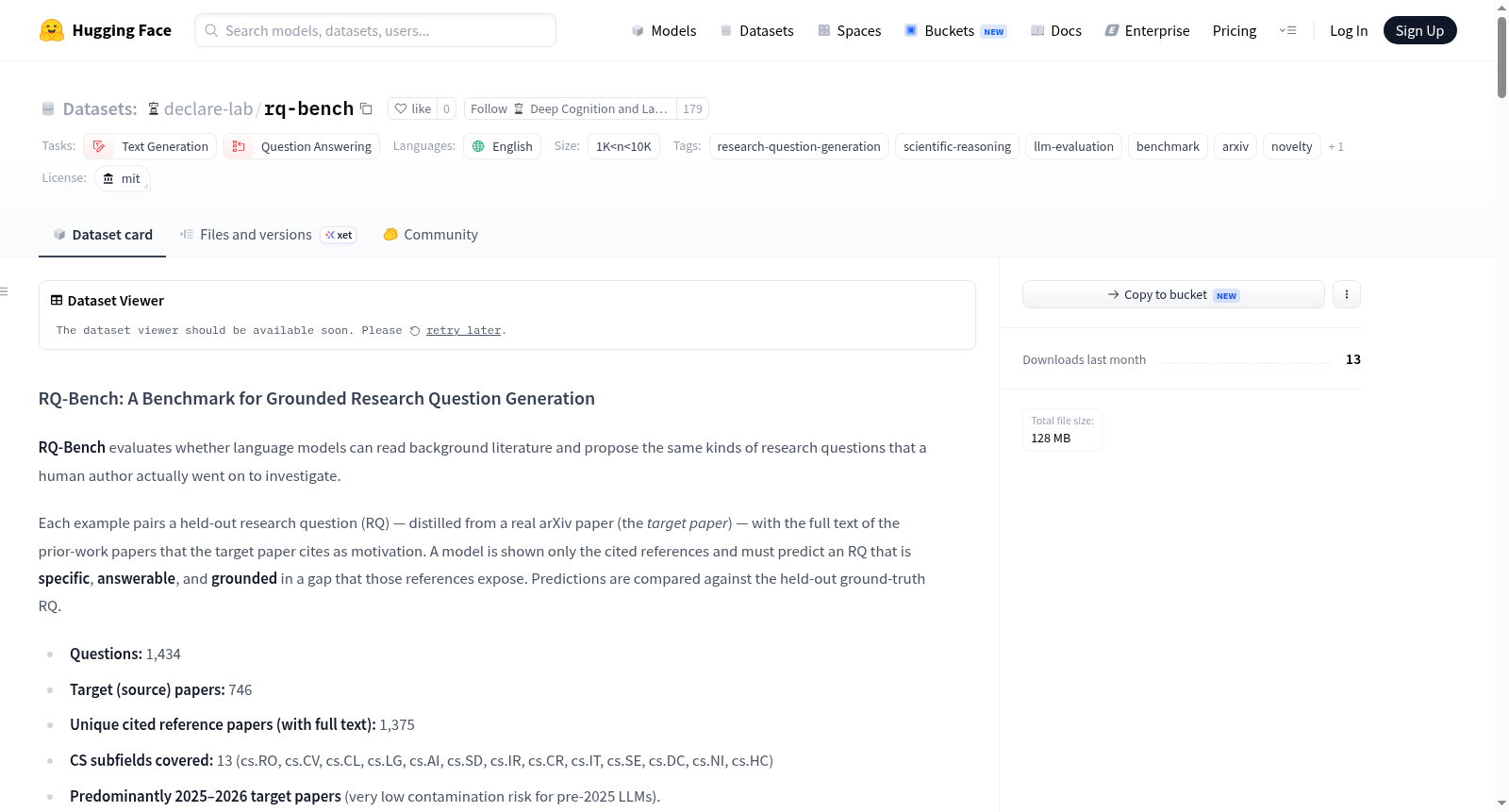
RQ-Bench is a benchmark dataset for evaluating the ability of language models to propose research questions based on background literature. It aims to fill existing evaluation gaps by directly testing models capability to identify research questions, a key step preceding idea generation in real research. The dataset contains 1,434 research questions extracted from the motivation and contribution frameworks of 746 real arXiv papers (target papers), rather than being fabricated post-hoc. Each research question is paired with the full text of its cited references, which are prior works cited by the target paper as motivation. The dataset requires models to predict specific, answerable research questions based solely on the cited references, exposing gaps in these references, and then compare them with the actual research questions. It consists of two main parts: the rq_dataset.jsonl file contains research question records and their metadata, and the cited_papers/ directory contains the full text of 1,375 cited references (organized by sections). The research questions cover 13 computer science subfields (e.g., cs.RO, cs.CV, cs.CL), with target papers primarily from 2025-2026, reducing the risk of data contamination in pre-trained language models. Each research question record includes a unique identifier, question text, source paper metadata (e.g., title, subfield, novelty type, main idea, problem statement), and gap analysis information based on the cited literature. The dataset is primarily used for benchmarking research question generation, scientific ideation, and literature-grounded reasoning models, as well as for fine-tuning/preference learning in scientific assistants and studying gap analysis in citation-based research. Limitations include coverage limited to computer science, recent target paper dates, variable section structures in cited papers, and research questions extracted via an LLM-assisted process from paper frameworks rather than being directly authored.
RQ-Bench 数据集概述
基本信息
- 数据集名称:RQ-Bench (A Benchmark for Grounded Research Question Generation)
- 许可证:MIT License
- 语言:英语
- 任务类型:文本生成、问答
- 数据集规模:1K < n < 10K
- 标签:研究问题生成、科学推理、大语言模型评估、基准、新颖性、文献综述
数据集核心目标
RQ-Bench 用于评估语言模型能否阅读背景文献,并提出与人类作者实际研究的科研问题相似的问题。每个样本将真实 arXiv 论文中提炼出的研究问题(ground-truth RQ)与目标论文引用的先前工作文献全文配对,模型仅依据引用文献预测研究问题。
数据集规模与统计
| 统计项 | 数值 |
|---|---|
| 研究问题总数 | 1,434 |
| 目标论文数 | 746 |
| 唯一引用文献数 | 1,375 |
| 引用论文 JSON 文件数 | 1,375 |
| 计算机学子领域数 | 13 |
| 新颖性类型 | 3种(方法型 / 应用型 / 组合型) |
各子领域问题分布
- cs.RO: 245
- cs.CV: 222
- cs.CL: 173
- cs.LG: 162
- cs.AI: 146
- cs.SD: 115
- cs.IR: 92
- cs.CR: 75
- cs.IT: 69
- cs.SE: 67
- cs.DC: 36
- cs.NI: 19
- cs.HC: 13
问题分布详情
- 每篇目标论文的问题数:1个(229篇)、2个(361篇)、3个(141篇)、4个(15篇),平均约1.92个
- 每个问题引用的参考文献数:1篇(752个)、2篇(439个)、3篇(164个)、4篇(61个)、5篇(12个)、6篇(4个)、7篇(2个),平均约1.72篇
- 每个问题的缺口数:平均约2.20个,最大11个,总缺口数3,151个
- 问题长度:平均24.7词,中位数24词,范围14-50词
数据集结构
文件组织
rq-bench/ ├── README.md ├── rq_dataset.jsonl # 1,434行,每行一个研究问题记录 └── cited_papers/ # 1,375篇引用文献,按章节划分全文 ├── 1011.0686.json ├── 1303.3679.json └── ...
rq_dataset.jsonl 字段说明
| 字段 | 类型 | 描述 |
|---|---|---|
rq_id |
str | 稳定标识符,格式 <arxiv_id>_rq<index> |
question |
str | 真实研究问题(对模型隐藏) |
source_paper |
dict | 目标论文元数据 |
source_paper.paper_id |
str | Semantic Scholar 论文ID |
source_paper.arxiv_id |
str | 目标论文arXiv标识符 |
source_paper.title |
str | 论文标题 |
source_paper.subfield |
str | arXiv CS子领域 |
source_paper.novelty_type |
str | 新颖性类型 |
source_paper.main_idea.headline |
str | 论文核心思想概述 |
source_paper.main_idea.contributions |
list[str] | 作者宣称的贡献列表 |
source_paper.problem |
str | 论文问题陈述 |
source_paper.venue_info |
dict | 发表信息(venue, venue_type, venue_id, year) |
grounded_in_refs |
list[dict] | 引用参考文献列表 |
grounded_in_refs[].arxiv_id |
str | 引用文献的arXiv ID |
grounded_in_refs[].gaps |
list[dict] | 引用文献遗留的缺口 |
grounded_in_refs[].gaps[].limitation |
str | 具体局限性 |
grounded_in_refs[].gaps[].evidence_quote |
str | 目标论文中证明缺口的原话 |
grounded_in_refs[].gaps[].evidence_source |
str | 证据来源章节 |
grounded_in_refs[].gaps[].target_relation |
str | 目标论文如何解决该缺口 |
cited_papers/<arxiv_id>.json 字段说明
每份文件至少包含:
| 字段 | 描述 |
|---|---|
arxiv_id |
与文件名匹配的arXiv ID |
title |
论文标题 |
abstract |
论文摘要 |
<SECTION_NAME> |
各章节全文(如INTRODUCTION、PRELIMINARIES、EXPERIMENTS等) |
数据集特点
- 仅评估集:仅包含
test划分,无训练/验证集 - 作者锚定:每个真实研究问题均从真实 arXiv 论文中提取
- 引用锚定:每个问题附带具体的引用文献、原文引用证据以及解决方案描述
- 低污染风险:目标论文主要为2025-2026年,对2025年之前的LLM污染风险很低
使用场景
适用场景
- 研究问题生成、科学构思和文献推理模型的基准测试
- 科学助手的微调/偏好学习(利用 cited_papers, gaps, question 三元组)
- 引文锚定的缺口分析研究
不适用场景
- 预测目标论文的标题、完整方法或实验结果
- 超出所列13个CS子领域的文本任务
- 作为arXiv论文摘要生成的训练语料
局限性
- 仅限CS领域:所有13个子领域均为arXiv CS类别,不包含生物医学或物理科学问题
- 时间分布不均:目标论文主要来自2025-2026年
- 章节结构不统一:引用文献JSON文件的键为论文专属章节标题
- 非作者原始撰写:真实研究问题由LLM辅助提取,非作者直接撰写
- 缺口文本自动提取:部分字段为模型生成的改写,非人工审校
引用信息
@misc{rqbench2026, title = {The Novelty Mirage: RQBench and the Limits of LLM-as-Judge for Scientific Research Questions}, author = {Sinhahajari, Soumitra and Majumder, Navonil and Poria, Soujanya}, year = {2026}, howpublished = {url{https://huggingface.co/datasets/declare-lab/rq-bench}} }
维护方
南洋理工大学深度认知与语言研究实验室(DeCLaRe Lab)