five

Lekim89/MOT17

收藏
Hugging Face2026-05-29 更新2026-05-31 收录
下载链接:
https://hf-mirror.com/datasets/Lekim89/MOT17
下载链接
链接失效反馈
官方服务:
资源简介:
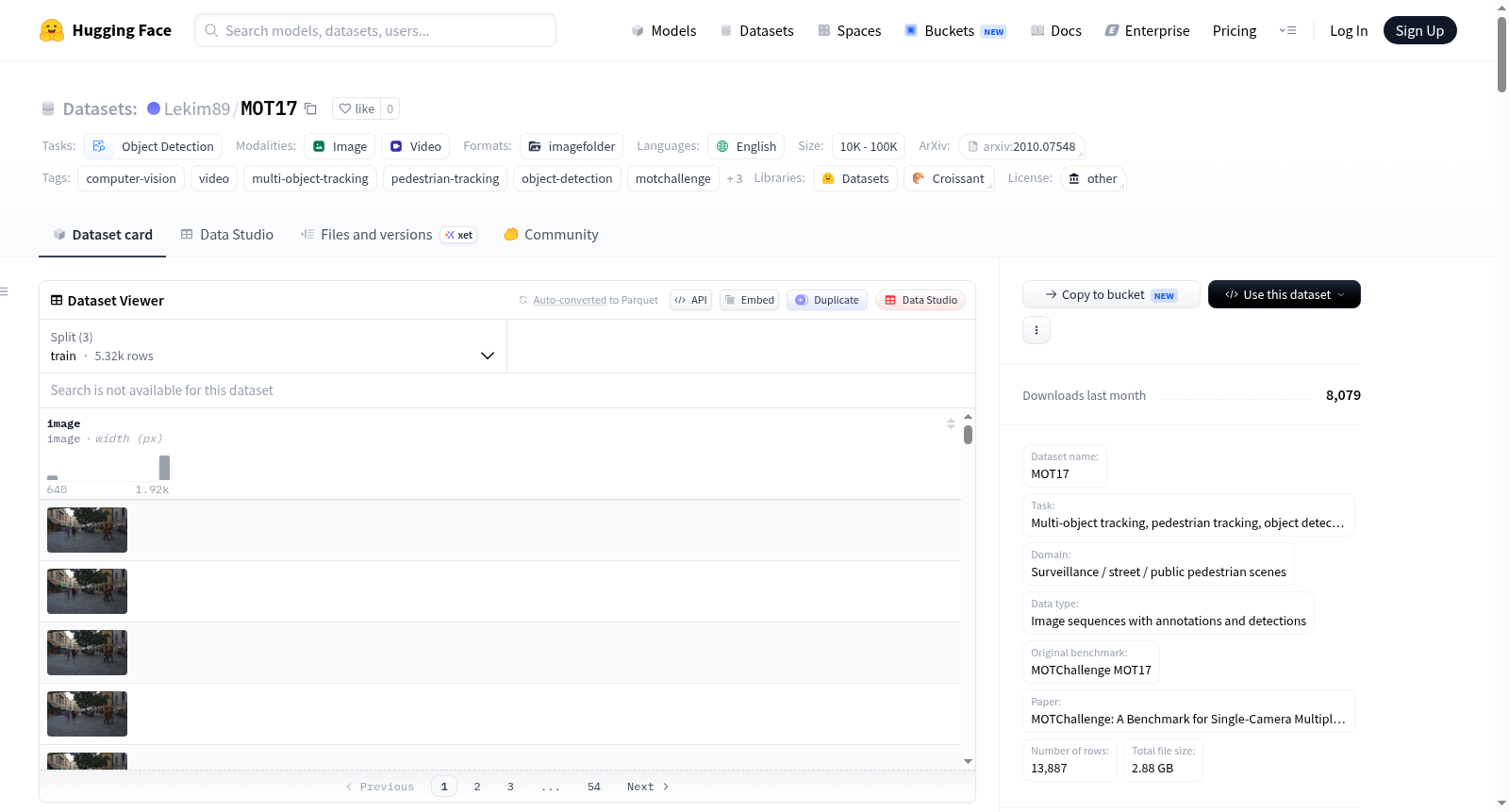
--- pretty_name: "MOT17" language: - en license: other task_categories: - object-detection tags: - computer-vision - video - multi-object-tracking - pedestrian-tracking - object-detection - motchallenge - mot17 - tracking - datasets size_categories: - 10K<n<100K --- # MOT17 MOT17 is a benchmark dataset for **single-camera multi-object tracking (MOT)**, focused primarily on pedestrian tracking in real-world video sequences. This Hugging Face repository provides the MOT17 data in the original MOTChallenge-style structure for research, benchmarking, training, and evaluation of multi-object tracking systems. MOT17 extends MOT16 with more accurate ground-truth annotations and provides each sequence with three public detection sets: - **DPM** - **Faster R-CNN / FRCNN** - **SDP** > This repository is a convenience mirror/repackaging of MOT17. Please cite the original MOTChallenge work and follow the original dataset terms and conditions. ## Dataset Details ### Dataset Description - **Dataset name:** MOT17 - **Task:** Multi-object tracking, pedestrian tracking, object detection - **Domain:** Surveillance / street / public pedestrian scenes - **Data type:** Image sequences with annotations and detections - **Original benchmark:** [MOTChallenge MOT17](https://motchallenge.net/data/MOT17/) - **Paper:** [MOTChallenge: A Benchmark for Single-Camera Multiple Target Tracking](https://arxiv.org/abs/2010.07548) MOT17 contains the same underlying image sequences as MOT16, but with updated ground truth and detector outputs. Each sequence is supplied with detections from DPM, Faster R-CNN, and SDP, which enables comparison of trackers under different detection-quality settings. ### Supported Tasks This dataset can be used for: - Multiple Object Tracking (MOT) - Multi-pedestrian tracking - Tracking-by-detection research - Pedestrian detection - Re-identification-assisted tracking - MOT benchmark conversion and evaluation pipelines ## Dataset Structure A typical MOT17 repository follows the official MOTChallenge folder layout: ```text MOT17/ ├── train/ │ ├── MOT17-02-DPM/ │ ├── MOT17-02-FRCNN/ │ ├── MOT17-02-SDP/ │ ├── MOT17-04-DPM/ │ ├── ... │ └── MOT17-13-SDP/ ├── test/ │ ├── MOT17-01-DPM/ │ ├── MOT17-01-FRCNN/ │ ├── MOT17-01-SDP/ │ ├── ... │ └── MOT17-14-SDP/ └── README.md ``` Each sequence directory typically contains: ```text MOT17-XX-DET/ ├── img1/ # Video frames as image files ├── det/ # Public detections │ └── det.txt ├── gt/ # Ground-truth annotations; training split only │ └── gt.txt └── seqinfo.ini # Sequence metadata ``` Where `DET` is one of: - `DPM` - `FRCNN` - `SDP` ## Splits ### Training Sequences The MOT17 training split contains 7 base video sequences, each provided with DPM, FRCNN, and SDP detections, resulting in 21 sequence-detector folders. Base training sequences: - `MOT17-02` - `MOT17-04` - `MOT17-05` - `MOT17-09` - `MOT17-10` - `MOT17-11` - `MOT17-13` ### Test Sequences The MOT17 test split contains 7 base video sequences, each provided with DPM, FRCNN, and SDP detections, resulting in 21 sequence-detector folders. Base test sequences: - `MOT17-01` - `MOT17-03` - `MOT17-06` - `MOT17-07` - `MOT17-08` - `MOT17-12` - `MOT17-14` ## Annotation Format MOT17 uses the standard MOTChallenge comma-separated text format. ### Ground Truth Format Training annotations are stored in: ```text gt/gt.txt ``` Each row generally follows: ```text <frame>, <id>, <bb_left>, <bb_top>, <bb_width>, <bb_height>, <conf>, <class>, <visibility> ``` Field descriptions: | Field | Description | |---|---| | `frame` | Frame index, starting from 1 | | `id` | Object identity ID | | `bb_left` | Left coordinate of bounding box | | `bb_top` | Top coordinate of bounding box | | `bb_width` | Bounding-box width | | `bb_height` | Bounding-box height | | `conf` | Confidence flag for ground truth | | `class` | Object class label | | `visibility` | Visibility ratio / visibility flag | ### Detection Format Public detections are stored in: ```text det/det.txt ``` Each row generally follows: ```text <frame>, <id>, <bb_left>, <bb_top>, <bb_width>, <bb_height>, <conf>, <x>, <y>, <z> ``` For detection files, `id` is commonly set to `-1`, and the final world-coordinate fields may be unused depending on the detector or sequence. ## Usage ### Download from Hugging Face ```python from huggingface_hub import snapshot_download repo_dir = snapshot_download( repo_id="YOUR_USERNAME_OR_ORG/MOT17", repo_type="dataset", ) print(repo_dir) ``` Replace `YOUR_USERNAME_OR_ORG/MOT17` with the actual Hugging Face dataset repository ID. ### Example: Read MOTChallenge Annotations with Python ```python from pathlib import Path import pandas as pd seq_dir = Path("MOT17/train/MOT17-02-FRCNN") gt_path = seq_dir / "gt" / "gt.txt" gt = pd.read_csv( gt_path, header=None, names=[ "frame", "id", "bb_left", "bb_top", "bb_width", "bb_height", "conf", "class", "visibility", ], ) print(gt.head()) ``` ### Example: Iterate Over Frames ```python from pathlib import Path img_dir = Path("MOT17/train/MOT17-02-FRCNN/img1") frames = sorted(img_dir.glob("*.jpg")) print(f"Number of frames: {len(frames)}") print(frames[:5]) ``` ## Evaluation For official MOTChallenge-style evaluation, use the MOTChallenge evaluation protocol and compatible tools such as TrackEval. Typical predicted tracking result format: ```text <frame>, <id>, <bb_left>, <bb_top>, <bb_width>, <bb_height>, <conf>, <x>, <y>, <z> ``` Common MOT metrics include: - MOTA - MOTP - IDF1 - HOTA - FP / FN / ID switches - Mostly Tracked / Mostly Lost trajectories Official benchmark submissions should be made through the MOTChallenge platform, not through this Hugging Face repository. ## Intended Use This dataset is intended for: - Academic and industrial research in multi-object tracking - Benchmarking MOT algorithms - Studying detector quality and its impact on tracking - Developing tracking-by-detection pipelines - Training and validating pedestrian tracking systems ## Limitations and Responsible Use MOT17 contains real-world pedestrian scenes. Users should consider privacy, surveillance, and fairness implications when training or deploying models using this dataset. Known limitations include: - The dataset focuses on pedestrian-heavy urban and public scenes. - Tracking performance may vary strongly with detector choice. - The dataset is not representative of all countries, camera types, lighting conditions, or pedestrian demographics. - Test-set ground truth is not included in the public dataset release. - Models trained on MOT17 should be evaluated carefully before deployment in real-world surveillance or safety-critical systems. ## Licensing and Redistribution The license metadata for this Hugging Face dataset card is set to: ```yaml license: other ``` Please refer to the original MOTChallenge website for the authoritative dataset access terms, redistribution rules, and citation requirements. Do not assume this mirror grants rights beyond those provided by the original dataset owners. ## Citation Please cite the MOTChallenge benchmark paper if you use this dataset: ```bibtex @article{dendorfer2020motchallenge, title={MOTChallenge: A Benchmark for Single-Camera Multiple Target Tracking}, author={Dendorfer, Patrick and Osep, Aljosa and Milan, Anton and Schindler, Konrad and Cremers, Daniel and Reid, Ian and Roth, Stefan and Leal-Taixe, Laura}, journal={International Journal of Computer Vision}, year={2020}, doi={10.1007/s11263-020-01393-0} } ``` You may also cite the earlier MOT16/MOTChallenge references listed on the official MOT17 page when appropriate. ## References - MOTChallenge MOT17: https://motchallenge.net/data/MOT17/ - MOTChallenge paper: https://arxiv.org/abs/2010.07548 - MOTChallenge website: https://motchallenge.net/
提供机构:
Lekim89
搜集汇总
数据集介绍
main_image_url
构建方式
MOT17作为多目标跟踪领域的权威基准数据集,聚焦于真实街景监控场景中的行人跟踪任务。该数据集沿用了MOT16的图像序列,但提供了更为精确的标注信息,并创新性地为每个视频序列配发了三种不同检测器(DPM、Faster R-CNN及SDP)生成的公共检测结果。数据集严格遵循MOTChallenge标准目录结构,将视频帧、检测结果及标注文件分别存放,训练集与测试集各包含7个基础视频序列,每个序列均以三种检测器版本独立组织,共计42个序列文件夹,为跟踪算法的跨检测器性能评估提供了标准化平台。
特点
该数据集的核心特色在于其多检测器对比设计,通过统一场景下DPM、Faster R-CNN与SDP三种检测器的输出,使研究者能够系统评估检测质量对多目标跟踪算法的影响。标注信息采用MOTChallenge标准格式,包含帧号、目标ID、边界框坐标及可见性比率等关键属性,且训练集与测试集在场景复杂度和目标密度上保持差异。此外,数据集中行人的类间与类内遮挡情况丰富,真实反映了城市监控中的典型挑战,为跟踪、检测及重识别等任务提供了兼具广度与深度的验证环境。
使用方法
研究者可通过Hugging Face平台使用snapshot_download函数便捷下载完整数据集,随后利用Python的pandas库解析gt.txt中的地面真值标注。检测文件det.txt同样采用逗号分隔的文本格式,可直接导入进行分析。对于模型评估,建议使用TrackEval等兼容MOTChallenge协议的工具,计算MOTA、IDF1及HOTA等标准化指标。值得注意的是,该数据集的测试集版本不公开真值,研究者需通过官方MOTChallenge平台提交结果以获得评估反馈,确保基准测试的公平性与权威性。
背景与挑战
背景概述
MOT17是MOTChallenge基准套件中的核心数据集,由Dendorfer、Osep、Milan等多位学者共同构建,发表于2020年。该数据集聚焦于单摄像头多目标跟踪(MOT)任务,特别面向真实世界视频序列中的行人跟踪场景。其核心研究问题在于评估与比较多目标跟踪算法在复杂监控环境下的综合性能。MOT17在MOT16的基础上进一步优化了真实标注质量,并为每个视频序列提供DPM、Faster R-CNN和SDP三种公共检测器结果,从而支持跟踪器在不同检测质量下的稳健性分析与公平比较。该数据集已成为学术研究与工业界在行人跟踪、检测驱动跟踪及重识别辅助跟踪等领域的重要标杆,对多目标跟踪方法的演进产生了深远影响。
当前挑战
MOT17所解决的领域问题在于多目标跟踪面临的根本性挑战,包括目标间频繁遮挡、身份切换、动态光照条件下检测质量波动以及复杂场景中的轨迹一致性维持。这些因素使得精确且鲁棒的跟踪系统设计极具难度。构建过程中,MOT17面临的主要挑战包括:对不同检测器质量(DPM、Faster R-CNN、SDP)生成的误报和漏检轨迹进行人工审核与纠正,以获得高一致性标注;在多样化监控场景中采集与标注大量连续帧,确保时空标注的连贯性与准确性;以及界定测试集与训练集,保护测试集真实标注的隐蔽性,以避免过拟合与评价偏差。
常用场景
经典使用场景
MOT17数据集是单摄像头多目标跟踪(MOT)领域的经典基准,其核心应用在于评估和比较跟踪算法在真实世界视频序列中的性能。该数据集主要聚焦于行人跟踪场景,包含7个训练和7个测试视频序列,每个序列都提供了三种不同检测器(DPM、Faster R-CNN、SDP)的公共检测结果,为研究者提供了在统一框架下探究检测质量对跟踪性能影响的独特视角。通过MOT17,研究人员能够系统性地测试和优化跟踪-检测联合框架(tracking-by-detection),推动模型在复杂行人密集环境下的鲁棒性和精度提升。该数据集还常用于评估诸如MOTA、MOTP、IDF1和HOTA等关键指标,是衡量多目标跟踪算法进步的重要标尺。
实际应用
在实际应用中,MOT17数据集所驱动的技术成果广泛应用于智能视频监控、自动驾驶感知系统和人群行为分析等领域。例如,基于MOT17训练的跟踪算法能够在交通枢纽、商场或十字路口等复杂场景中实时、准确地追踪多个行人轨迹,为公共安全预警、客流统计和异常行为检测提供关键技术支撑。在自动驾驶领域,稳健的行人多目标跟踪能力使车辆能够精准预测周边行人动向,显著提升行车安全。此外,该数据集还促进了视觉引导的人机交互系统发展,如服务机器人可在动态环境中持续追踪并响应多个用户。这些实际部署不仅验证了算法的泛化能力,也证明了MOT17作为测试床对于从学术研究向工业应用转化的核心价值。
衍生相关工作
MOT17数据集衍生了许多具有深远影响的经典工作。在其基础上,研究者提出了FairMOT,通过联合学习目标检测和重识别特征实现了实时且高性能的跟踪效果。另一个代表性工作是ByteTrack,它创新性地利用每个检测框的置信度进行多阶段关联,极大降低了遮挡场景下的身份切换错误。此外,TransTrack引入Transformer架构进行端到端的轨迹预测与关联,展示了自注意力机制在时序建模中的潜力。还有BOT-SORT等算法,通过融合运动模型和外观特征进一步提升了跟踪鲁棒性。这些工作不仅在MOT17排行榜上取得领先成绩,更深刻塑造了领域的发展脉络,推动了多目标跟踪从传统贝叶斯方法向现代深度学习范式的全面演进。
以上内容由遇见数据集搜集并总结生成
二维码
社区交流群
二维码
科研交流群
商业服务