体温测量数据集
收藏资源简介:
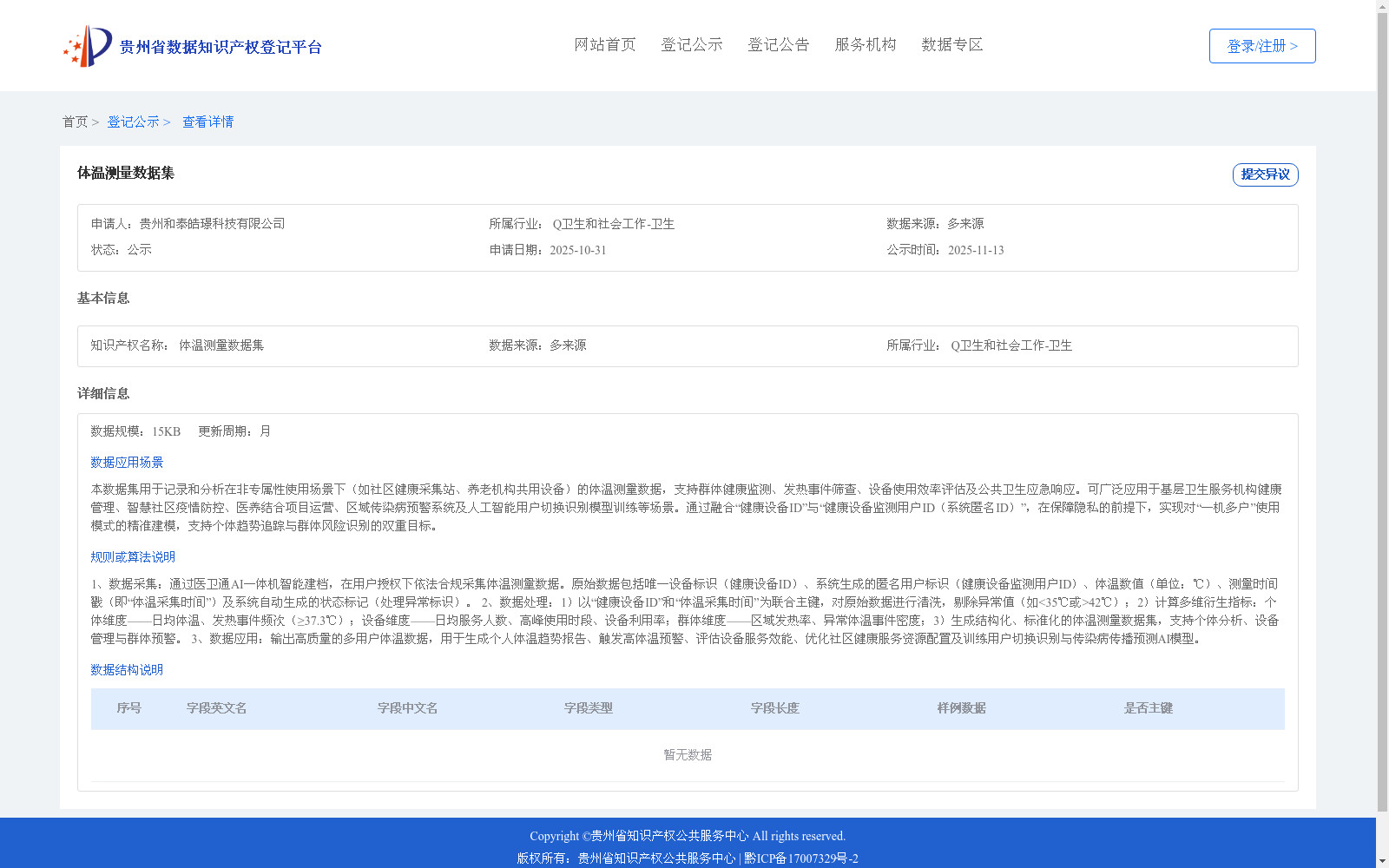
1、数据采集:通过医卫通AI一体机智能建档,在用户授权下依法合规采集体温测量数据。原始数据包括唯一设备标识(健康设备ID)、系统生成的匿名用户标识(健康设备监测用户ID)、体温数值(单位:℃)、测量时间戳(即“体温采集时间”)及系统自动生成的状态标记(处理异常标识)。 2、数据处理:1)以“健康设备ID”和“体温采集时间”为联合主键,对原始数据进行清洗,剔除异常值(如<35℃或>42℃);2)计算多维衍生指标:个体维度——日均体温、发热事件频次(≥37.3℃);设备维度——日均服务人数、高峰使用时段、设备利用率;群体维度——区域发热率、异常体温事件密度;3)生成结构化、标准化的体温测量数据集,支持个体分析、设备管理与群体预警。 3、数据应用:输出高质量的多用户体温数据,用于生成个人体温趋势报告、触发高体温预警、评估设备服务效能、优化社区健康服务资源配置及训练用户切换识别与传染病传播预测AI模型。
1. Data Collection: Body temperature measurement data is collected in compliance with applicable laws and regulations with explicit user authorization via the Yiwitong AI All-in-One Device for intelligent health record creation. The raw data includes unique device identifier (Health Device ID), system-generated anonymous user identifier (Health Device Monitoring User ID), body temperature value (unit: ℃), measurement timestamp (i.e., "body temperature collection time"), and system-generated status marker (processing abnormality flag). 2. Data Processing: 1) Clean the raw data with "Health Device ID" and "body temperature collection time" as the composite primary key, and remove outliers (e.g., values <35℃ or >42℃); 2) Calculate multi-dimensional derived metrics: Individual-level: daily average body temperature, frequency of fever events (body temperature ≥37.3℃); Device-level: daily average number of served users, peak usage hours, device utilization rate; Population-level: regional fever rate, density of abnormal body temperature events; 3) Generate a structured and standardized body temperature measurement dataset that supports individual analysis, device management and population-level early warning. 3. Data Application: High-quality multi-user body temperature data is output, which is used to generate individual body temperature trend reports, trigger high-body-temperature early warnings, evaluate device service effectiveness, optimize the allocation of community health service resources, and train AI models for user switching recognition and infectious disease transmission prediction.