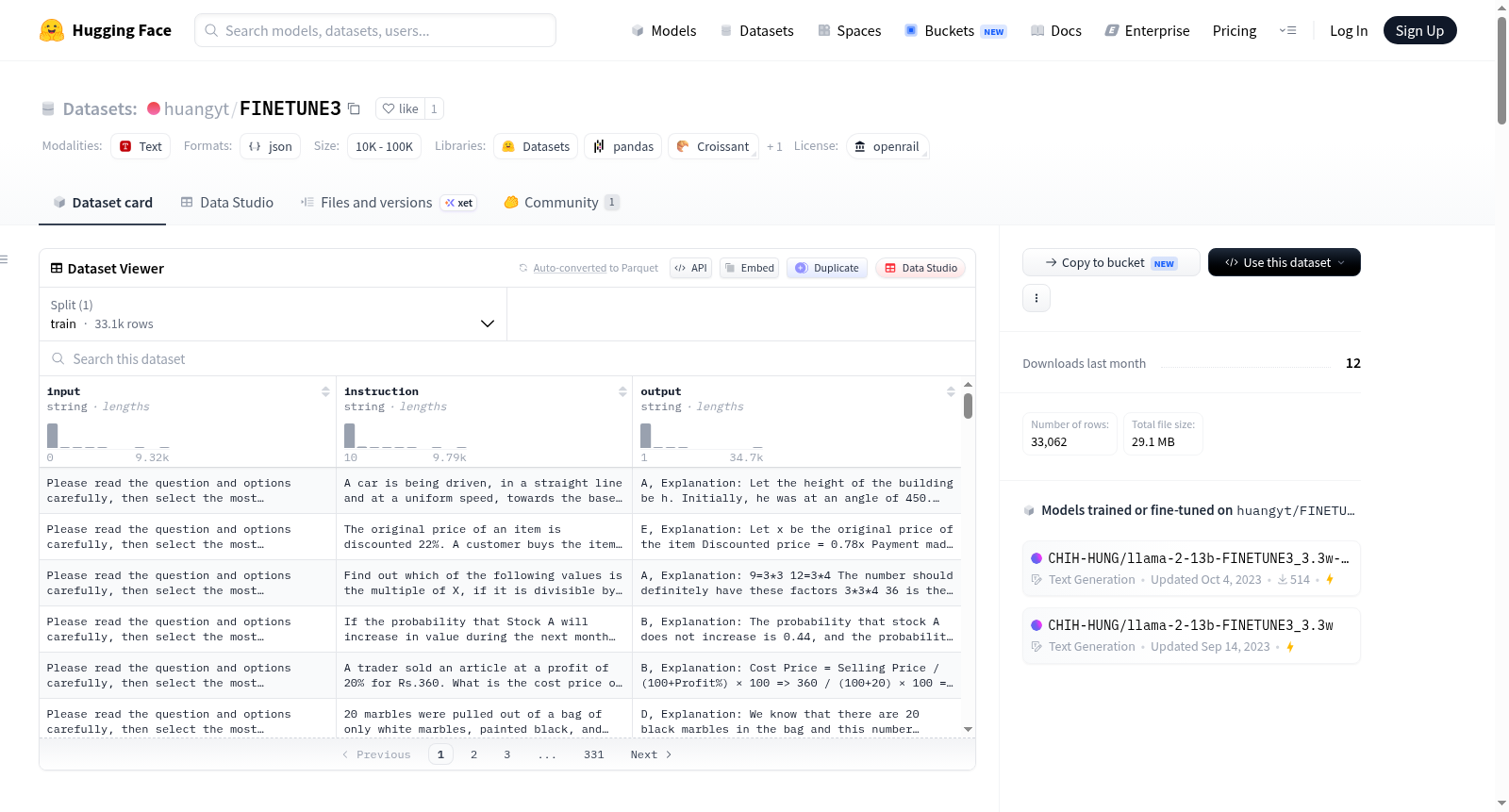
huangyt/FINETUNE3
收藏资源简介:
该数据集由多个子集组成,包括FLAN_CoT(zs)、Prm800k、ScienceQA等,涵盖了推理、数学、科学问答、常识等多个类别。每个子集的问题数量从100到8000不等。数据集的格式定义为instruction、input、output,用于指导模型执行特定任务。采样算法部分详细描述了如何从FLAN_V2 COT数据集中筛选和分层采样,以确保数据集的多样性和高质量。
This dataset comprises multiple subsets, including FLAN_CoT(zs), Prm800k, ScienceQA, and others, covering various categories such as reasoning, mathematics, scientific question answering, and common sense. The number of questions in each subset ranges from 100 to 8000. The dataset is structured with three standard fields: instruction, input, and output, which are designed to guide models in executing specific tasks. The sampling algorithm section elaborates on the process of filtering and stratified sampling from the FLAN_V2 COT dataset to ensure the diversity and high quality of the dataset.
数据集概述
数据集列表
| 数据集 | 类别 | 问题数量 |
|---|---|---|
| FLAN_CoT(zs) | Reasoning、MATH、ScienceQA、Commonsense | 8000 |
| Prm800k | Reasoning、MATH | 6713 |
| ScienceQA | ScienceQA | 5177 |
| SciBench | ScienceQA | 695 |
| ReClor | Reasoning | 1624 |
| TheoremQA | Commonsense、MATH、ScienceQA | 800 |
| OpenBookQA | Text_Understanding、Reasoning、Commonsense、ScienceQA | 5957 |
| ARB | Reasoning、MATH、ScienceQA、Commonsense、Text_Understanding | 605 |
| Openassistant-guanaco | Commonsense、Text_Understanding、Reasoning | 802 |
| SAT | Text_Understanding、Reasoning、MATH | 426 |
| GRE、GMAT | Reasoning、MATH | 254 |
| AMC、AIME | Reasoning、MATH | 1000 |
| LSAT | Reasoning、LAW | 1009 |
数据集格式定义
数据集采用“instruction、input、output”格式,每个样本包括一个指令、一个输入和一个预期的输出。指令提供了如何处理输入以生成输出的指导。这种格式的数据集通常用于训练模型执行特定任务,因为它们明确指示了模型应执行的操作。
示例格式: json { "input": "", "output": "", "instruction": "" }
数据集配置
-
SAT、GRE、GMAT、AMC、AIME、LSAT:
- 对于GRE、GMAT、SAT等数据集,输入配置为“请仔细阅读问题和选项,然后选择最合适的答案并提供相应的解释。”
- 对于数学输入,配置为“请根据给定的问题提供答案及相应的解释。”
- 问题按难度级别升序排列。
- LSAT数据集不涉及逐步过程,将段落转换为指令,问题和选项组合为输入,标签作为输出。
-
其他数据集:
- Prm800k、ScienceQA、SciBench、ReClor、TheoremQA、OpenBookQA、ARB和OpenAssistant-Guanaco数据集采用与Platypus相同的格式。
采样算法
- 从flan_v2 cot数据集中选择zs_opt问题。
- 过滤掉输出长度超过平均长度的问题,以帮助模型学习更丰富的推理步骤。
- 进行分层采样,先进行长度过滤,然后进行分层采样,以确保样本大小一致。
采样算法示例代码: python import json import random
with open("cot_ORIGINAL.json", "r") as f: abc = json.load(f)
zsopt_data = [] # "zs_opt" for i in abc: if i["template_type"] == "zs_opt": zsopt_data.append(i)
output_lengths = [len(i["targets"]) for i in zsopt_data] average_length = sum(output_lengths) / len(output_lengths) # average length
filtered_data = [] for a in zsopt_data: if len(a["targets"]) >= average_length: filtered_data.append(a) # output length need to >= average_length
class_counts = {} # Count the number of samples for each class for a in filtered_data: task_name = a["task_name"] if task_name in class_counts: class_counts[task_name] += 1 else: class_counts[task_name] = 1
total_samples = 8000 # we plan to select a total of 8000 samples
sample_ratios = {} for task_name, count in class_counts.items(): sample_ratios[task_name] = count / len(filtered_data)
sample_sizes = {} for task_name, sample_ratio in sample_ratios.items(): sample_sizes[task_name] = round(sample_ratio * total_samples)
stratified_samples = {} # Perform stratified sampling for each class for task_name, sample_size in sample_sizes.items(): class_samples = [] for data in filtered_data: if data["task_name"] == task_name: class_samples.append(data)
selected_samples = random.sample(class_samples, sample_size)
stratified_samples[task_name] = selected_samples
final_samples = [] # Convert to the specified format for task_name, samples in stratified_samples.items(): for sample in samples: final_samples.append( { "input": "", # use "" "output": sample["targets"], # output "instruction": sample["inputs"], # question } )
with open("cot_change.json", "w") as f: json.dump(final_samples, f, indent=2)
LSAT按级别排列的示例代码: python import json
with open("math-json.json", "r", encoding="utf-8") as f: data_list = json.load(f)
sorted_data = sorted(data_list, key=lambda x: x["other"]["level"])
output_data = [ { "input": "Please provide the answer along with a corresponding explanation based on the given question.", "output": f"{item[answer]},solution:{item[other][solution]}", "instruction": item["question"], } for item in sorted_data ]
with open("math_convert.json", "w", encoding="utf-8") as output_file: json.dump(output_data, output_file, ensure_ascii=False, indent=4)