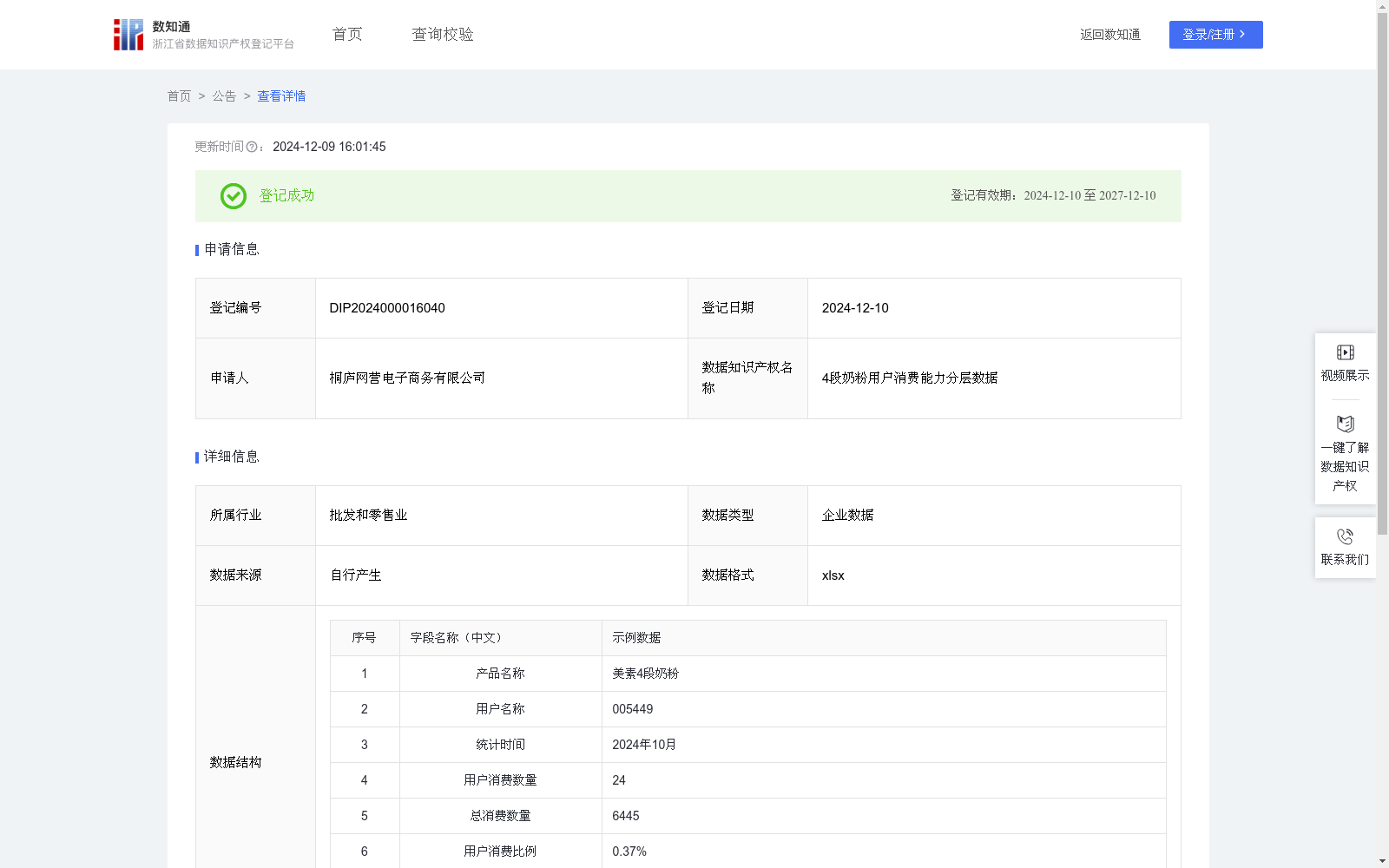
4段奶粉用户消费能力分层数据
收藏资源简介:
统计分析4段奶粉消费数据,通过对历史下单用户建立表格,对用户进行标签制定,定位用户消费级别,为同类型企业在全国各地设立产品周转仓及针对各地区消费者对规格的喜好有针对性的制定广告营销策略提供数据支持。1、数据采集:采集4段奶粉在各个省的消费数据并统计。2、用户消费比例=用户消费数量/总消费数量*100%,用户消费占总消费的比例按从大到小进行排名;3、消费分类运用ABCDEF分类法,对占比3%及以上的,给予“A类用户”分层;占比在2%-3%(不含3%)区间的,给予“B类用户”分层;占比在1%-2%(不含2%)区间的,给予“C类用户”分层;占比在0.5%-1%(不含1%)区间的,给予“D类用户”分层;占比在0.1%-0.5%(不含0.5%)区间的,给予“E类用户”分层;占比在0.1%(不含0.1%)以下的,给予“F类用户”分层。
This dataset conducts statistical analysis on the consumption data of stage 4 infant formula. It establishes tables for historical purchasing users, formulates user tags, and positions user consumption tiers, providing data support for similar enterprises to set up product distribution warehouses across the country and develop targeted advertising and marketing strategies based on regional consumers' preferences for product specifications. 1. Data Collection: Collect and statistically analyze the consumption data of stage 4 infant formula in each province. 2. User consumption proportion = (user consumption quantity / total consumption quantity) * 100%. Rank the proportion of each user's total consumption in descending order. 3. The ABCDEF classification method is adopted for consumption classification: users with a proportion of 3% and above are categorized as "Class A users"; those with a proportion ranging from 2% to 3% (excluding 3%) are classified as "Class B users"; those with a proportion between 1% and 2% (excluding 2%) are "Class C users"; those with a proportion of 0.5% to 1% (excluding 1%) are "Class D users"; those with a proportion of 0.1% to 0.5% (excluding 0.5%) are "Class E users"; and those with a proportion below 0.1% (excluding 0.1%) are "Class F users".