electricsheepafrica/africa-ilo-emp-temp-sex-age-jbt-nb-employment-by-sex-age-and-working-time-arrangement
收藏资源简介:
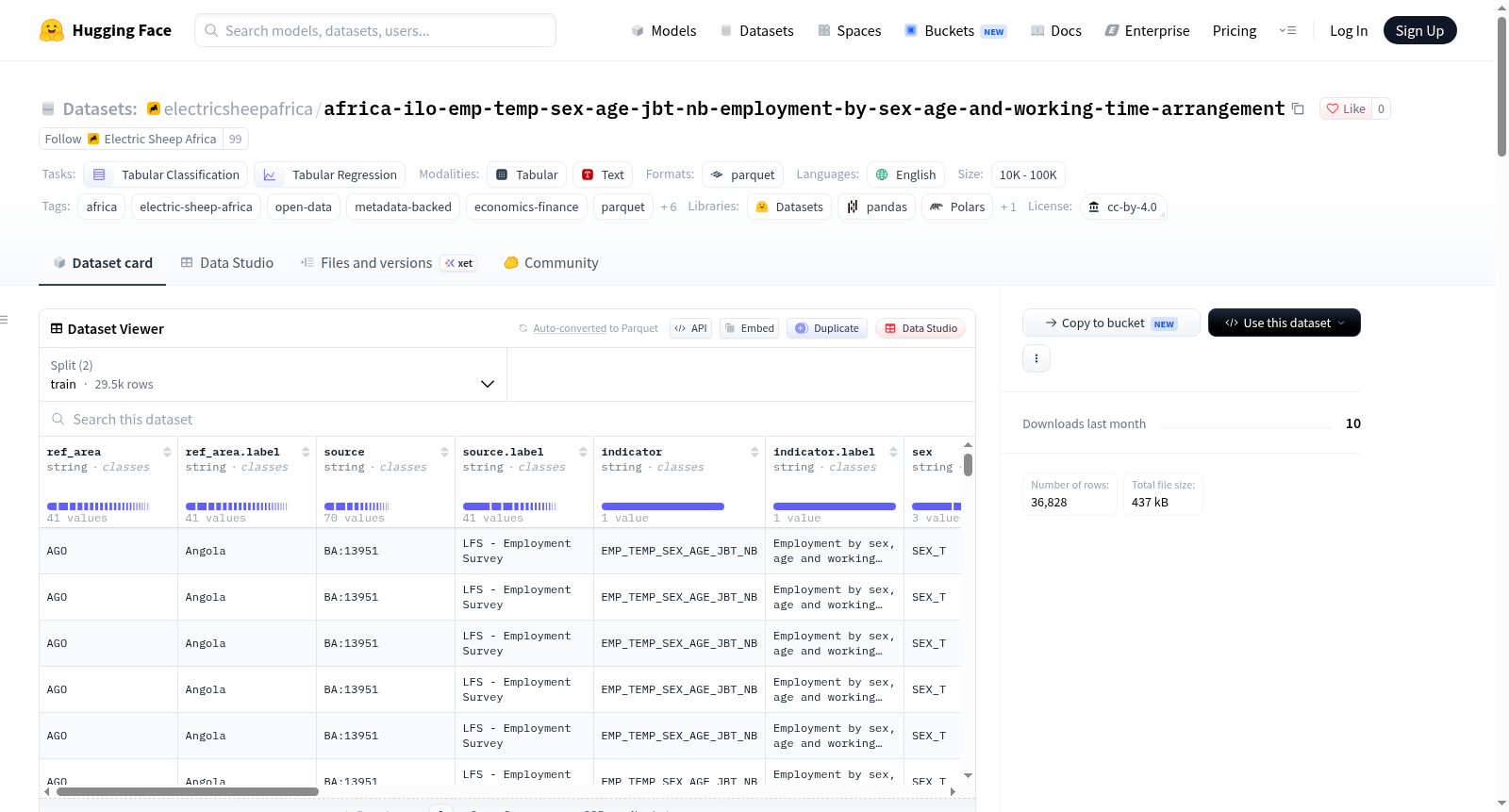
该数据集包含36,828个观测值,涵盖了45个非洲国家从1991年至2025年的就业数据,涉及1个具体指标:按性别、年龄和工作时间安排的就业(千人)。数据来源于国际劳工组织(ILO)的ILOSTAT数据库,经过标准化处理,包括国家代码、性别分类、年龄组、工作时间安排等维度。数据集适用于表格分类、回归和时间序列预测任务,重点关注非洲地区的劳动力市场分析。
--- license: 知识共享署名4.0协议(cc-by-4.0) language: - 英语(en) task_categories: - 表格分类(tabular-classification) - 表格回归(tabular-regression) - 时间序列预测(time-series-forecasting) multilinguality: 单语言(monolingual) size_categories: - 10000<n<100000 tags: - 表格数据(tabular) - 非洲(africa) - 国际劳工组织统计数据库(ILOSTAT) - 就业(employment) - 国际劳工组织(ILO) - 劳工(labour) pretty_name: "按性别、年龄和工作时间安排划分的就业人数(单位:千人)| 非洲(ILOSTAT)" --- # 按性别、年龄和工作时间安排划分的就业人数(单位:千人)| 非洲(ILOSTAT) 🌍 **36,828条观测数据** · **45个非洲国家** · **1991–2025年** · *由[Electric Sheep Africa](https://huggingface.co/electricsheepafrica)重新封装*      ## 内容摘要 本数据集包含**45个非洲国家、1991至2025年间的36,828条就业(Employment)观测数据**,仅涵盖**1项独立指标**。 ## 关于数据源 **国际劳工组织统计数据库(ILOSTAT)** 是国际劳工组织(International Labour Organization, ILO)的核心统计数据库,为全球领先的劳工统计权威来源。其整合了就业、失业、薪资、工作时长、童工、非正规经济、社会保障、职业伤害以及可持续发展目标(SDG)体面工作目标等领域的指标,数据源自全国劳动力调查、家庭收入调查、机构调查以及行政记录。该数据库覆盖全球200余个经济体,由国际劳工组织统计司负责数据的标准化协调。 - **来源**:[ILOSTAT](https://www.ilo.org/shinyapps/bulkexplorer/?id=EMP_TEMP_SEX_AGE_JBT_NB) - **发布方**:国际劳工组织(International Labour Organization, ILO) - **许可证**:[cc-by-4.0](https://creativecommons.org/licenses/by/4.0/) - **主题**:就业(Employment) ## 数据处理方法 本数据集直接从ILOSTAT的REST API接口`https://rplumber.ilo.org/data/indicator?id=EMP_TEMP_SEX_AGE_JBT_NB`拉取数据,并筛选出非洲地区的ISO 3166-1 alpha-3国家代码对应的数据。ILOSTAT采用国际劳工统计学家会议(International Conference of Labour Statisticians, ICLS)的定义对原始调查微观数据进行标准化协调;数据来源会在`source.label`列中标记,以确保可追溯性。 ## 地理覆盖范围 45个非洲国家,以下按观测条数排序展示部分国家: | 国家代码 | 观测条数 | 起始年份 | 结束年份 | |---------|-----:|-----------:|----------:| | `ZAF` | 3,600 | 2000 | 2024 | | `MUS` | 2,734 | 2001 | 2019 | | `EGY` | 2,640 | 2008 | 2023 | | `RWA` | 1,824 | 2014 | 2025 | | `MLI` | 1,584 | 2013 | 2024 | | `ZMB` | 1,536 | 2017 | 2024 | | `BWA` | 1,344 | 1996 | 2024 | | `GHA` | 1,248 | 1991 | 2024 | | `TZA` | 1,152 | 2001 | 2024 | | `AGO` | 1,152 | 2009 | 2025 | | `NAM` | 1,135 | 1994 | 2018 | | `SYC` | 1,092 | 2014 | 2024 | | `UGA` | 1,056 | 2010 | 2021 | | `NGA` | 1,051 | 2011 | 2024 | | `SEN` | 1,008 | 2011 | 2024 | | ... | 其余30个国家 | | | ## 指标(示例) - `EMP_TEMP_SEX_AGE_JBT_NB` — 按性别、年龄和工作时间安排划分的就业人数(单位:千人) ## 数据架构 | 列名 | 数据类型 | 描述 | 示例 | |--------|------|-------------|---------| | `ref_area` | `string` | ISO 3166-1 alpha-3国家代码 | `AGO` | | `ref_area.label` | `string` | 英语国家名称 | `安哥拉` | | `source` | `string` | ILOSTAT来源代码(如劳动力调查) | `BA:13951` | | `source.label` | `string` | 英语来源名称 | `劳动力调查` | | `indicator` | `string` | ILOSTAT指标代码 | `EMP_TEMP_SEX_AGE_JBT_NB` | | `indicator.label` | `string` | 英语指标名称 | `按性别、年龄和工作时间安排划分的就业人数(缩略)` | | `sex` | `string` | 性别分解维度(SEX_T = 总计,SEX_M = 男性,SEX_F = 女性) | `SEX_T` | | `sex.label` | `string` | — | `总计` | | `classif1` | `string` | 第一分类变量(年龄、教育程度、就业状态等) | `AGE_YTHADULT_YGE15` | | `classif1.label` | `string` | — | `年龄(青年、成年):15岁及以上` | | `classif2` | `string` | 第二分类变量(如适用) | `JBT_TIME_TOTAL` | | `classif2.label` | `string` | — | `工作时间安排:总计` | | `time` | `int64` | 观测年份 | `2025` | | `obs_value` | `float64` | 观测指标值(单位详见指标定义) | `13984.984` | | `obs_status` | `string` | 观测状态标记(如临时、不可靠) | `B` | | `obs_status.label` | `string` | — | `序列中断` | | `note_classif` | `float64` | — | `—` | | `note_classif.label` | `float64` | — | `—` | | `note_indicator` | `string` | — | `I11:264` | | `note_indicator.label` | `string` | — | `序列中断:方法学修订` | | `note_source` | `string` | — | `R1:3513` | | `note_source.label` | `string` | — | `存储库:国际劳工组织统计 - 微观数据(缩略)` | ## 分解维度 以下列提供数据分解维度: - **`sex`**(共3个唯一值):`SEX_T`、`SEX_M`、`SEX_F` ## 数据质量与注意事项 - 数据为年度频率。部分指标同时发布月度或季度序列,本数据集未包含此类数据。 - 当同一国家×年份存在多个数据源时,本数据集采用国际劳工组织选定的“最优数据源”。 - 分解维度列(`sex`、`classif1`、`classif2`)仅在指标支持对应分解时非空。 ## 使用方法 python from datasets import load_dataset ds = load_dataset("electricsheepafrica/africa-ilo-emp-temp-sex-age-jbt-nb-employment-by-sex-age-and-working-time-arrangement") df = ds["train"].to_pandas() print(df.head()) ### 筛选单个国家 python kenya = df[df["ref_area"] == "KEN"] ### 单个指标的时间序列数据 python sample = (df[df["indicator"] == "EMP_TEMP_SEX_AGE_JBT_NB"] .sort_values("time")) sample.plot(x="time", y="obs_value", title="EMP_TEMP_SEX_AGE_JBT_NB") ### 转换为国家×年份矩阵 python matrix = (df[df["indicator"] == "EMP_TEMP_SEX_AGE_JBT_NB"] .pivot_table(index="time", columns="ref_area", values="obs_value")) print(matrix.tail()) ## 引用格式 bibtex @misc{africa_ilo_emp_temp_sex_age_jbt_nb_employment_by_sex_age_and_working_time_arrangement_2025, title = {按性别、年龄和工作时间安排划分的就业人数(单位:千人)| 非洲(ILOSTAT)}, author = {国际劳工组织(International Labour Organization, ILO)}, year = {2025}, url = {https://www.ilo.org/shinyapps/bulkexplorer/?id=EMP_TEMP_SEX_AGE_JBT_NB}, publisher = {HuggingFace数据集平台,由Electric Sheep Africa重新封装}, howpublished = {url{https://huggingface.co/datasets/electricsheepafrica/africa-ilo-emp-temp-sex-age-jbt-nb-employment-by-sex-age-and-working-time-arrangement}} } ## 许可证 本数据集采用[cc-by-4.0](https://creativecommons.org/licenses/by/4.0/)协议发布。 原始数据版权归国际劳工组织(International Labour Organization, ILO)所有。使用本数据集时,请同时引用上述原始数据源以及Electric Sheep Africa的重新封装版本。 ## 关于Electric Sheep Electric Sheep Africa是Electric Sheep使命的一部分:旨在HuggingFace平台上构建统一的、适用于机器学习的非洲数据层。我们从权威开源数据源获取数据,对数据架构进行标准化处理,以Parquet格式打包发布,并采用统一的数据集卡片格式,使研究人员和开发者可以通过`load_dataset()`函数在数秒内启动数据分析工作。 浏览完整数据集集合:[huggingface.co/electricsheepafrica](https://huggingface.co/electricsheepafrica) --- _数据溯源:2026年5月26日通过Electric Sheep流水线获取。源URL:https://www.ilo.org/shinyapps/bulkexplorer/?id=EMP_TEMP_SEX_AGE_JBT_NB_