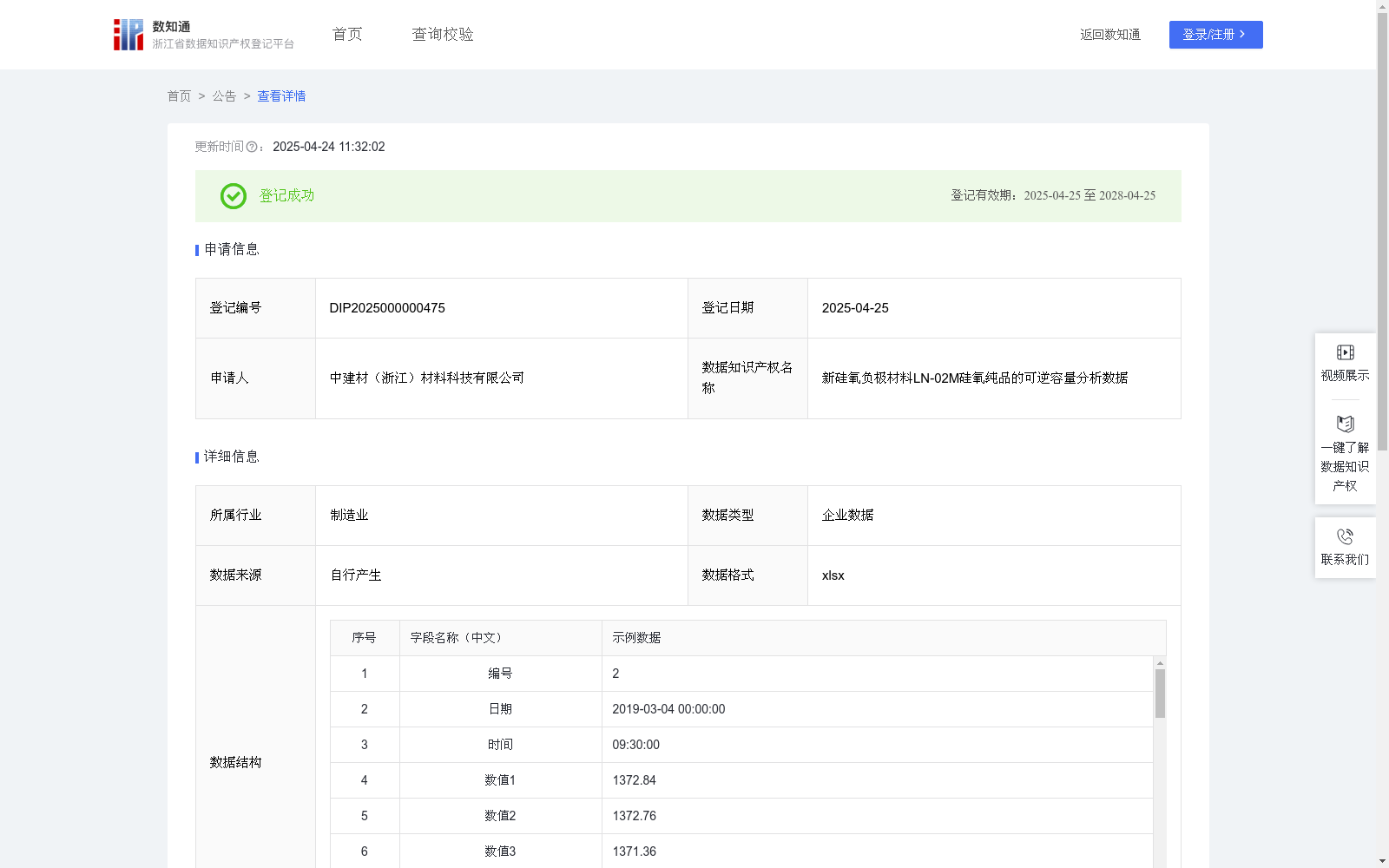
新硅氧负极材料LN-02M硅氧纯品的可逆容量分析数据
收藏资源简介:
采集了新硅氧负极材料LN-02M硅氧纯品制程中可逆容量(2.0V截止)数据,分析得到该数据的均值CLX、极差CLR、能力指数CP、性能指数PP、过程性能指数PPK及过程能力指数CPK等数值,一方面可用于产品生产商内部评估该材料出厂前是否满足质量标准,同时用于指导生产过程调整,保持产品质量稳定性。另一方面,可用于以下外部场景:(1)电池材料制造商:监控可逆容量数据,确保生产稳定性和产品质量达标。 (2)电池生产企业:采购高质量材料,验证供应商生产过程能力,确保电池性能稳定。 (3)质量管理与认证机构:评估企业生产过程能力,确保符合行业标准和客户要求。在规定的可逆容量(2.0V截止)检测制度下,采集由新硅氧负极材料硅氧纯品的可逆容量(2.0V截止)数据五组,进行分析计算。计算方法; (1)过程能力指数(CP/CPK) CP = (USL - LSL) / (6 × (CLR / γ)) CPU = (USL - CLX) / (3 × (CLR / γ)) CPL = (CLX - LSL) / (3 × (CLR / γ)) CPK = min(CPU, CPL) (2)过程性能指数(PP/PPK) PP = (USL - LSL) / (6×бP) PPU = (USL - CLX) / (3×бP) PPL = (CLX - LSL) / (3×бP) PPK = min(PPU, PPL) (3)控制限(UCLX/LCLX/UCLR/LCLR) UCLX = CLX + β×CLR LCLX = CLX - β×CLR UCLR = α × CLR LCLR = ε × CLR 其中, CLX:数据的平均值。 CLR:数据的极差(最大值 - 最小值)。 USL:规格上限 LSL:规格下限 β,α,ε,γ:常数,与样本量相关。 б:短期标准差,计算公式为 б = CLR / γ。 бP:长期标准差,基于长期数据计算。 其中,数据指数的上下限越小,代表该产品生产过程更稳定,更严格,产品出品质量越好,CPK用来评价生产过程能力的指数,其数值越大表示生产过程能力越强,产品品质控制能力越好,CP反映了生产过程的稳定性和一致性,Cp值越大,表明过程变异越小,设备能力越强,PP用来评价一个对实际生产过程性能的评估,与CP值作用相近,但是更加实际,PPK用于在统计过程控制中计算工序性能或过程性能的重要指标,作用与CPK相似,反映了长期过程性能。
Data on the reversible capacity (cutoff at 2.0 V) during the pure silicon-oxide manufacturing process of the new silicon-oxide anode material LN-02M were collected. Values including the mean CLX, range CLR, capability index CP, performance index PP, process performance index PPK, and process capability index CPK were derived from the analysis. On one hand, these data can be used by product manufacturers to internally assess whether the material meets quality standards prior to shipment, as well as to guide production process adjustments and maintain product quality stability. On the other hand, they can be applied in the following external scenarios: 1. Battery material manufacturers: Monitor reversible capacity data to ensure production stability and compliance with product quality requirements. 2. Battery manufacturing enterprises: Procure high-quality materials, verify the production process capability of suppliers, and guarantee stable battery performance. 3. Quality management and certification bodies: Evaluate the production process capability of enterprises to ensure compliance with industry standards and customer requirements. Under the specified reversible capacity (2.0 V cutoff) testing protocol, five sets of reversible capacity data (cutoff at 2.0 V) collected from the pure silicon-oxide batch of the new silicon-oxide anode material LN-02M were subjected to analysis and calculation. The calculation methods are as follows: (1) Process Capability Indices (CP/CPK) CP = (USL - LSL) / (6 × (CLR / γ)) CPU = (USL - CLX) / (3 × (CLR / γ)) CPL = (CLX - LSL) / (3 × (CLR / γ)) CPK = min(CPU, CPL) (2) Process Performance Indices (PP/PPK) PP = (USL - LSL) / (6×σ_P) PPU = (USL - CLX) / (3×σ_P) PPL = (CLX - LSL) / (3×σ_P) PPK = min(PPU, PPL) (3) Control Limits (UCLX/LCLX/UCLR/LCLR) UCLX = CLX + β×CLR LCLX = CLX - β×CLR UCLR = α × CLR LCLR = ε × CLR Where: CLX: Mean value of the dataset CLR: Range of the dataset (maximum value - minimum value) USL: Upper Specification Limit LSL: Lower Specification Limit β, α, ε, γ: Constants related to sample size σ: Short-term standard deviation, calculated as σ = CLR / γ σ_P: Long-term standard deviation, calculated based on long-term datasets Specifically, the smaller the upper and lower limits of the data indices, the more stable and stringent the product production process is, and the better the ex-factory product quality. CPK is an index for evaluating production process capability: the larger its value, the stronger the production process capability and the better the product quality control ability. CP reflects the stability and consistency of the production process: the larger the CP value, the smaller the process variation and the stronger the equipment capability. PP is used to evaluate actual production process performance, with a similar function to CP but more practical. PPK is an important indicator for calculating process performance in statistical process control, with a function similar to CPK, reflecting long-term process performance.