TigreGotico/search-term-extraction
收藏资源简介:
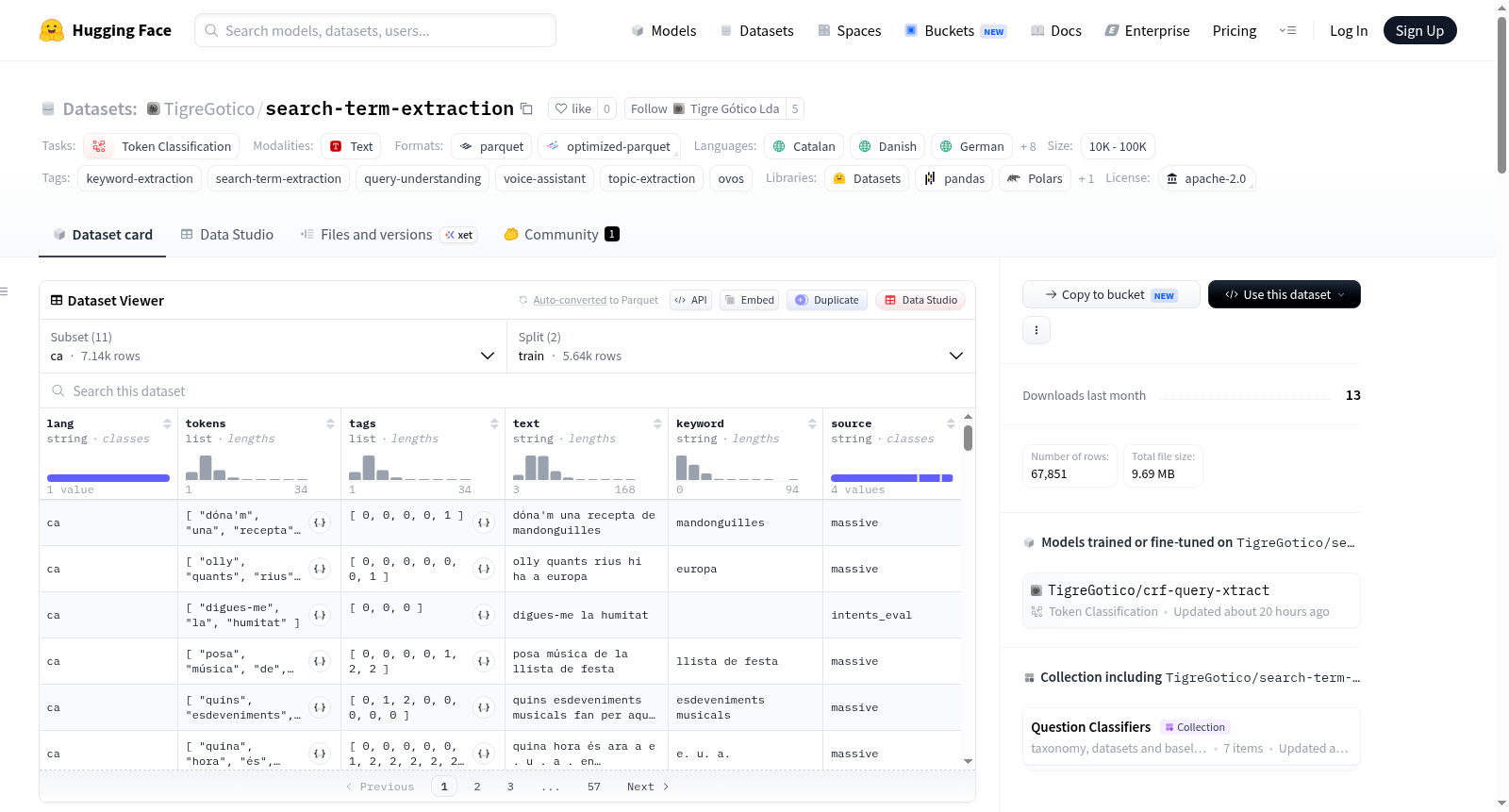
这是一个多语言搜索词提取数据集,专门用于标记语音助手查询中的搜索词——即传递给知识库或搜索引擎的最小主题字符串。例如,对于查询what is the speed of light?,目标是提取speed of light;而对于set volume to fifty,则没有搜索词(因为没有需要查找的主题)。该任务不是文档关键词提取,也不是完整的意图/槽位自然语言理解,而是专注于回答一个问题:我要搜索什么?——这是OVOS common-query、DuckDuckGo或Wikipedia技能向下游发送的输入。数据集支持多种语言:加泰罗尼亚语、丹麦语、德语、英语、西班牙语、巴斯克语、法语、加利西亚语、意大利语、荷兰语和葡萄牙语。数据采用序列标注格式,每个令牌有三个标签:O(不是搜索词部分)、B-KW(搜索词跨度的第一个令牌)和I-KW(搜索词跨度的延续)。每行数据包含语言、令牌列表、标签序列、原始文本、关键词(目标字符串)和数据来源。数据来源于OpenVoiceOS资源(如模板填充、真实问题)和本地LLM处理(包括生成问题)。测试集为人工标注的黄金标准,训练集部分为LLM标注的银标准。数据集旨在训练或评估位于意图分类和搜索/知识库后端之间的主题/搜索词提取器,适用于序列标注模型(如CRF、令牌分类器)或作为LLM的监督数据。
This is a multilingual search term extraction dataset specifically designed for marking search terms in voice assistant queries — that is, the minimal thematic string passed to a knowledge base or search engine. For example, for the query 'what is the speed of light?', the goal is to extract 'speed of light'; while for 'set volume to fifty', there is no search term as there is no topic to look up. This task is neither document keyword extraction nor complete intent/slot natural language understanding, but focuses on answering the question: What am I searching for? — this is the input sent downstream by OVOS common-query, DuckDuckGo or Wikipedia skills. The dataset supports multiple languages: Catalan, Danish, German, English, Spanish, Basque, French, Galician, Italian, Dutch and Portuguese. The data is in sequence labeling format, with three labels assigned to each token: O (not part of the search term), B-KW (the first token of the search term span), and I-KW (the continuation of the search term span). Each line of data contains the language, token list, label sequence, original text, keywords (target string) and data source. The data is sourced from OpenVoiceOS resources such as template filling and real user questions, as well as local LLM processing including generated questions. The test set is a manually annotated gold standard, while part of the training set is a silver standard annotated by LLMs. The dataset is intended to train or evaluate topic/search term extractors located between intent classification and the search/knowledge base backend, suitable for sequence labeling models such as CRFs and token classifiers, or as supervised data for LLMs.