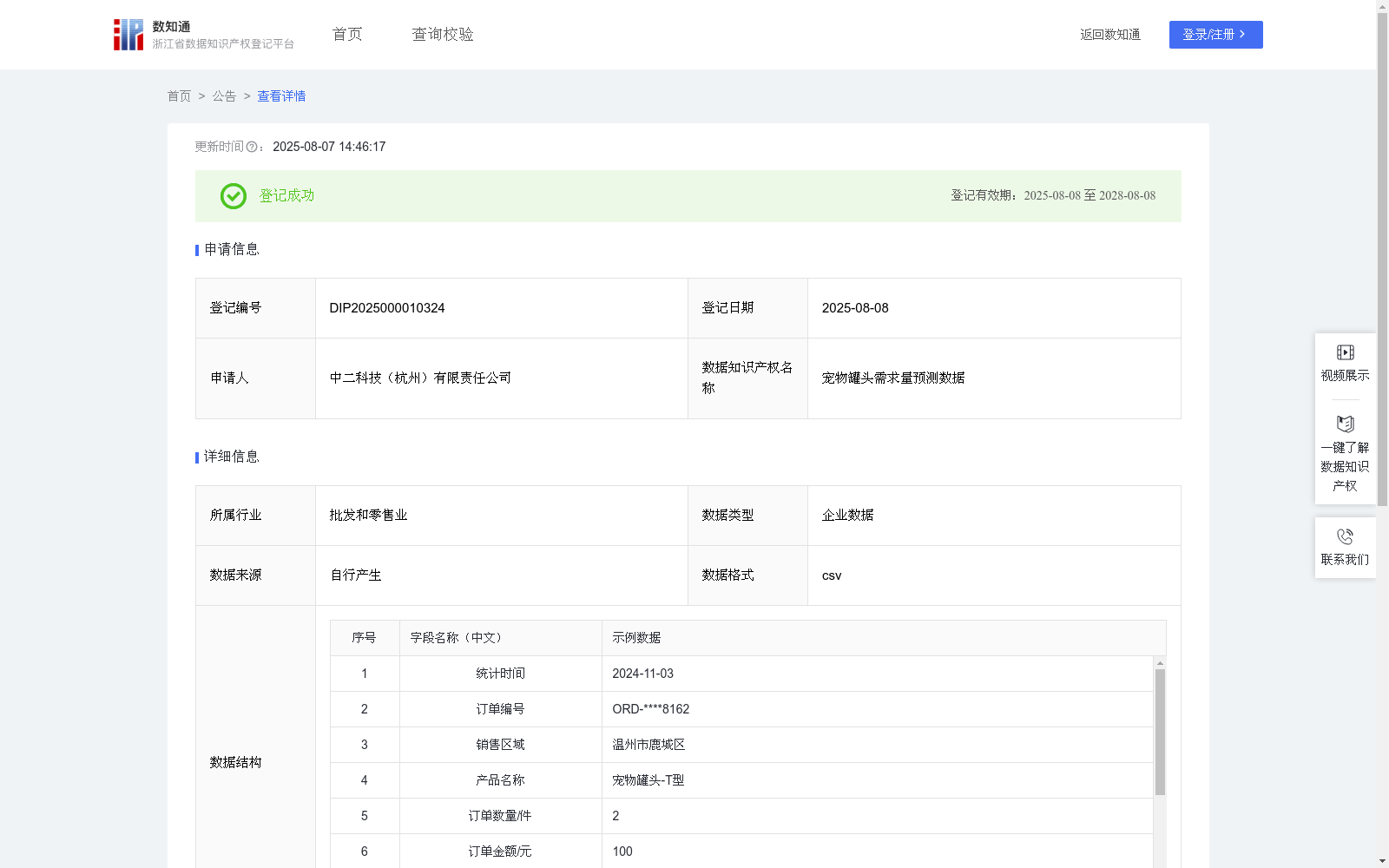
宠物罐头需求量预测数据
收藏资源简介:
本数据聚焦于预测宠物罐头的需求量。对于公司而言,通过预测各区域对该产品的市场需求量,可以精准配置生产资源、优化物流安排,并合理规划库存水平,避免出现供应不足或库存积压的情况,从而提升整体运营效率和服务响应速度。对宠物相关产品的原材料供应商、包装服务商及物流配送合作伙伴而言,本预测数据可作为其制定生产计划、仓储策略和供应链调度的重要参考依据。根据市场需求趋势调整供应节奏和服务策略,有助于避免原料过剩或短缺问题,提升资源配置效率。1.数据采集:采集宠物罐头的销售数据,包括统计时间、订单编号、销售区域、产品名称、订单数量/件、订单金额/元。 2.数据预处理:对采集的数据进行清洗,去除重复记录,处理缺失值。 3.数据加工与分析:(1)计算历史需求量:对于商品名称,使用SUMIFS函数对订单数量进行累加,分别计算出其过去365天、90天和30天的总需求量。(2)建立需求量预测模型:该产品名称的未来30天需求量预测值=[(过去365天总需求量÷365*a)+(过去90天的总需求量÷90*b)+(过去30天的总需求量÷30×c)]*30*k;其中,系数a=0.5,b=0.3,c=0.2,调整因子k=1.1。系数a、b、c反映数值对未来30天需求量预测的影响程度,由于算法更注重长期需求趋势的影响,因此a被赋予了最高的权重。调整因子k基于市场增长预期进行修正。
This dataset focuses on demand forecasting for pet canned food. For the manufacturing company, forecasting the regional market demand for this product enables precise allocation of production resources, optimization of logistics arrangements, and reasonable planning of inventory levels, thereby avoiding supply shortages or overstock situations and improving overall operational efficiency and service response speed. For raw material suppliers, packaging service providers, and logistics distribution partners of pet-related products, this forecasting data can serve as an important reference for formulating production plans, warehousing strategies, and supply chain scheduling. Adjusting supply rhythm and service strategies based on market demand trends helps avoid raw material surplus or shortage issues and improves resource allocation efficiency. 1. Data Collection: Collect sales data of pet canned food, including statistical time, order number, sales region, product name, order quantity (unit: piece), and order amount (unit: RMB). 2. Data Preprocessing: Clean the collected data, remove duplicate records, and handle missing values. 3. Data Processing and Analysis: (1) Historical Demand Calculation: For each product name, use the SUMIFS function to accumulate order quantities, and calculate the total demand over the past 365 days, 90 days, and 30 days respectively. (2) Demand Forecasting Model Establishment: The 30-day future demand forecast value for a given product name is calculated as: Forecast Value = [(Total Demand of Past 365 Days / 365 * a) + (Total Demand of Past 90 Days / 90 * b) + (Total Demand of Past 30 Days / 30 * c)] * 30 * k; where coefficients a=0.5, b=0.3, c=0.2, and adjustment factor k=1.1. The coefficients a, b, and c reflect their respective influence degrees on the 30-day future demand forecast. Since the algorithm prioritizes the impact of long-term demand trends, a is assigned the highest weight. The adjustment factor k is revised based on market growth expectations.