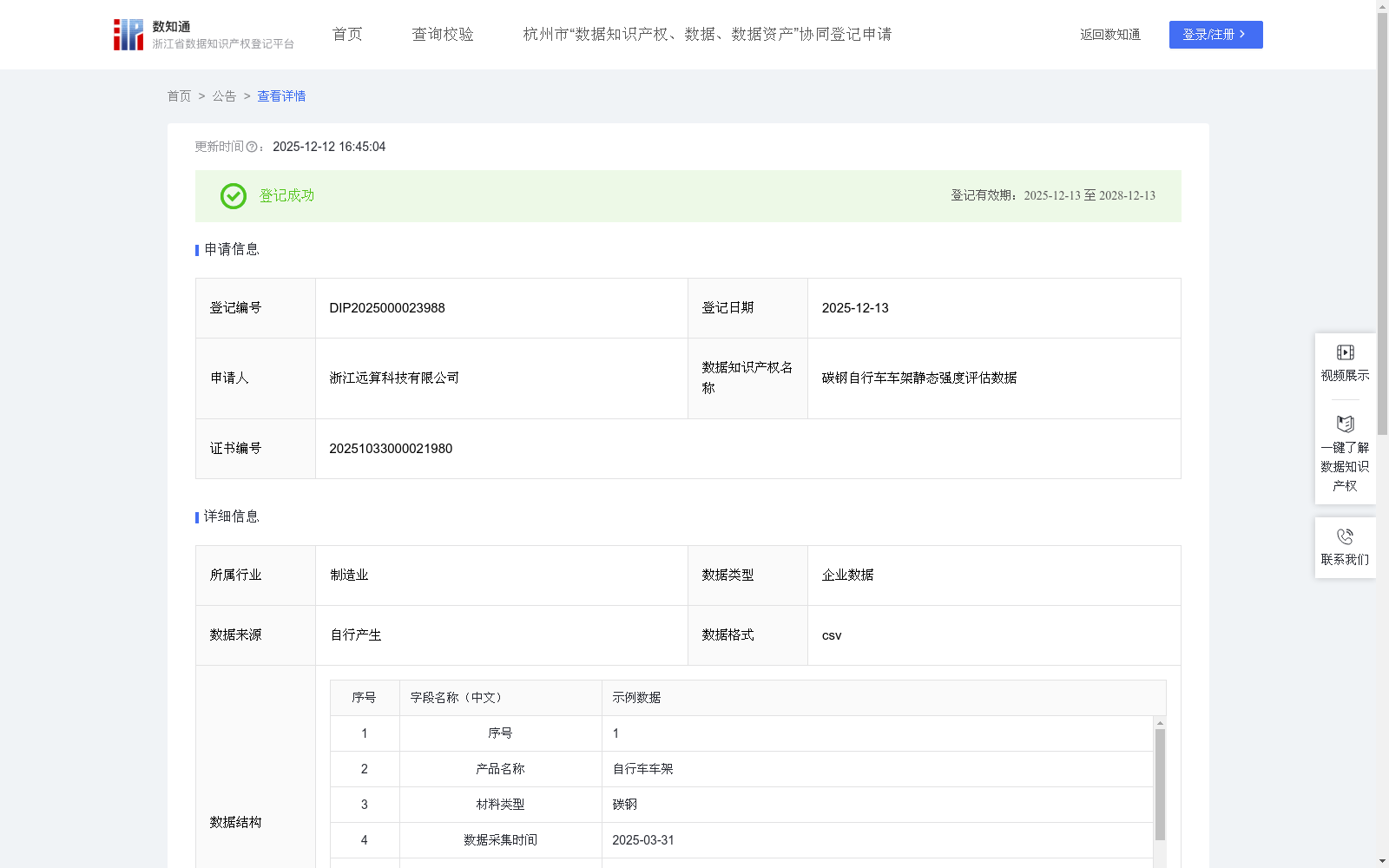
碳钢自行车车架静态强度评估数据
收藏资源简介:
碳钢自行车车架静态强度评估数据据可贯通产品全流程:在上游,为材料与供应商选择、企业/行业测试规范制定与模型标定提供可追溯证据;在中游,支撑方案比选与轻量化迭代,沉淀标准化工况与边界条件模板,指导工艺规划与制造质控的参数下放;在下游,则转化为招投标与采购的技术条款、进出厂与在役抽检的判定依据,以及第三方认证与监管合规的佐证。数据同时可作为机器学习训练样本,构建“几何—材料—工况—响应—判定”的知识图谱,形成从设计到制造、验收到运维的数字闭环,持续降低成本、缩短周期并提升产品可靠性。1. 数据采集 采集内容包括碳钢自行车车架结构的几何参数与主要材料特性(如屈服强度 σ_s、极限强度 σ_u),并定义典型使用场景下的静态载荷。基于有限元方法开展静力学仿真,提取最大等效应力 σ_max 与最大位移,以反映碳钢自行车车架在载荷作用下的结构响应。 2. 数据处理 (1)应力比:Rs = σ_max / σ_s (2)极限应力比:Ru = σ_max / σ_u (3)安全裕度:M = 1 − Rs 3. 数据应用(参考建议) 判定顺序:不合格 → 设计偏保守 → 设计合理 → 临界状态 → 预警区间。 (1)不合格:Rs ≥ 1.0 或 Ru ≥ 0.8。说明:存在失效风险;需调整结构方案或使用更高强度材料后复评。 (2)设计偏保守:Rs ≤ 0.6 且 Ru ≤ 0.3。说明:材料利用率较低;在满足舒适性与刚度前提下可开展轻量化或成本优化。 (3)设计合理:满足下列任一:a)Rs ≤ 0.6 且 0.3 < Ru ≤ Rs;b)0.6 < Rs ≤ 0.8 且 Ru ≤ 0.6。说明:材料强度发挥充分,安全与经济性平衡。 (4)临界状态:0.8 < Rs ≤ 0.9 且 Ru ≤ 0.6。说明:已接近屈服;需加强工况监测与抽检,关注长期疲劳与异常集中载荷。 (5)预警区间:满足下列任一(且未命中以上区间)a)0.6 < Rs ≤ 0.8 且 0.6 < Ru ≤ Rs;b)0.8 < Rs ≤ 0.9 且 0.6 < Ru ≤ Rs;c)0.9 < Rs < 1.0 且 Ru < 0.8。说明:强度利用度偏高或极限强度储备偏低;宜优化关键部位几何与连接,或提升材料等级,并实施更严密的质量与工况监控。
Static strength assessment data for carbon steel bicycle frames can span the entire product lifecycle: Upstream: provides traceable evidence for material and supplier selection, formulation of enterprise/industry test specifications, and model calibration; Midstream: supports scheme comparison and lightweight iteration, establishes standardized working condition and boundary condition templates, and guides parameter allocation for process planning and manufacturing quality control; Downstream: it can be converted into technical clauses for bidding and procurement, judgment basis for incoming/outgoing factory and in-service spot inspections, and supporting evidence for third-party certification and regulatory compliance. Additionally, the data can serve as machine learning training samples to construct a knowledge graph of "geometry-material-working condition-response-judgment", forming a digital closed loop from design to manufacturing, inspection and acceptance to operation and maintenance, continuously reducing costs, shortening cycles and improving product reliability. 1. Data Collection The collected content includes geometric parameters of carbon steel bicycle frame structures and main material properties (such as yield strength σ_s, ultimate strength σ_u), and defines static loads under typical usage scenarios. Static simulation is carried out based on the finite element method, and the maximum equivalent stress σ_max and maximum displacement are extracted to reflect the structural response of the carbon steel bicycle frame under loads. 2. Data Processing (1) Stress ratio: Rs = σ_max / σ_s (2) Ultimate stress ratio: Ru = σ_max / σ_u (3) Safety margin: M = 1 − Rs 3. Data Application (Reference Recommendations) Judgment sequence: Unqualified → Over-conservative design → Reasonable design → Critical state → Early warning interval. (1) Unqualified: Rs ≥ 1.0 or Ru ≥ 0.8. Note: There is a risk of failure; the structural scheme or higher-strength materials need to be adjusted for re-evaluation. (2) Over-conservative design: Rs ≤ 0.6 and Ru ≤ 0.3. Note: The material utilization rate is low; lightweight or cost optimization can be carried out under the premise of meeting comfort and stiffness requirements. (3) Reasonable design: Meet any of the following: a) Rs ≤ 0.6 and 0.3 < Ru ≤ Rs; b) 0.6 < Rs ≤ 0.8 and Ru ≤ 0.6. Note: The material strength is fully utilized, balancing safety and economy. (4) Critical state: 0.8 < Rs ≤ 0.9 and Ru ≤ 0.6. Note: It is close to yielding; working condition monitoring and spot inspections need to be strengthened, paying attention to long-term fatigue and abnormal concentrated loads. (5) Early warning interval: Meet any of the following (and not fall into the above intervals): a) 0.6 < Rs ≤ 0.8 and 0.6 < Ru ≤ Rs; b) 0.8 < Rs ≤ 0.9 and 0.6 < Ru ≤ Rs; c) 0.9 < Rs < 1.0 and Ru < 0.8. Note: The strength utilization rate is relatively high or the ultimate strength reserve is low; it is advisable to optimize the geometry and connections of key parts, or upgrade the material grade, and implement stricter quality and working condition monitoring.