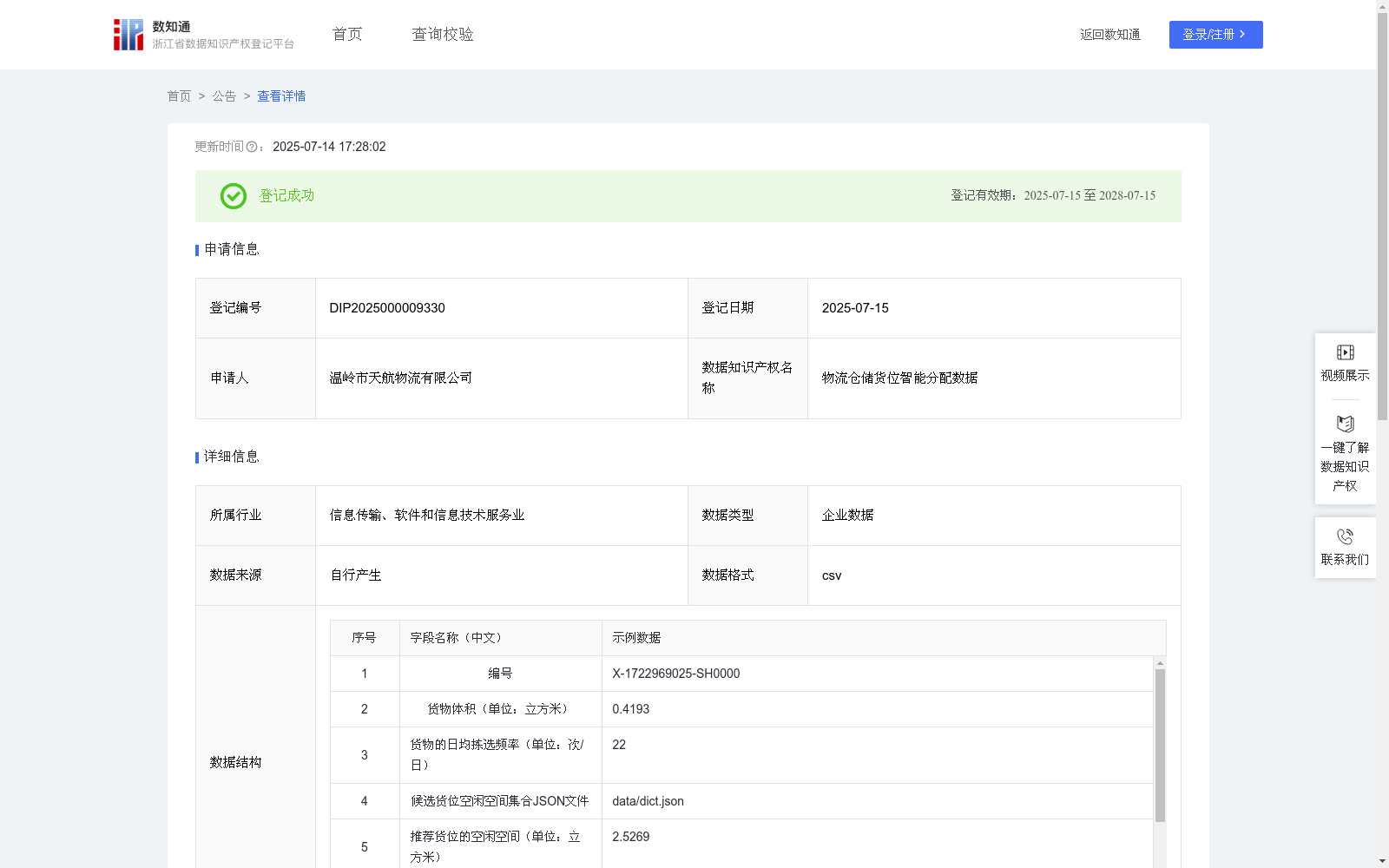
物流仓储货位智能分配数据
收藏资源简介:
该数据在仓储货位智能分配中具有重要的应用价值。能够提供动态货位优化策略,更精确地进行空间资源利用率分析,帮助仓库管理员进行货物摆放与调度决策。在自动化仓储管理中具有广泛的应用场景,特别是多品类物料入库、临期物品优先分配和高频次货物靠近出口的智能布局,能够提高货位利用效率,降低拣货路径成本,提供实时货位分配策略。数据收集: 在该模型中,算法所需的数据来自仓储管理系统(WMS)与物流调度系统(LDS),包括货物入库记录、物品拣选频率统计、货物体积信息和实时货位占用状态。每条样本记录包含编号、货物体积、货物的日均拣选频率、候选货位空闲空间集合JSON文件、推荐货位编号(人工标注)、推荐货位的空闲空间、推荐货位编号(模型推荐)。此外,通过历史模型运行记录计算平均分配成功率与平均耗时,作为模型性能评估指标。 数据预处理: 货物体积与候选货位空闲空间(人工标注)归一化处理至0~1区间,以便于网络数值稳定性。货物拣选频率以对数形式进行变换,平滑高频次偏态数据分布。所有特征拼接为统一向量输入,并在每一训练轮次中进行批归一化处理以提升学习稳定性。对于异常样本(如体积超出所有候选货位空闲空间),系统自动标记为不可分配状态,并从训练集中剔除。 模型构建: 模型采用基于深度Q网络(DQN)的强化学习框架,以货物特征为状态输入,以货位编号为动作输出,通过Q值函数进行策略优化。货物特征由货物体积、拣选频率、候选货位空闲空间组成。 核心公式如下:状态表示:S = [V, F, E]。其中,V表示“货物体积”,F表示“货物拣选频率”,E表示“候选货位空闲空间”。Q值计算与动作选择:Q(S, a) = W2 × ReLU(W1 × S + b1) + b2。其中,W1、W2为模型的权重矩阵,b1、b2为偏置项,a为所有候选货位编号中的一个,Q(S, a)表示将状态S映射至动作a的价值预估。 最终,模型输出最大Q值所对应的动作,即为推荐货位编号,再输出推荐货位的空闲空间(从候选货位空闲空间集合JSON文件查找获得)。系统根据“平均分配成功率”与“平均分配耗时”两个指标评估模型性能,保证分配结果既合理又高效。模型具备在线学习能力,能够持续适应仓储系统的动态变化环境。
This dataset holds significant application value in intelligent storage location allocation. It can provide dynamic storage location optimization strategies, conduct more accurate spatial resource utilization rate analysis, and assist warehouse managers in making cargo placement and scheduling decisions. It has a wide range of application scenarios in automated warehouse management, especially in intelligent layout for multi-category material putaway, priority allocation of expiring items, and high-frequency picking cargoes placed close to the warehouse exit. It can improve storage location utilization efficiency, reduce picking path costs, and provide real-time storage location allocation strategies. Data Collection: The data required by the algorithm in this model is sourced from the Warehouse Management System (WMS) and Logistics Dispatch System (LDS), including cargo putaway records, item picking frequency statistics, cargo volume information, and real-time storage location occupancy status. Each sample record includes a sample ID, cargo volume, daily average picking frequency of the cargo, a JSON file of the free space set of candidate storage locations, manually annotated recommended storage location ID, free space of the recommended storage location, and model-recommended storage location ID. Additionally, the average allocation success rate and average allocation time are calculated using historical model operation records, which serve as model performance evaluation metrics. Data Preprocessing: The cargo volume and free spaces of candidate storage locations (manually annotated) are normalized to the [0, 1] range to ensure numerical stability of the neural network. The cargo picking frequency is transformed using a logarithmic function to smooth the skewed data distribution of high-frequency picking items. All features are concatenated into a unified vector as input, and batch normalization is performed at each training epoch to improve learning stability. For outlier samples (e.g., cargo volume exceeding the free space of all candidate storage locations), the system automatically marks them as unallocatable and removes them from the training dataset. Model Construction: The model adopts a reinforcement learning framework based on the Deep Q-Network (DQN). It takes cargo features as state inputs, uses storage location IDs as action outputs, and optimizes the policy via the Q-value function. The cargo features consist of cargo volume, picking frequency, and free spaces of candidate storage locations. Core Formulas: State representation: $S = [V, F, E]$, where $V$ denotes cargo volume, $F$ denotes cargo picking frequency, and $E$ denotes free spaces of candidate storage locations. Q-value calculation and action selection: $Q(S, a) = W_2 imes ext{ReLU}(W_1 imes S + b_1) + b_2$, where $W_1$ and $W_2$ are the model's weight matrices, $b_1$ and $b_2$ are the bias terms, $a$ is one of all candidate storage location IDs, and $Q(S, a)$ represents the value estimate of mapping state $S$ to action $a$. Ultimately, the model outputs the action corresponding to the maximum Q-value, which serves as the recommended storage location ID, and then outputs the free space of the recommended storage location (retrieved from the JSON file of the free space set of candidate storage locations). The system evaluates model performance using two metrics: average allocation success rate and average allocation time, ensuring that the allocation results are both reasonable and efficient. The model supports online learning capabilities and can continuously adapt to the dynamic and changing environment of the warehouse system.