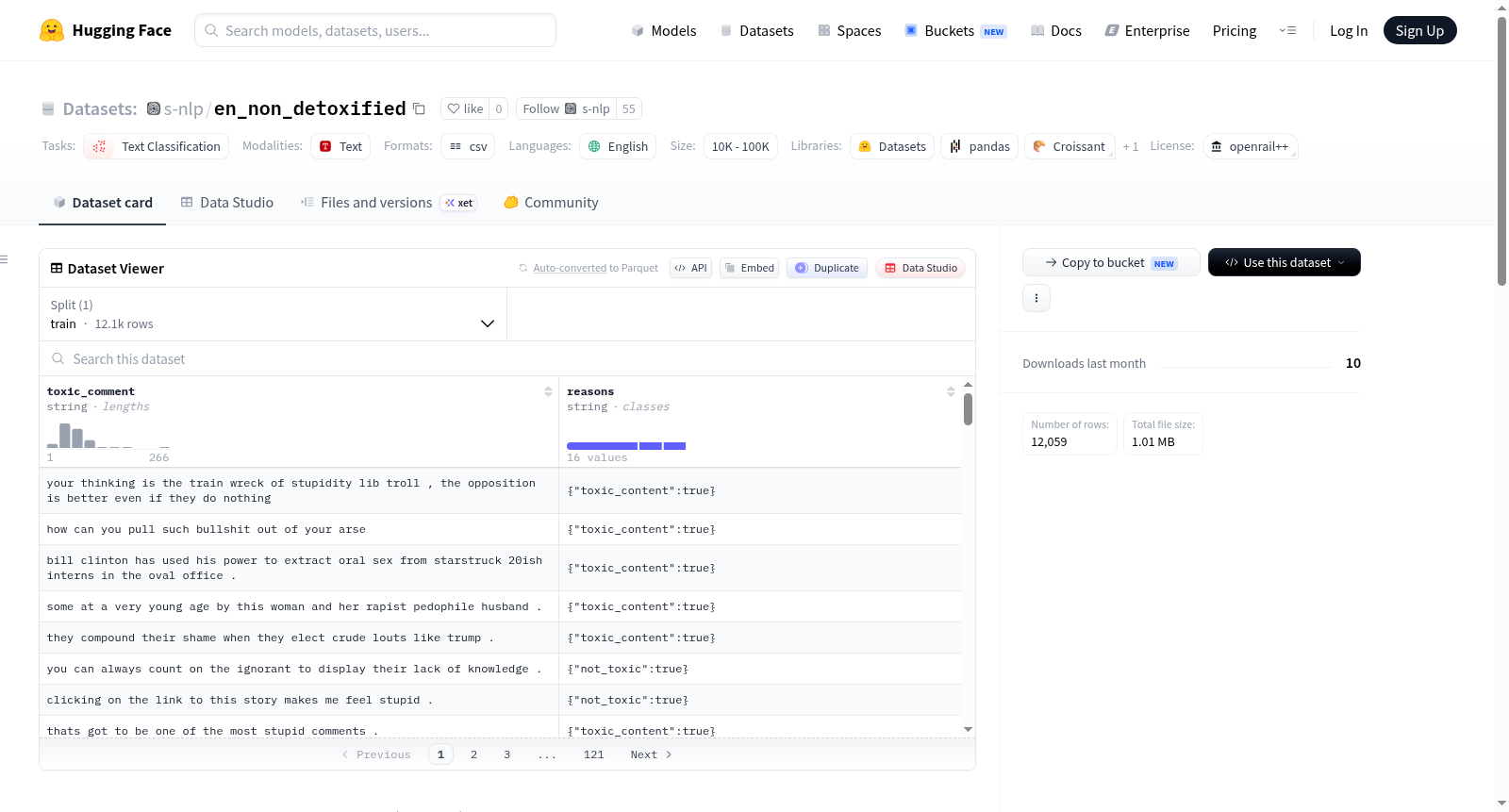
s-nlp/en_non_detoxified
收藏资源简介:
ParaDetox数据集是一个用于文本去毒任务的英语数据集,特别包含了在改写任务中被标注为‘无法重写’的样本。这些样本无法去毒的原因可能包括文本本身无毒、毒性内容深植于信息中或文本难以理解。数据集通过Yandex.Toloka众包平台收集,分为生成改写、内容保留检查和毒性检查三个步骤。此仓库特别包含了生成改写任务的结果,数据集总大小约为12,059个样本。
ParaDetox数据集是一个用于文本去毒任务的英语数据集,特别包含了在改写任务中被标注为‘无法重写’的样本。这些样本无法去毒的原因可能包括文本本身无毒、毒性内容深植于信息中或文本难以理解。数据集通过Yandex.Toloka众包平台收集,分为生成改写、内容保留检查和毒性检查三个步骤。此仓库特别包含了生成改写任务的结果,数据集总大小约为12,059个样本。
ParaDetox: Detoxification with Parallel Data (English)
数据集概述
- 任务类别: 文本分类
- 语言: 英语
- 许可证: openrail++
数据集内容
- 描述: 本数据集包含Paraphrase Task标记,来自English Paradetox dataset收集流程。数据集中包含被标记为*"cannot rewrite"*的样本。
- 数据收集流程:
- Task 1: 生成改写: 要求用户在保持内容的同时消除句子中的毒性。
- Task 2: 内容保持检查: 展示生成的改写与原始版本,并询问用户它们是否具有相似的含义。
- Task 3: 毒性检查: 最终检查工作者是否成功移除了毒性。
- 特定内容: 本仓库包含Task 1: 生成改写的结果,数据集总大小约12,059样本,其中包含标注者无法解毒的样本。
- 无法解毒的原因:
- 非毒性: 文本本身不含有毒性,可能带有负面情绪,但没有淫秽或粗鲁的词汇。
- 毒性内容: 文本是被动攻击性的、讽刺的或其他,侮辱深植于信息中。要解毒,需要大幅度改变意义。
- 不清晰: 文本仅涉及淫秽词汇、随机单词或任何其他令其难以理解主要内容的词组合。
引用信息
@inproceedings{logacheva-etal-2022-paradetox, title = "{P}ara{D}etox: Detoxification with Parallel Data", author = "Logacheva, Varvara and Dementieva, Daryna and Ustyantsev, Sergey and Moskovskiy, Daniil and Dale, David and Krotova, Irina and Semenov, Nikita and Panchenko, Alexander", booktitle = "Proceedings of the 60th Annual Meeting of the Association for Computational Linguistics (Volume 1: Long Papers)", month = may, year = "2022", address = "Dublin, Ireland", publisher = "Association for Computational Linguistics", url = "https://aclanthology.org/2022.acl-long.469", pages = "6804--6818", abstract = "We present a novel pipeline for the collection of parallel data for the detoxification task. We collect non-toxic paraphrases for over 10,000 English toxic sentences. We also show that this pipeline can be used to distill a large existing corpus of paraphrases to get toxic-neutral sentence pairs. We release two parallel corpora which can be used for the training of detoxification models. To the best of our knowledge, these are the first parallel datasets for this task.We describe our pipeline in detail to make it fast to set up for a new language or domain, thus contributing to faster and easier development of new parallel resources.We train several detoxification models on the collected data and compare them with several baselines and state-of-the-art unsupervised approaches. We conduct both automatic and manual evaluations. All models trained on parallel data outperform the state-of-the-art unsupervised models by a large margin. This suggests that our novel datasets can boost the performance of detoxification systems.", }