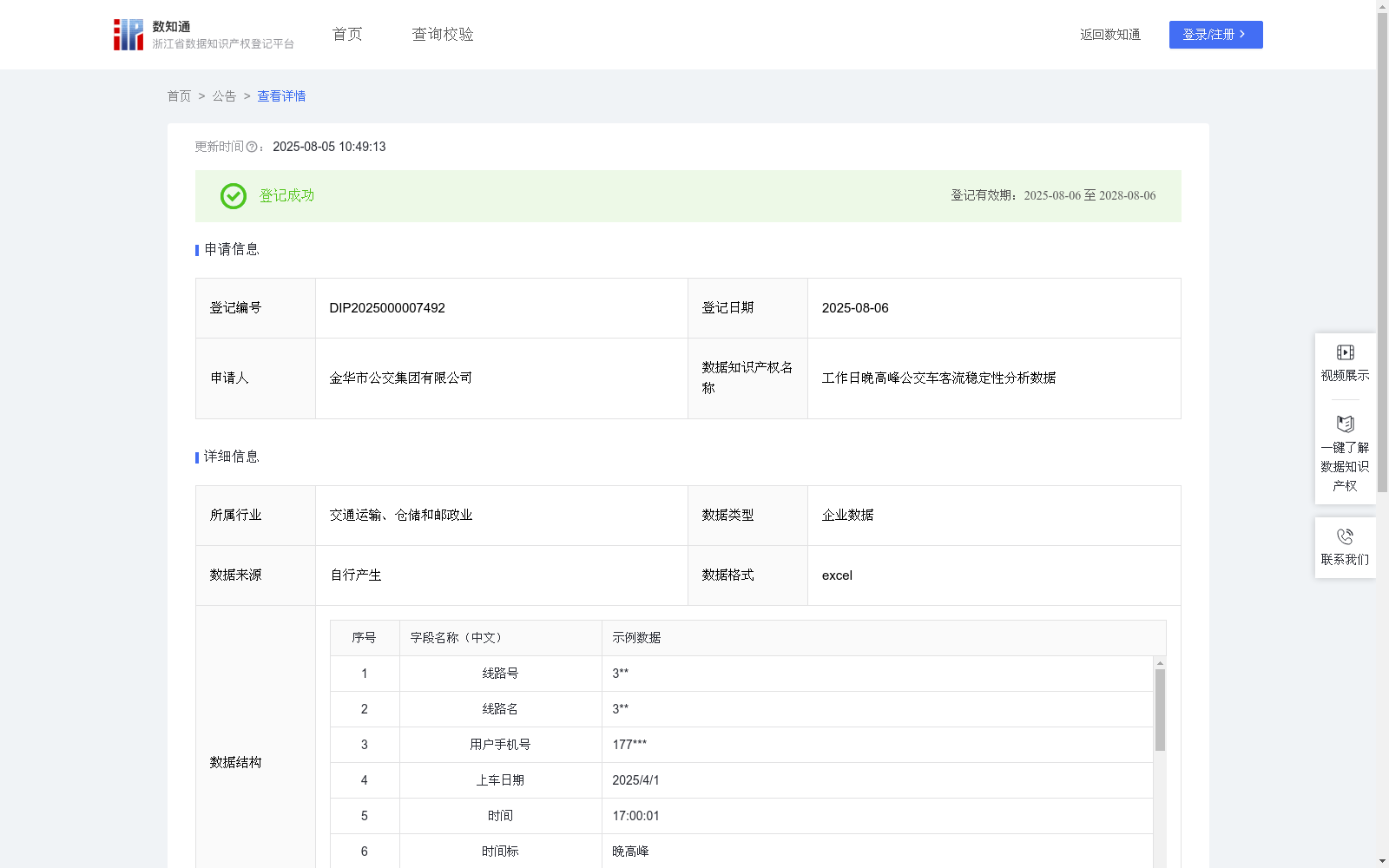
工作日晚高峰公交车客流稳定性分析数据
收藏资源简介:
在智慧交通时代获取精准数据能为公交运营管理带来全新思路。金华行作为金华市公共交通出行的重要线上平台,汇聚了海量的用户乘车数据。通过收集一段时间内使用金华行APP 乘车的用户数据,将离散系数、标准差、变异系数三者结合,能够快速生成客流稳定性评估结果。公交运营部门可以依据这些结果,按照波动程度对线路进行排序,快速筛选出需要重点关注的线路,极大地缩小了问题排查范围。比如筛查出不稳定时段,运营部门可以深入分析其背后的原因,是由于途经区域有大型商业区、学校等导致特定时段客流集中,还是受到道路施工、临时交通管制等外部因素影响,从而采取不同的应对策略。1、数据采集:从金华行数据库里获取2025年4月的线路号、线路名、用户手机号、上车日期、上车时间等数据。2、数据筛选:根据金华市工作日晚高峰时间点(下午五点到七点),增加时间标、日期类型、星期字段,提取出工作日晚高峰时间段内数据,对数据进行清洗,去除极限值、缺失值。3、数据处理:用COUNTIF计算当天当前小时客流、当天客流总数,当天小时平均客流=当天客流总数/3(下午五点到七点)。用MAXIF、MINIF分别计算出当天小时尖峰客流、当天小时低谷客流,计算得到当天的离散系数=(当天小时尖峰客流-当天小时低谷客流)/当天小时平均客流。用STDEV计算标准差,得到变异系数=标准差/当天小时平均客流*100%。稳定分=离散系数*K1+标准差*K2+变异系数*K3,其中K1、K2、K3为各指标对应系数,系数分别为3、0.03、40。 4、数据分类:稳定分小于10判断为稳定,稳定分大于25判断为不稳定,其余情况判定为较为稳定.
In the era of smart transportation, acquiring precise data can bring brand-new insights into bus operation management. Jinhua Xing, a critical online platform for public transit travel in Jinhua City, aggregates massive volumes of user ridership data. By collecting user ridership data from the Jinhua Xing APP over a specific period and combining the range coefficient, standard deviation, and coefficient of variation, rapid generation of passenger flow stability assessment results is achievable. Public transit operation departments can sort bus routes based on fluctuation levels using these results, quickly identify routes requiring priority attention, and significantly narrow the scope of problem investigation. For example, upon identifying unstable time periods, operation departments can conduct in-depth analysis of the underlying causes: whether passenger flow concentration during specific periods is caused by large commercial districts, schools, or other facilities along the route, or affected by external factors such as road construction or temporary traffic control, so as to formulate corresponding response strategies. 1. Data Collection: Extract data including route number, route name, user mobile phone number, boarding date, and boarding time from the Jinhua Xing database for April 2025. 2. Data Filtering: Add timestamp, date type, and weekday fields based on the evening rush hour (5:00 PM to 7:00 PM) on workdays in Jinhua City. Extract data within the evening rush hour period on workdays, and clean the data by removing outliers and missing values. 3. Data Processing: Use the COUNTIF function to calculate the hourly passenger flow of the current hour and the total daily passenger flow. The average hourly passenger flow is calculated as total daily passenger flow / 3 (5:00 PM to 7:00 PM). Use the MAXIF and MINIF functions to calculate the peak hourly passenger flow and trough hourly passenger flow of the day, respectively. The daily range coefficient is then calculated as (peak hourly passenger flow - trough hourly passenger flow) / average hourly passenger flow. Use the STDEV function to calculate the standard deviation, and the coefficient of variation is obtained as (standard deviation / average hourly passenger flow) * 100%. The stability score is defined as: Stability Score = K1 * Range Coefficient + K2 * Standard Deviation + K3 * Coefficient of Variation, where K1, K2, and K3 are the corresponding weights for each indicator, with values of 3, 0.03, and 40, respectively. 4. Data Classification: Routes are categorized as stable if the stability score is less than 10, unstable if the stability score is greater than 25, and moderately stable for all other cases.