油酸甘油酯摩擦改进剂与金属摩擦界面的作用机制研究
收藏资源简介:
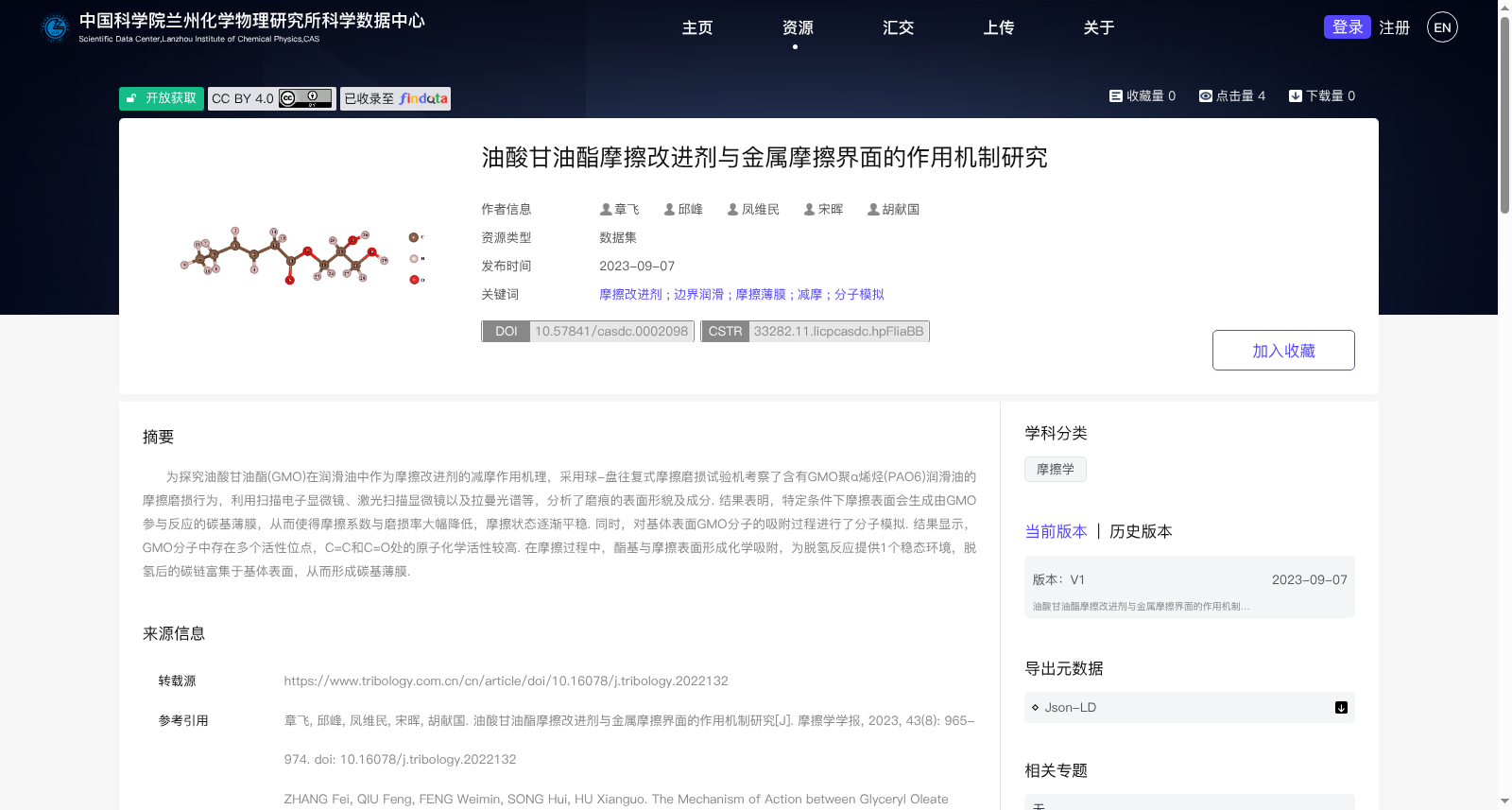
为探究油酸甘油酯(GMO)在润滑油中作为摩擦改进剂的减摩作用机理,采用球-盘往复式摩擦磨损试验机考察了含有GMO聚α烯烃(PAO6)润滑油的摩擦磨损行为,利用扫描电子显微镜、激光扫描显微镜以及拉曼光谱等,分析了磨痕的表面形貌及成分. 结果表明,特定条件下摩擦表面会生成由GMO参与反应的碳基薄膜,从而使得摩擦系数与磨损率大幅降低,摩擦状态逐渐平稳. 同时,对基体表面GMO分子的吸附过程进行了分子模拟. 结果显示,GMO分子中存在多个活性位点,C=C和C=O处的原子化学活性较高. 在摩擦过程中,酯基与摩擦表面形成化学吸附,为脱氢反应提供1个稳态环境,脱氢后的碳链富集于基体表面,从而形成碳基薄膜.
To investigate the friction-reducing mechanism of glyceryl monooleate (GMO) as a friction modifier in lubricating oils, the friction and wear behavior of polyalphaolefin (PAO6) lubricating oil containing GMO was examined using a ball-on-disk reciprocating friction and wear tester. The surface morphology and composition of the wear scars were analyzed via scanning electron microscope (SEM), laser scanning microscope (LSM), Raman spectroscopy, and other characterization techniques. The results demonstrate that under specific conditions, a carbon-based film generated through the reaction involving GMO forms on the friction surface, which significantly reduces the friction coefficient and wear rate while gradually stabilizing the friction state. Meanwhile, molecular simulations were conducted to explore the adsorption process of GMO molecules on the substrate surface. The simulation results reveal that multiple active sites are present in GMO molecules, with the atoms at the C=C and C=O groups showing high chemical reactivity. During the friction process, the ester groups form chemical adsorption with the friction surface, providing a stable environment for the dehydrogenation reaction. The dehydrogenated carbon chains accumulate on the substrate surface, thus forming the carbon-based film.