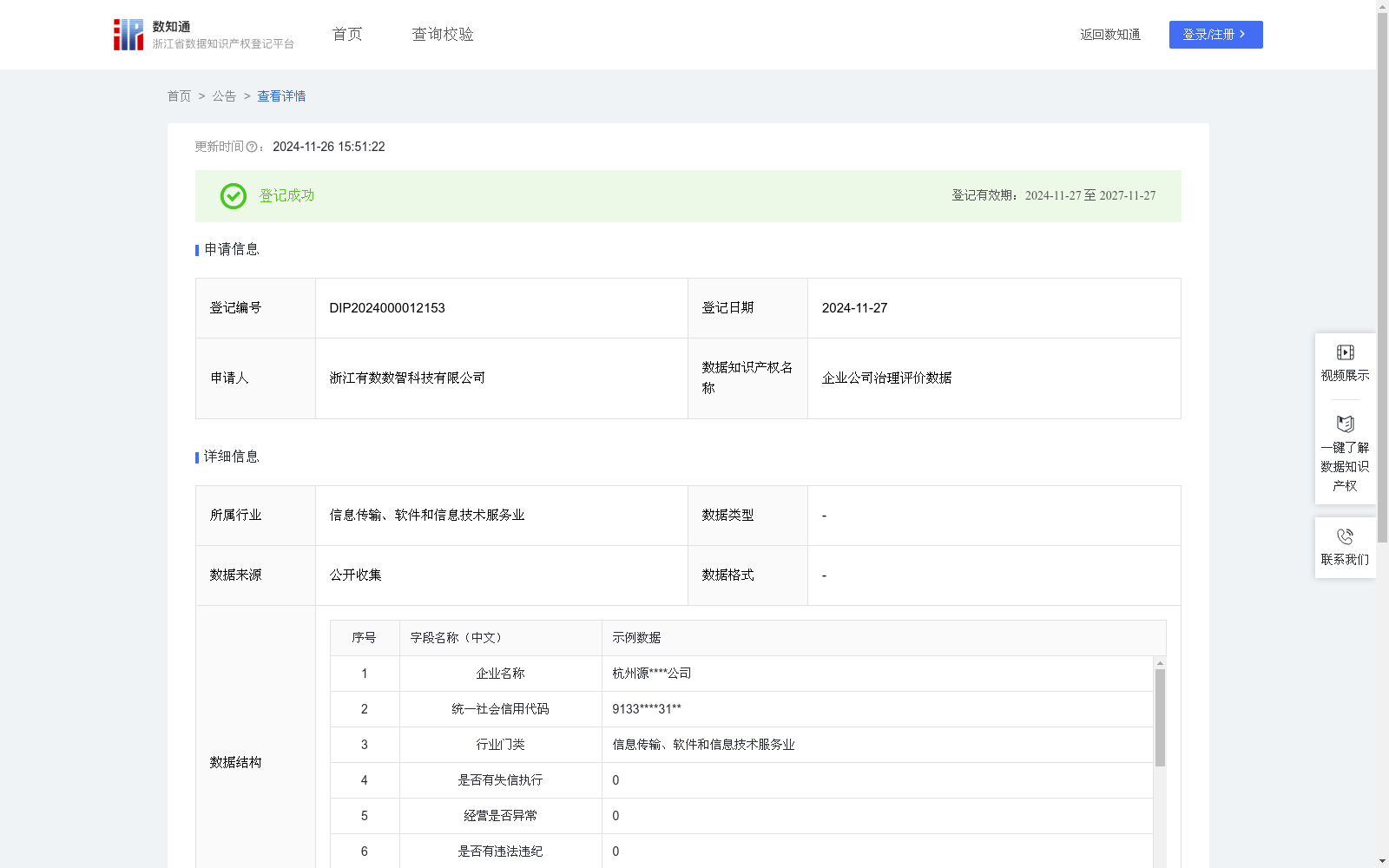
企业公司治理评价数据
收藏资源简介:
支持金融机构在金融场景下营销获客、尽调、风险监控、宏观研究的应用,我司基于企业的社会特征并结合数据的可获得性和有效性,构建了企业公司治理评价模型,基于该模型得出企业公司治理评价数据,协助金融机构从微观角度和宏观角度进行分析,可以动态监控单家企业公司治理评价数据的变动情况,及时发现企业经营的异常情况,也可以结合地域、行业等属性宏观分析整体的情况,再对比单家企业所处的水平。企业公司治理评价分=S1*(是否有失信执行)+S2*(经营是否异常)+S3*(是否有违法违纪)+S4*(行政处罚数量)+S5*(是否有行政违法失信)+S6*(授权专利数量)+S7*(是否有知识产权管理体系)+S8*(是否为科创型、高成长性企业)+S9*(是否有科技厅奖项获奖)+S10*(是否有行业资质许可)+S11*(是否有不当竞争纠纷)+S12*(是否有劳务纠纷),S1-S12是通过层次分析法得出的不同权重系数。
This dataset enables financial institutions to carry out applications including marketing-driven customer acquisition, due diligence, risk monitoring, and macroeconomic research within financial scenarios. Our company developed a corporate governance evaluation model for enterprises by leveraging their social characteristics, while considering data availability and validity. Corporate governance evaluation data for enterprises are generated using this model, which helps financial institutions perform analyses from both micro and macro perspectives. The system can dynamically track changes in the corporate governance evaluation data of individual enterprises, timely identify abnormal business conditions of enterprises, conduct macro-level overall analysis by integrating attributes such as region and industry, and compare the standing of individual enterprises against the overall benchmark. The Corporate Governance Evaluation Score is calculated as: Corporate Governance Evaluation Score = S1 × (Presence of enforced dishonesty cases) + S2 × (Presence of abnormal business operations) + S3 × (Presence of violations of laws and disciplinary regulations) + S4 × (Number of administrative penalties) + S5 × (Presence of administrative illegal and dishonest conduct) + S6 × (Number of authorized patents) + S7 × (Presence of intellectual property management systems) + S8 × (Sci-tech-oriented and high-growth enterprise status) + S9 × (Presence of awards from the Department of Science and Technology) + S10 × (Possession of valid industry qualification licenses) + S11 × (Presence of unfair competition disputes) + S12 × (Presence of labor disputes). Here, S1 to S12 are distinct weight coefficients derived via the Analytic Hierarchy Process (AHP).