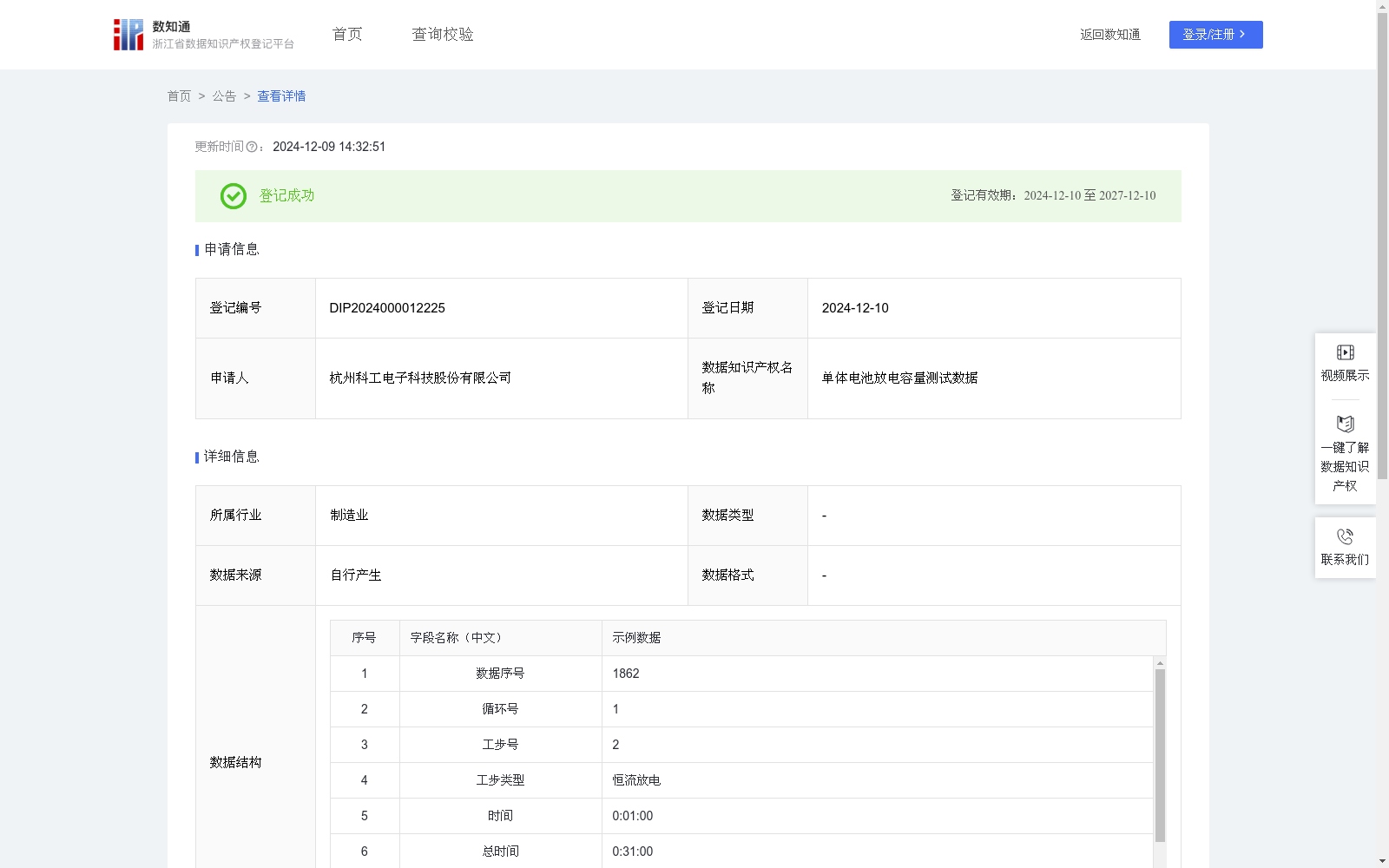
单体电池放电容量测试数据
收藏资源简介:
电池制造商可以通过单体电池放电容量测试数据来评估电池的质量和性能。这有助于确保生产的电池符合既定的标准和规格,从而提高产品的可靠性和市场竞争力。通过测试数据,制造商可以及时发现生产过程中的问题,如原材料质量、生产工艺等,从而采取相应的改进措施,降低次品率和退货率,提高客户满意度。同时,测试数据还可以为电池产品的定价提供依据。根据电池的放电容量、性能表现以及市场需求,制造商可以制定合理的价格策略,确保产品在市场上的竞争力。基于单体电池管理模块(BMS)对单体电池数据进行采集,包括电池编号,工步类型,工步时间,总时间,瞬时电流,瞬时电压等数据,采样以一天24小时为周期,按时间顺序以1秒为时间间隔进行数据采样;2、数据处理:将数据清洗、去噪,补充完整;3、数据加工:电池是以搁置-放电-搁置-充电进行循环工步动作,循环号表示当前的循环次数,工步号表示现在为第几个工步,当前工步时间表示当前工步已经进行的时间,总时间表示从第一次循环时间开始到现在的绝对时间。瞬时电流、瞬时电压是该时间点传感器采集到的信号。计算放电容量,首先判断当前工步类型,工步类型为放电工步时启动计算,放电容量的计算公式为Q(容量)=I(电流)*T(时间)为基本公式,实践中用瞬时电流乘以时间1s,按当前工步时间进行积分,例如当前工步是恒流放电,当前工步时间是1分15秒,就是对这75秒的电流和时间相乘的结果进行求和。当放电容量达到最大值时,也就是拐点时,即为该电池当前的放电容量。工步类型非放电工步时放电容量统一为0。
Battery manufacturers can evaluate the quality and performance of single-cell batteries using discharge capacity test data. This helps ensure that manufactured batteries comply with predefined standards and specifications, thereby enhancing product reliability and market competitiveness. By analyzing these test data, manufacturers can timely detect issues in the production process, such as raw material quality and production craftsmanship, and take targeted improvement measures to reduce the defective rate and return rate, improving customer satisfaction. Meanwhile, test data can also serve as a basis for battery product pricing. Based on the discharge capacity, performance and market demand of batteries, manufacturers can develop reasonable pricing strategies to maintain their product competitiveness in the market. 1. Data Collection: The single-cell Battery Management Module (BMS) is utilized to collect single-cell battery data, including battery ID, step type, step duration, total elapsed time, instantaneous current, instantaneous voltage and other relevant parameters. The sampling cycle is 24 hours per day, and data is sampled at 1-second intervals in chronological order. 2. Data Preprocessing: Clean, denoise and supplement the collected data to ensure data integrity. 3. Data Post-processing and Feature Calculation: Batteries operate in cyclic test steps of rest-discharge-rest-charge. The cycle number indicates the current cycle count, the step number represents the sequence number of the current test step, the current step elapsed time refers to the time elapsed since the start of the current step, and the total elapsed time represents the absolute time elapsed since the beginning of the first cycle. Instantaneous current and instantaneous voltage are the signals collected by sensors at the corresponding time point. To calculate the discharge capacity, first determine the type of the current step: the calculation is initiated only when the step type is a discharge step. The basic formula for discharge capacity is Q (capacity) = I (current) × T (time). In practical applications, the integral calculation is performed by multiplying the instantaneous current by the 1-second sampling interval and summing the products over the duration of the current step. For example, if the current step is constant-current discharge and the current step elapsed time is 1 minute and 15 seconds, the products of current and time for these 75 seconds are summed. When the discharge capacity reaches its maximum value, i.e., the inflection point, this value is the current discharge capacity of the single battery. For test steps that are not discharge steps, the discharge capacity is uniformly set to 0.