订单商品实际金额--让利金额计算模型
收藏资源简介:
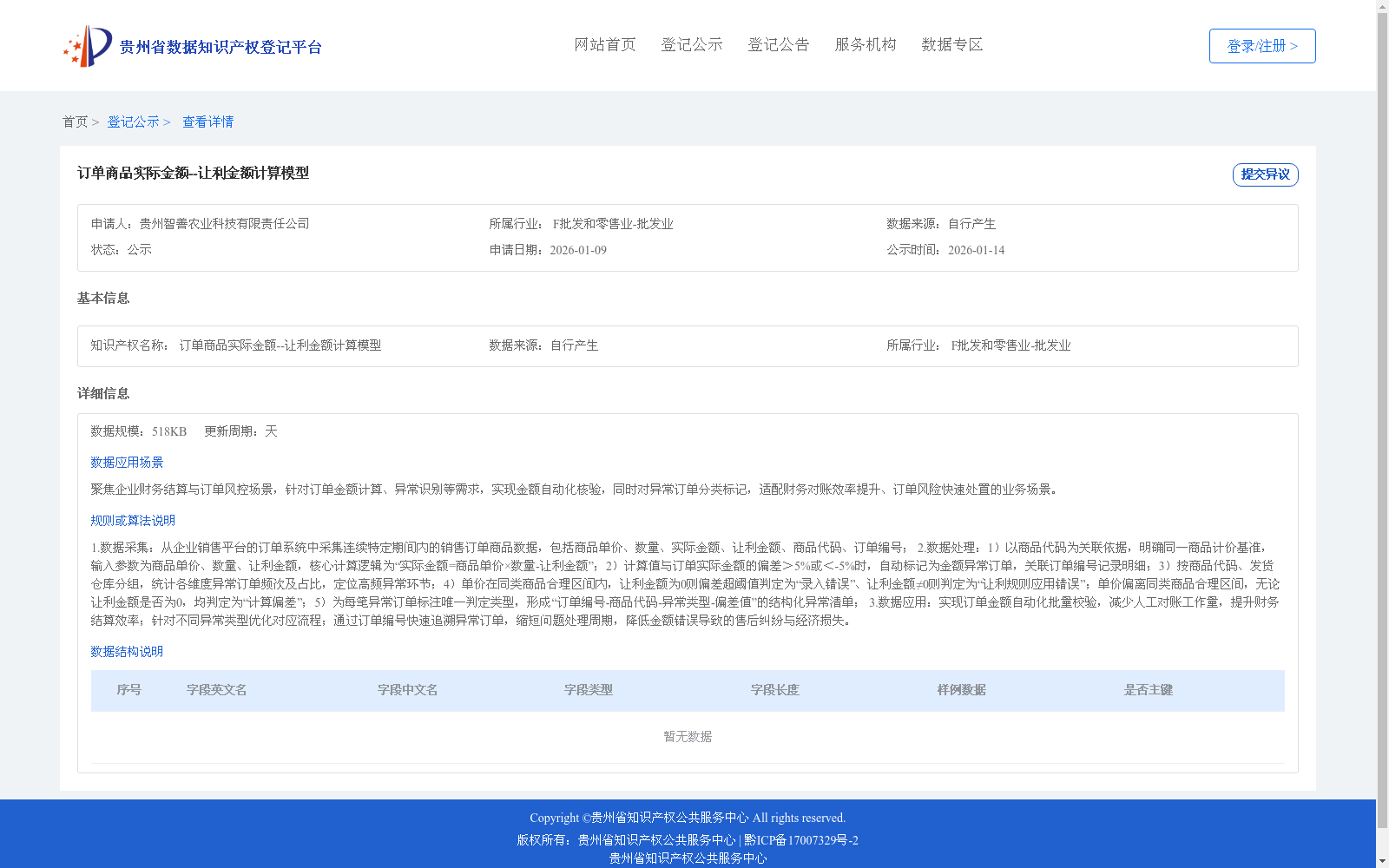
1.数据采集:从企业销售平台的订单系统中采集连续特定期间内的销售订单商品数据,包括商品单价、数量、实际金额、让利金额、商品代码、订单编号; 2.数据处理:1)以商品代码为关联依据,明确同一商品计价基准,输入参数为商品单价、数量、让利金额,核心计算逻辑为“实际金额=商品单价×数量-让利金额”;2)计算值与订单实际金额的偏差>5%或<-5%时,自动标记为金额异常订单,关联订单编号记录明细;3)按商品代码、发货仓库分组,统计各维度异常订单频次及占比,定位高频异常环节;4)单价在同类商品合理区间内,让利金额为0则偏差超阈值判定为“录入错误”、让利金额≠0则判定为“让利规则应用错误”;单价偏离同类商品合理区间,无论让利金额是否为0,均判定为“计算偏差”;5)为每笔异常订单标注唯一判定类型,形成“订单编号-商品代码-异常类型-偏差值”的结构化异常清单; 3.数据应用:实现订单金额自动化批量校验,减少人工对账工作量,提升财务结算效率;针对不同异常类型优化对应流程;通过订单编号快速追溯异常订单,缩短问题处理周期,降低金额错误导致的售后纠纷与经济损失。
1. Data Collection: Collect sales order item data within a continuous specified period from the order system of the enterprise sales platform, including unit price of goods, quantity, actual amount, discount amount, item code, and order number; 2. Data Processing: 1) Take the item code as the association basis to clarify the pricing benchmark for identical goods. The input parameters are unit price of goods, quantity and discount amount, and the core calculation logic is "Actual Amount = Unit Price of Goods × Quantity - Discount Amount"; 2) When the deviation between the calculated value and the actual order amount is greater than 5% or less than -5%, automatically mark it as an amount abnormal order, and associate the order number to record details; 3) Group by item code and delivery warehouse, count the frequency and proportion of abnormal orders in each dimension, and locate high-frequency abnormal links; 4) If the unit price is within the reasonable range of goods of the same category, and the discount amount is 0, the deviation exceeding the threshold will be judged as "entry error"; if the discount amount is not 0, it will be judged as "discount rule application error"; If the unit price deviates from the reasonable range of goods of the same category, regardless of whether the discount amount is 0 or not, it will be judged as "calculation deviation"; 5) Mark a unique judgment type for each abnormal order, and form a structured abnormal list of "Order Number - Item Code - Abnormal Type - Deviation Value"; 3. Data Application: Achieve automated batch verification of order amounts, reduce manual reconciliation workload, and improve financial settlement efficiency; Optimize corresponding processes for different abnormal types; Quickly trace abnormal orders through order numbers, shorten the problem handling cycle, and reduce after-sales disputes and economic losses caused by amount errors.