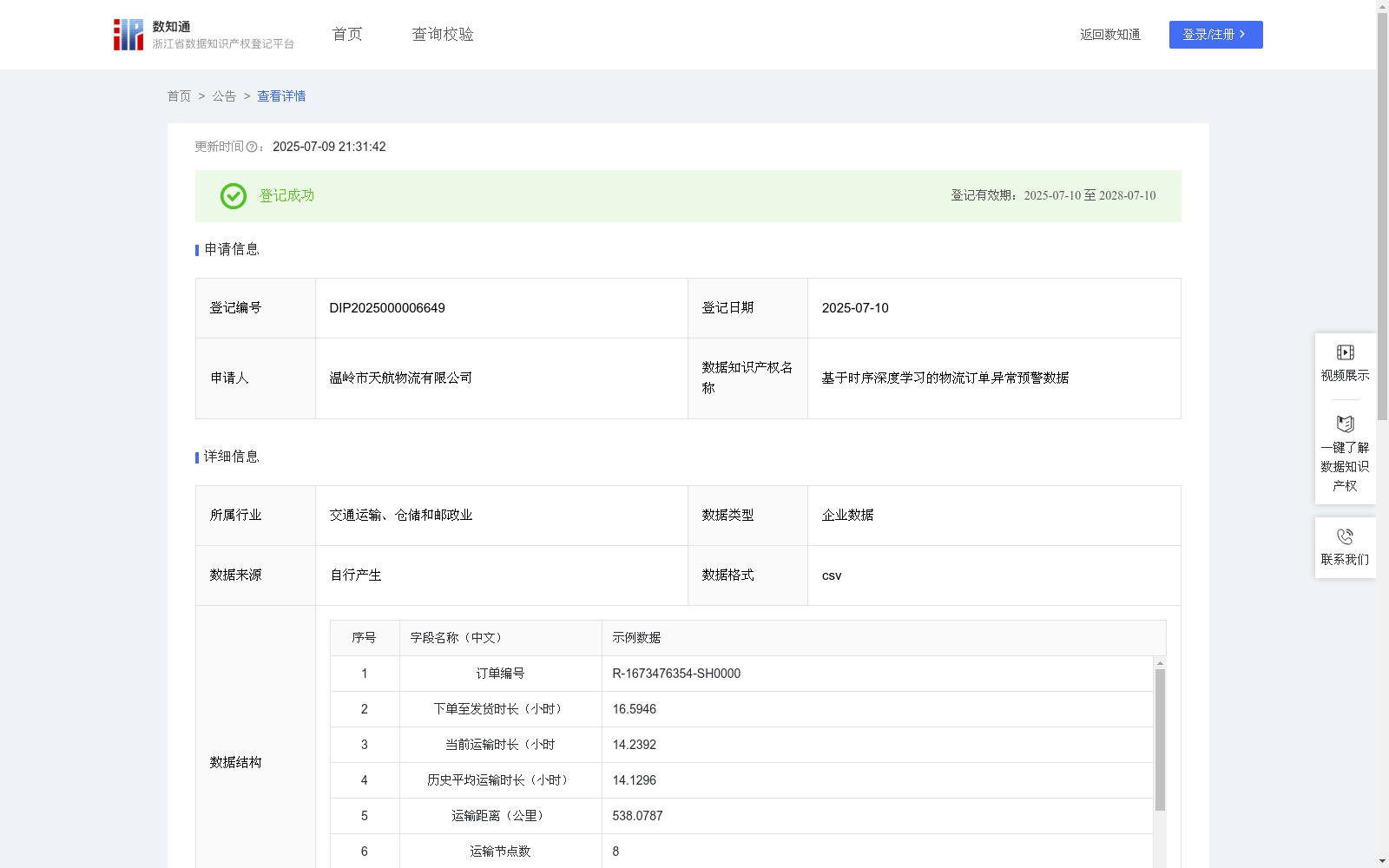
基于时序深度学习的物流订单异常预警数据
收藏资源简介:
基于时序深度学习技术在物流订单异常预警中具有重要的应用价值。能够提供订单状态行为建模,更精确地识别潜在异常订单,帮助物流调度员进行智能预警与资源调配。这项技术在物流配送系统中具有广泛的应用场景,特别是跨区域物流延迟识别、冷链运输监控和高风险订单预防,能够提高配送可靠性,降低客户投诉率,提供智能化运单风险评估能力。数据收集: 模型所用数据来源于物流信息系统中的实时和历史订单记录,包含订单编号、下单至发货时长、当前运输时长、历史平均运输时长、运输距离、GPS偏移率、是否冷链运输、温度偏差值。每条数据样本以订单编号为索引,结合人工标注的异常标签组成训练和验证数据集,用于构建时序分类模型。 数据预处理: 针对每条订单记录进行如下处理: 对运输时长、温度偏差率、GPS偏移率等连续变量进行归一化处理。 将是否冷链运输进行二值编码处理。 提取时间序列特征(如每小时状态变动、温度波动曲线)并用固定窗口进行切片处理,构建可输入模型的时间序列张量。 异常标签字段作为监督信号参与模型训练,预测输出为异常概率值。 模型构建: 采用基于长短期记忆网络(LSTM)的异常检测模型,模型结构包括输入层、两层LSTM层和一层全连接输出层。输入为包含时间维度的订单行为序列,输出为异常概率。 具体计算公式如下: 隐藏状态序列的计算: 时间步t的隐藏状态表示为: 隐藏状态_t = LSTM(输入序列_t,前一时刻隐藏状态_t-1) 最终异常概率输出为: 模型预测异常概率 = Sigmoid(权重矩阵 × 最终隐藏状态 + 偏置项) 其中: 输入序列_t包含字段:下单至发货时长、当前运输时长、历史平均运输时长、运输距离、运输节点数、GPS偏移率、是否冷链运输、温度偏差值 模型预测异常概率字段为最终输出,对应字段“模型预测异常概率” 异常标签作为训练时的目标值,对应字段“异常标签” Sigmoid函数用于将模型输出值映射为0到1之间的异常概率 损失函数使用二元交叉熵函数用于最小化预测值与真实异常标签之间的误差 通过上述模型,系统可实时识别物流过程中的潜在异常,辅助调度人员优先处理高风险订单,实现订单智能分级与动态预警响应。
Temporal deep learning technologies hold significant application value in logistics order anomaly early warning. They enable order state behavior modeling, more accurately identify potential anomalous orders, and assist logistics dispatchers in implementing intelligent early warning and resource allocation. This technology has a wide range of application scenarios in logistics distribution systems, particularly in cross-regional logistics delay identification, cold chain transportation monitoring, and high-risk order prevention. It can improve delivery reliability, reduce customer complaint rates, and provide intelligent waybill risk assessment capabilities. Data Collection: The data used by the model originates from real-time and historical order records in the logistics information system, including order number, duration from order placement to shipment, current transportation duration, historical average transportation duration, transportation distance, GPS offset rate, whether it is cold chain transportation, and temperature deviation value. Each data sample is indexed by the order number, and forms the training and validation datasets together with manually annotated anomaly labels, which are used to construct a temporal classification model. Data Preprocessing: The following processing is performed for each order record: 1. Normalize continuous variables such as transportation duration, temperature deviation rate, and GPS offset rate. 2. Perform binary encoding on the "whether it is cold chain transportation" field. 3. Extract time series features (such as hourly state changes, temperature fluctuation curves) and slice them using fixed windows to construct time series tensors that can be input into the model. The anomaly label field serves as a supervision signal for model training, and the prediction output is the anomaly probability value. Model Construction: An anomaly detection model based on Long Short-Term Memory (LSTM) is adopted. The model structure includes an input layer, two LSTM layers, and one fully connected output layer. The input is the order behavior sequence with time dimension, and the output is the anomaly probability. Specific calculation formulas are as follows: Calculation of hidden state sequence: The hidden state at time step t is expressed as: Hidden State_t = LSTM(Input Sequence_t, Previous Hidden State_{t-1}) The final anomaly probability output is: Model Predicted Anomaly Probability = Sigmoid(Weight Matrix × Final Hidden State + Bias Term) Wherein: Input Sequence_t includes the following fields: duration from order placement to shipment, current transportation duration, historical average transportation duration, transportation distance, number of transportation nodes, GPS offset rate, whether it is cold chain transportation, and temperature deviation value The model predicted anomaly probability field is the final output, corresponding to the field "Model Predicted Anomaly Probability". The anomaly label serves as the target value during training, corresponding to the field "Anomaly Label". The Sigmoid function is used to map the model's output value to an anomaly probability between 0 and 1. The binary cross-entropy function is used as the loss function to minimize the error between the predicted values and the true anomaly labels. Through the above model, the system can identify potential anomalies in the logistics process in real time, assist dispatchers in prioritizing high-risk orders, and realize intelligent order classification and dynamic early warning response.