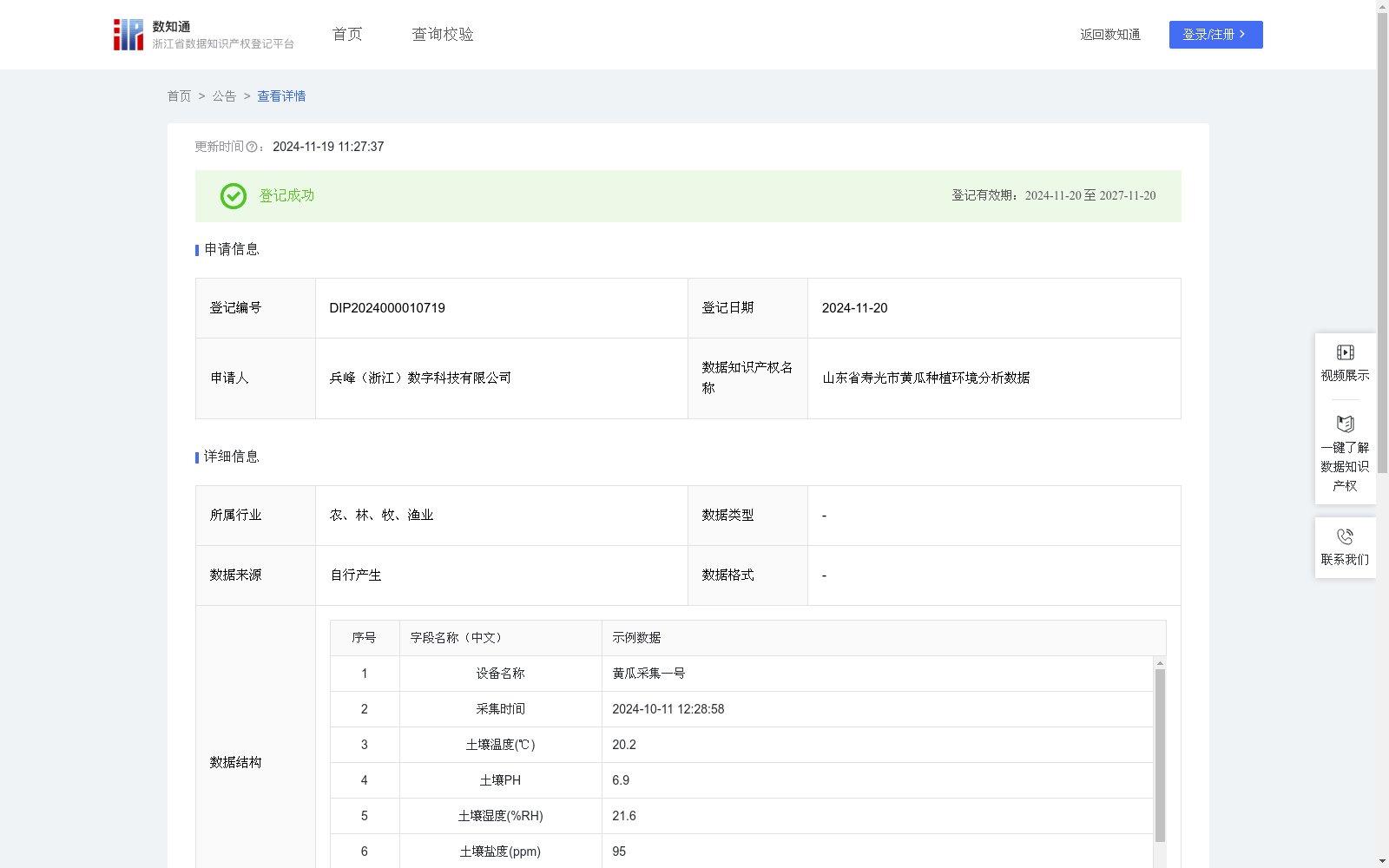
山东省寿光市黄瓜种植环境分析数据
收藏资源简介:
采集黄瓜种植的土壤湿温度、土壤盐度、土壤PH、土壤电导率等数据,这些数据直接反映了土壤的健康状态和肥力水平,为种植者提供了科学决策的依据。通过监测土壤湿度与温度,种植者能够精确控制灌溉量和灌溉时机,确保黄瓜根系处于最佳生长环境,促进果实发育。土壤盐度与电导率的测量则帮助识别土壤盐碱化风险,及时调整施肥方案,避免盐分过高对黄瓜造成损害。同时,土壤pH值的监测对于调节土壤酸碱度、优化养分吸收至关重要,有助于提升黄瓜品质和产量。综上所述,这些数据在黄瓜种植中的应用,不仅提高了资源利用效率,还促进了黄瓜产业的可持续发展。1.数据采集:通过土壤PH传感器、土壤盐度传感器、土壤电导率传感器、土壤温湿度传感器等物联网设备,结合4G/5G、Wi-Fi与有线网络,实时采集种植环境中的土壤PH、土壤盐度、土壤电导率、土壤温湿度等多维数据。 2.算法规则:系统采用环境参数评分算法,对环境数据进行评分。基于作物生长理想条件(如土壤PH、土壤盐度、土壤电导率、土壤温湿度等),并通过以下公式计算:环境参数评分=100-Σ(w_i×|当前值_i-理想值_i|/容差_i)其中,Σ表示对所有参数的累加,w_i是第i个参数的权重。当前值_i是第i个参数的实际测量值,理想值_i是第i个参数的理想值。容差_i是第i个参数的允许波动范围。权重、理想值和容差范围设定基于历史数据分析以及实际种植经验的确定。对作物生长影响较大的参数获得较高的权重。容差范围则考虑到环境因素的波动性,针对作物对不同环境变化的耐受性设定进行适当设定,环境参数偏离理想值越多,扣分越大,以土壤湿度为例,其权重为2,理想值设定为70,容差范围为±10,扣分计算如下:土壤湿度扣分=2×|21.6-70|/10=2×4.84=9.68。根据这些评分生成具体的环境优化方案。
This dataset collects data including soil moisture and temperature, soil salinity, soil pH, and soil electrical conductivity from cucumber cultivation. These data directly reflect soil health status and fertility level, providing a scientific basis for decision-making for growers. By monitoring soil moisture and temperature, growers can precisely control irrigation volume and timing, ensuring that cucumber root systems are in an optimal growing environment and promoting fruit development. Soil salinity and electrical conductivity measurements help identify soil salinization risks, allowing growers to adjust fertilization plans promptly and avoid damage to cucumbers caused by excessive salt levels. Meanwhile, monitoring soil pH is critical for regulating soil acidity and alkalinity and optimizing nutrient absorption, which helps improve cucumber quality and yield. In summary, the application of these data in cucumber cultivation not only improves resource use efficiency but also promotes the sustainable development of the cucumber industry. 1. Data Collection: Multi-dimensional soil data including pH, salinity, electrical conductivity, moisture and temperature in the cultivation environment are collected in real-time via IoT devices such as soil pH sensors, soil salinity sensors, soil electrical conductivity sensors, and soil temperature and humidity sensors, combined with 4G/5G, Wi-Fi and wired networks. 2. Algorithm Rules: The system adopts an environmental parameter scoring algorithm to score environmental data. Based on the ideal growth conditions of crops (such as soil pH, salinity, electrical conductivity, moisture and temperature), the score is calculated using the following formula: Environmental Parameter Score = 100 - Σ(w_i × |Current Value_i - Ideal Value_i| / Tolerance_i) where Σ denotes the summation over all parameters, w_i is the weight of the i-th parameter, Current Value_i is the actual measured value of the i-th parameter, Ideal Value_i is the ideal value of the i-th parameter, and Tolerance_i is the allowable fluctuation range of the i-th parameter. The weights, ideal values and tolerance ranges are determined based on historical data analysis and actual cultivation experience. Parameters that have a greater impact on crop growth are assigned higher weights. The tolerance ranges are appropriately set considering environmental volatility and crop tolerance to different environmental changes. The more the environmental parameters deviate from the ideal values, the more points are deducted. Taking soil moisture as an example, its weight is 2, the ideal value is set to 70, and the tolerance range is ±10. The deduction calculation is as follows: Soil Moisture Deduction = 2 × |21.6 - 70| / 10 = 2 × 4.84 = 9.68. Specific environmental optimization plans are generated based on these scores.