
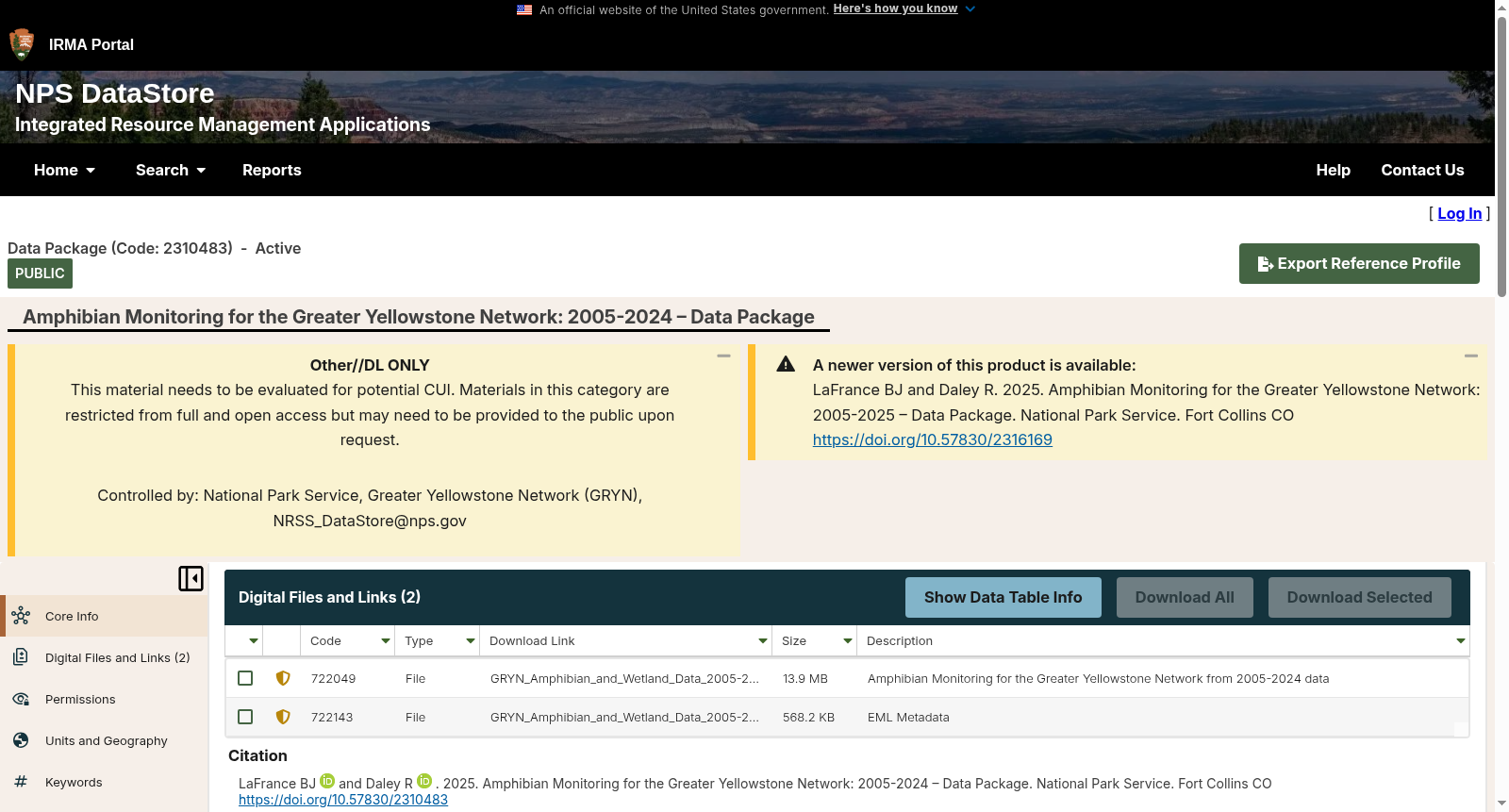
Amphibian Monitoring for the Greater Yellowstone Network: 2005-2024 – Data Package
收藏DataCite Commons2025-04-22 更新2025-05-18 收录
下载链接:
https://irma.nps.gov/DataStore/Reference/Profile/2310483
下载链接
链接失效反馈官方服务:
资源简介:
This data package contains the final flattened csv file and associated metadata for data collected following the amphibian and wetland monitoring protocol under the Greater Yellowstone Inventory and Monitoring Network. Amphibian and wetland monitoring surveys have been conducted annually in Grand Teton and Yellowstone national parks and John D. Rockefeller, Jr. Memorial Parkway since 2005. The main goals of this program are to estimate wetland flooding and amphibian breeding occurrence rates. These annual measures of amphibian occurrence and wetland dynamics offer insights about changing wetland conditions and amphibian status and trends, contributing to local, regional, and national level trend analysis. This work, when combined with historical data, will provide managers and the public with information on a class of native fauna and on wetland characteristics that are important for understanding long-term trends or climate induced changes to wetlands.
This data package includes all wetland site visits and associated data from 2005-2024. The methodology consists of dual-observer visual encounter surveys with single visits per year to a target site (although some sites were visited multiple times per year in 2005 and 2006). The data collected in 2005 represent trial methods and are not intended for analysis with or comparison to data collected starting in 2006. Catchments in the low-quality stratum of the study design were found to provide scant information due to the low occurrence of detected breeding sites in the small number of catchments that GRYN was able to survey. Therefore, this stratum has been largely excluded from annual monitoring since 2011. Additional habitat and weather data were collected on site. The annual goal of the protocol is to conduct surveys in over 300 sites dispersed throughout 31 core catchments (sampling units). However, the Greater Yellowstone Network crews often survey more areas when resources allow. All four native species targeted for occupancy monitoring are surveyed for and found within the core catchments: Boreal Chorus Frog (Pseudacris maculata), Columbia Spotted Frog (Rana luteiventris), Western Tiger Salamander (Ambystoma mavortium), and Western Toad (Anaxyrus boreas). Note that Western Toad is operationally protected within Grand Teton and Yellowstone national parks as per 2019 memos (https://irma.nps.gov/DataStore/Reference/Profile/2263658; https://irma.nps.gov/DataStore/Reference/Profile/2263657), which limits unauthorized use or sharing of their data and location information.
本数据包包含遵循大黄石清单与监测网络(Greater Yellowstone Inventory and Monitoring Network)两栖动物与湿地监测规程采集的最终扁平化CSV文件及相关元数据。自2005年起,项目团队已在大提顿国家公园、黄石国家公园以及约翰·D·洛克菲勒小纪念大道沿线持续开展年度两栖动物与湿地监测调查。本监测项目的核心目标为估算湿地淹水范围与两栖动物繁殖出现率。这些年度两栖动物出现情况与湿地动态监测数据,可为湿地环境变化、两栖动物种群状况及变化趋势提供科学依据,支撑地方、区域乃至国家级的趋势分析工作。本数据集结合历史资料后,可为管理者与公众提供本土两栖动物类群及湿地特征的相关信息,助力理解湿地长期变化趋势或气候变化引发的湿地扰动。
本数据包涵盖2005年至2024年所有湿地野外踏勘及相关监测数据。监测方法采用双观察者目视偶遇调查法,目标样地每年仅开展1次调查(2005年与2006年部分样地曾开展年度多次踏勘)。2005年采集的数据为试验性方法所得,不可与2006年起采集的正式监测数据进行分析对比或混用。研究设计中低质量层级的集水区,因大黄石监测网络(Greater Yellowstone Network,简称GRYN)可踏勘的集水区数量较少,且其中检测到的繁殖位点出现率极低,导致该层级集水区所能提供的监测信息极为匮乏。因此,自2011年起,该层级集水区已基本不再纳入年度监测范围。本数据集同时采集了样地生境与气象的额外监测数据。本监测规程的年度目标为在31个核心集水区(抽样单元)内的300余个样地开展调查。当资源条件允许时,大黄石监测网络的野外工作组通常会拓展踏勘范围,覆盖更多样地。核心集水区内共监测到4种目标本土两栖动物,分别为:北方鸣蛙(Boreal Chorus Frog,*Pseudacris maculata*)、哥伦比亚斑点蛙(Columbia Spotted Frog,*Rana luteiventris*)、西部虎钝口螈(Western Tiger Salamander,*Ambystoma mavortium*)以及西部蟾蜍(Western Toad,*Anaxyrus boreas*)。请注意:根据2019年相关备忘录,西部蟾蜍在大提顿国家公园与黄石国家公园内受操作层面保护(相关链接:https://irma.nps.gov/DataStore/Reference/Profile/2263658;https://irma.nps.gov/DataStore/Reference/Profile/2263657),严禁未经授权使用或共享其监测数据与位点信息。
创建时间:
2025-04-22
搜集汇总
数据集介绍
背景与挑战
背景概述
该数据集为美国国家公园管理局发布的大黄石网络两栖动物监测数据包,涵盖2005年至2024年期间在大黄石、大提顿国家公园等区域采集的两栖动物和湿地监测数据。数据集旨在通过双观察者视觉调查方法,评估四种本地两栖动物物种的繁殖发生率和湿地动态,为长期生态趋势和气候变化影响研究提供支持。需要注意的是,2005年数据为试验方法,且西部蟾蜍数据受操作保护限制。
以上内容由遇见数据集搜集并总结生成


