depthrecall-ag-1000ep
收藏资源简介:
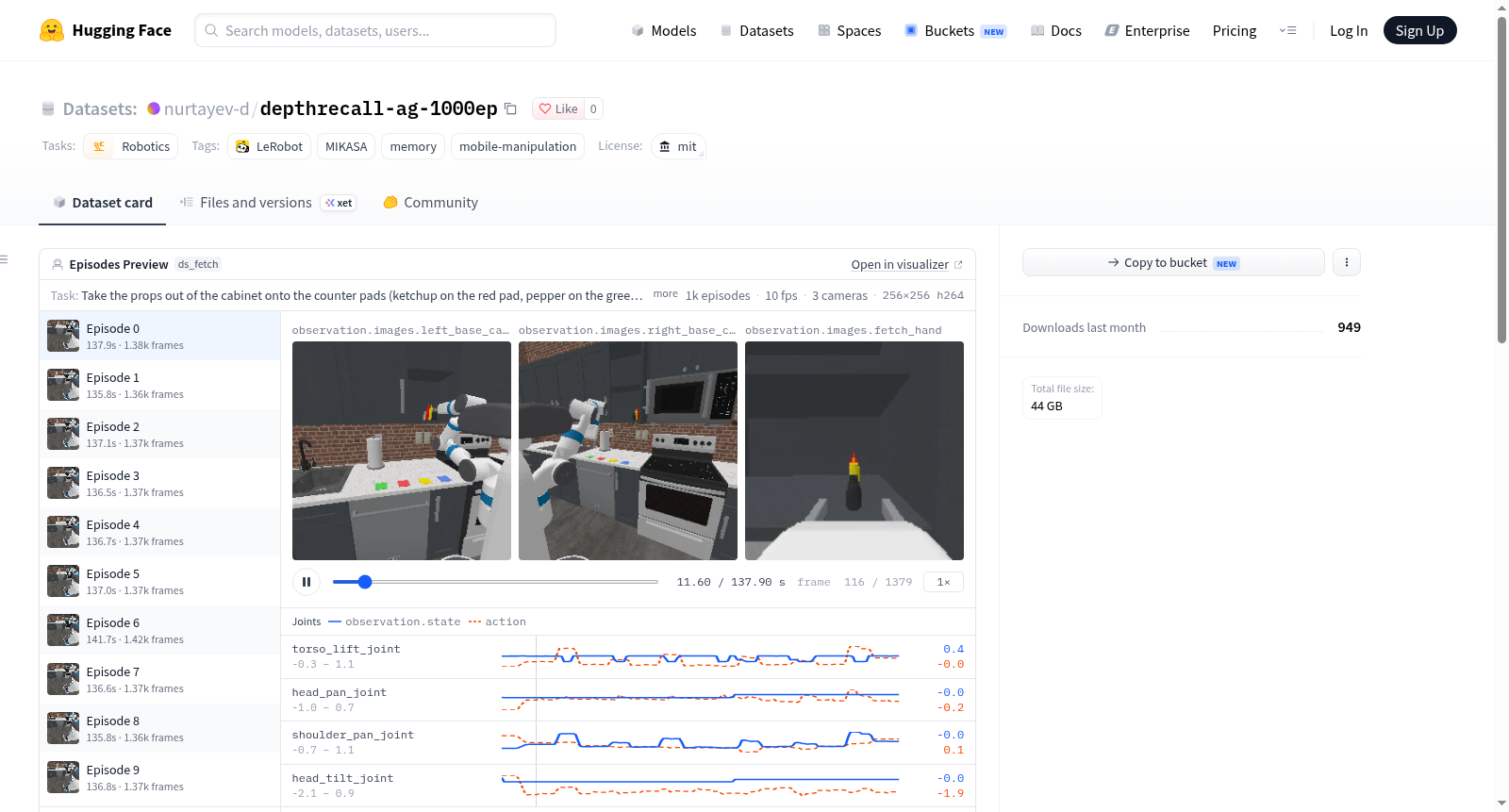
MIKASA DepthRecall(DSFetch,辅助抓取)是一个采用 MIT 许可证、任务类别为 robotics 的 LeRobot v3.0 机器人数据集,标签包括 LeRobot、MIKASA、memory 和 mobile-manipulation。它包含 MIKASA 记忆任务 MikasaDepthRecall-v1 在 DsFetch 移动机械臂(ds_fetch,MIKASA-Robo-MMM @ 4c5c8b3)上的 oracle(运动规划器)演示,采集使用 ManiSkill 3、CPU PhysX 和 collection profile 6。采集环境启用了辅助抓取(assisted_grasp: true):OmniGibson 的规则会在至少两根手指接触物体、物体位于夹爪垫之间且夹爪正在闭合时,将抓取物体焊接到手上(自由物体为刚性焊接,手柄为球形保持),并在夹爪打开时释放;策略应在相同环境中评测。数据集共 1000 个成功 episode,1376876 帧,频率为 10 Hz;控制录制频率为 20 Hz,保留每第二个控制步,动作保持两个控制步并在 10 Hz 下物理重放。action 为 13 维 pd_joint_pos,包括 7 个机械臂关节、夹爪、头部 pan、头部 tilt、躯干、基座前进速度和基座偏航角速度。observation.state 为 12 维,对应关节位置 qpos[3:];global_state(3 维基座位姿)仅用于调试,不作为策略输入。相机仅提供 RGB:left_base_camera_link 256x256、right_base_camera_link 256x256、fetch_hand 128x128。归一化统计包含全局和逐 episode 的 q01/q10/q50/q90/q99(用于 pi0 / pi0.5 分位数归一化)。语言指令有 1 条,每条少于 100 个 PaliGemma token。选择与成功率信息保存在 meta/source_rlds_metadata.json / source_h5_metadata.json 中,记录 seeds、长度、时长、奖励、成功与失败 seed;规划器在全部 1100 个尝试 seed 上成功 1057 个,成功率 96.1%。episode 选择为按采集顺序(批次号,然后批次导出内的 episode 顺序)保留前 1000 个接受的 episode,另有 57 个接受的 episode 未纳入。validation_seeds.json 提供 100 个规划器可解决的场景 seed,未用于采集或开发,应使用这些 seed 精确评测策略。任务指令为:把道具从柜子取出放到柜台垫子上(番茄酱放红垫、胡椒放绿垫、盐放蓝垫、芥末放黄垫),保留从后面拿取的那个,并将其余道具放回原处。该数据集适用于移动操作、机器人记忆任务、视觉-语言-动作策略训练与评测,尤其适合基于 LeRobot 格式、在相同辅助抓取环境下进行策略开发和评估。
MIKASA DepthRecall (DSFetch, assisted grasping) is a LeRobot v3.0 robotics dataset under the MIT license, with task category robotics and tags including LeRobot, MIKASA, memory, and mobile-manipulation. It contains oracle (motion planner) demonstrations for the MIKASA memory task MikasaDepthRecall-v1 on the DsFetch mobile manipulator (ds_fetch, MIKASA-Robo-MMM @ 4c5c8b3), collected using ManiSkill 3, CPU PhysX, and collection profile 6. The collection environment enables assisted grasping (assisted_grasp: true): OmniGibson rules weld a grasped object to the hand when at least two fingers contact the object, the object is between the gripper pads, and the gripper is closing (rigid welding for free objects, spherical holding for handles), and release when the gripper opens; policies should be evaluated in the same environment. The dataset has 1000 successful episodes and 1376876 frames at 10 Hz; control recording frequency is 20 Hz, retaining every second control step, with actions held for two control steps and physically replayed at 10 Hz. action is a 13-dimensional pd_joint_pos, including 7 robot arm joints, gripper, head pan, head tilt, torso, base forward velocity, and base yaw angular velocity. observation.state is 12-dimensional, corresponding to joint positions qpos[3:]; global_state (3-dimensional base pose) is for debugging only and is not used as policy input. Cameras provide RGB only: left_base_camera_link 256x256, right_base_camera_link 256x256, fetch_hand 128x128. Normalization statistics include global and per-episode q01/q10/q50/q90/q99 (for pi0 / pi0.5 quantile normalization). There is 1 language instruction, each fewer than 100 PaliGemma tokens. Selection and success information are saved in meta/source_rlds_metadata.json / source_h5_metadata.json, recording seeds, lengths, durations, rewards, success and failure seeds; the planner succeeded on 1057 of all 1100 attempted seeds, a success rate of 96.1%. Episode selection keeps the first 1000 accepted episodes in collection order (batch number, then episode order within batch export), with 57 additional accepted episodes not included. validation_seeds.json provides 100 planner-solvable scene seeds not used for collection or development; these seeds should be used to precisely evaluate policies. The task instruction is: take props out of the cabinet and place them on counter mats (ketchup on red mat, pepper on green mat, salt on blue mat, mustard on yellow mat), keep the one taken from behind, and put the remaining props back. This dataset is suitable for mobile manipulation, robotic memory tasks, and vision-language-action policy training and evaluation, especially for policy development and evaluation based on LeRobot format in the same assisted grasping environment.
MIKASA DepthRecall (DSFetch, assisted grasp) — 1000 successful episodes (LeRobot v3.0)
基本信息
- 数据集详情页:
https://huggingface.co/datasets/nurtayev-d/depthrecall-ag-1000ep - 许可证:mit
- 任务类别:robotics
- 标签:LeRobot、MIKASA、memory、mobile-manipulation
- 版本:LeRobot v3.0
数据来源与环境
- 演示类型:Oracle(运动规划器)演示
- 任务:MIKASA 记忆任务
MikasaDepthRecall-v1 - 机器人:DSFetch 移动操作机器人(
ds_fetch,代码仓库:https://github.com/jezvgg/MIKASA-Robo-MMM@ 4c5c8b3) - 仿真与配置:ManiSkill 3、CPU PhysX、collection profile 6
- 辅助抓取:开启(收集环境 kwargs 中
assisted_grasp: true)- OmniGibson 规则:当至少两根手指接触物体、物体位于指垫之间且夹爪正在闭合时,将抓取物体焊接到手部;自由物体为刚性焊接,手柄为球形保持;夹爪打开时释放。
- 策略应在相同环境中评估。
数据规模与录制
- 回合数:1000
- 帧数:1376876
- 帧率:10 Hz
- 录制方式:以 20 Hz 控制录制并每隔一步保留;动作保持两个控制步,并以 10 Hz 物理回放。
数据字段
action:13D,pd_joint_pos,包含 7 个手臂关节、夹爪、头部 pan、头部 tilt、躯干、基座前进速度、基座偏航角速度。observation.state:12D,关节位置qpos[3:];global_state(3D 基座位姿)仅供调试,不作为策略输入。- 相机:仅 RGB;left_base_camera_link 256x256、right_base_camera_link 256x256、fetch_hand 128x128。
- 归一化统计:包含 q01/q10/q50/q90/q99(pi0 / pi0.5 分位数归一化),提供全局和逐回合统计。
- 语言指令:1 条,每条少于 100 个 PaliGemma token,见下方指令。
选择与成功率
- 所有尝试的场景种子保存在元数据文件
https://huggingface.co/datasets/nurtayev-d/depthrecall-ag-1000ep/blob/main/meta/source_rlds_metadata.json/https://huggingface.co/datasets/nurtayev-d/depthrecall-ag-1000ep/blob/main/meta/source_h5_metadata.json中,包含种子、长度、时长、奖励、成功状态、失败种子。 - 规划器在全部 1100 个尝试种子上的成功率:1057/1100 = 96.1%。
- 回合选择:按收集顺序(批次号,然后批次导出内的回合顺序)选取前 1000 个接受的回合;保留 1000 个,另有 57 个接受的回合未包含。
验证
https://huggingface.co/datasets/nurtayev-d/depthrecall-ag-1000ep/blob/main/validation_seeds.json:100 个规划器可解决的场景种子,未用于收集或开发;应使用这些种子评估策略。
指令
- 将道具从柜子中取出放到柜台垫上(番茄酱放在红色垫上,胡椒放在绿色垫上,盐放在蓝色垫上,芥末放在黄色垫上),保留后面的那一个,并将其他道具放回它们原来所在的位置。