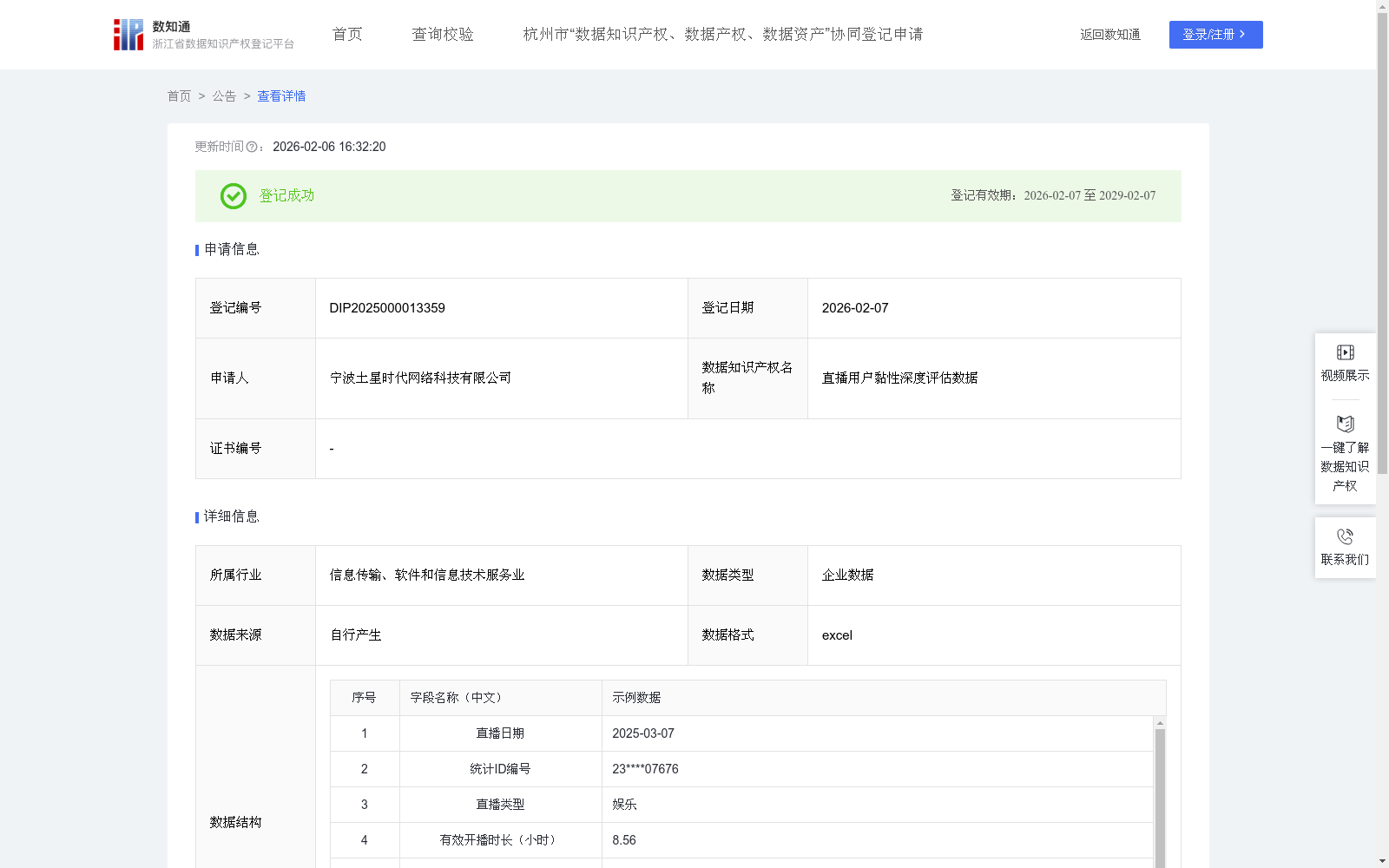
直播用户黏性深度评估数据
收藏资源简介:
本数据的核心在于将用户回访行为转化为可量化、可比较的黏性标尺。对企业内部而言,它可以驱动精细化运营,运营团队可据此识别高黏性主播与内容模式,优化签约、排期与流量分配;内容团队可提炼高黏性直播的共性以反哺创作;商业化团队则能以黏性数据为溢价依据,推动合作谈判,最终推动企业从“追求流量规模”转向“经营用户深度”,提升整体资源效率。对外部行业而言,该数据资产使企业具备定义“直播黏性”的话语权,可建立行业评级体系或榜单,并可封装为面向品牌方、MCN机构的付费数据服务,从而开辟B端变现新路径,实现从平台运营者向标准输出与数据服务提供者的升级。对上下游产业链而言,它可以发挥关键的调节作用,引导上游主播与MCN聚焦可持续的用户留存,推动内容向强互动方向优化;赋予中游平台在合作与谈判中更强的客观依据;助力下游品牌方精准筛选高黏性主播以提升营销效率,同时使用户隐性获得更优内容体验。1.数据采集与处理:采集一段周期内本公司直播后台系统数据,包括:直播日期、统计ID编号、直播类型、有效开播时长(小时)、进直播间人数(人)、进直播间次数(次)、人均频次等关键字段。对相关数据进行脱敏、清洗、聚集、分析。 2.数据计算与运用:(1)统计整理数据,人均频次(次)=进直播间次数(次)/进直播间人数(人),保留小数点后两位。(2)人均频次(次)≥5,用户黏性为高;2≤人均频次(次)<5,用户黏性为中等;人均频次(次)<2,用户黏性为低。
The core of this dataset is to translate user revisit behaviors into quantifiable and comparable live broadcast stickiness metrics. For internal enterprise operations: it can drive refined operations. The operation team can identify high-stickiness anchors and content models based on this data, optimize signing, scheduling and traffic allocation; the content team can extract the commonalities of high-stickiness live broadcasts to feedback content creation; the commercialization team can use stickiness data as a premium basis to promote cooperation negotiations, ultimately guiding the enterprise to shift from "pursuing traffic scale" to "operating user depth" and improving overall resource efficiency. For the external industry: this data asset enables the enterprise to hold the discourse power to define "live broadcast stickiness", can establish an industry rating system or rankings, and can be packaged as a paid data service for brands and MCN institutions, thereby opening up a new B-side monetization path and realizing the upgrade from a platform operator to a standard output and data service provider. For upstream and downstream industrial chains: it can play a key regulatory role, guiding upstream anchors and MCN institutions to focus on sustainable user retention, promoting content optimization towards strong interaction; empowering midstream platforms with stronger objective basis in cooperation and negotiations; helping downstream brands accurately screen high-stickiness anchors to improve marketing efficiency, while allowing users to implicitly obtain better content experiences. 1. Data Collection and Processing: Collect data from the company's live broadcast background system within a specified period, including key fields such as live broadcast date, statistical ID number, live broadcast type, effective broadcast duration (hours), number of unique live broadcast room entrants (persons), number of live broadcast room visits (times), per-capita frequency and other related indicators. Perform data anonymization, cleaning, aggregation and analysis on the collected data. 2. Data Calculation and Application: (1) Data statistics and sorting: Per-capita frequency (times) = number of live broadcast room visits (times) / number of unique live broadcast room entrants (persons), rounded to two decimal places. (2) User stickiness rating: High stickiness when per-capita frequency ≥ 5; medium stickiness when 2 ≤ per-capita frequency < 5; low stickiness when per-capita frequency < 2.