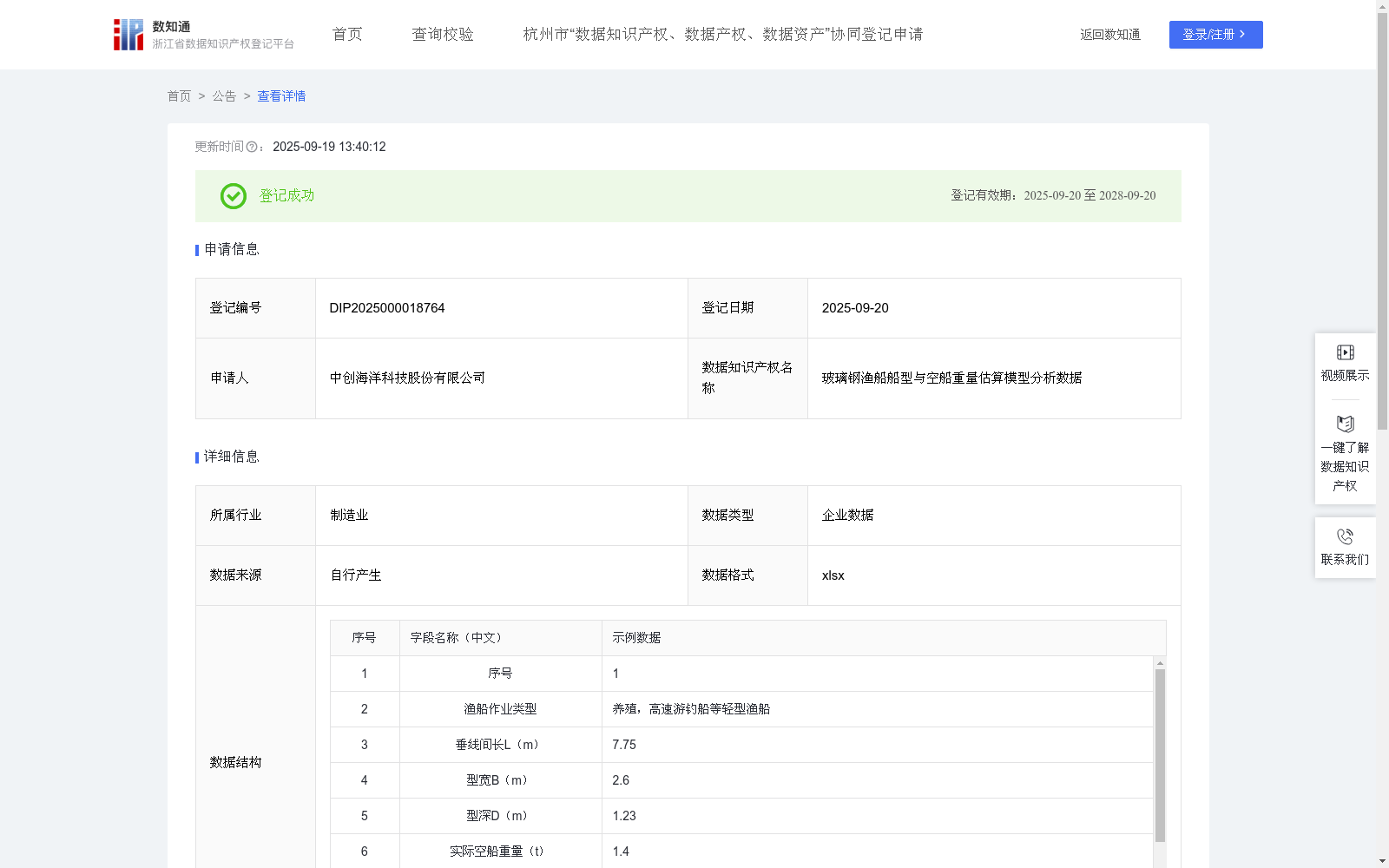
玻璃钢渔船船型与空船重量估算模型分析数据
收藏资源简介:
玻璃钢渔船船型与空船重量估算模型分析数据适用于玻璃钢渔船设计制造、渔业管理、科研评估及保险核验等领域,主要用于渔船空船重量的快速估算、设计校验与合规审查,具有良好的行业通用性和外部复用潜力。 一、适用对象与范围: 面向渔船设计单位、造船企业、渔业主管部门、检验机构及保险评估公司。适用于船长5~39米、具备典型作业方式(如养殖、钓业、拖网等)的玻璃钢渔船,尤其在缺乏详细结构资料或实船数据时发挥重要作用。 二、解决的核心问题: 在方案设计、成本控制、稳性初步分析、业务审批或资产评估中,快速、可靠地估算空船重量,减少对经验猜测或复杂计算的依赖,提升工作效率和决策科学性。 三、外部复用条件与价值: 用户可在遵守数据来源和误差范围的前提下,直接调用本模型于自有系统或设计流程。其基于统计回归分段的空船重量系数C和标准化公式,易于集成且计算稳定,误差普遍低于7%,可为行业提供统一、透明的估算基准,促进数据共享和设计协作。一、数据采集 采集玻璃钢渔船的基本船型参数,包括垂线间长L(m)、型宽B(m)、型深D(m),以及实际空船重量(t)。同时记录渔船作业类型,用于确定空船重量系数C的取值范围。 二、数据处理 根据渔船作业类型分类处理数据,确定适用的空船重量系数C的取值范围,空船重量系数C按垂线间长L(m)分段细化。 (1)养殖,高速游钓船等轻型渔船 当5m≤垂线间长L<10m时,空船重量系数C为0.06; 当10m≤垂线间长L<15m时,空船重量系数C为0.1; 当15m≤垂线间长L≤20m时,空船重量系数C为0.12; (2)竿钓,游钓,钓鱼,扇贝养殖船等不含冷冻系统的近海渔船 当8m≤垂线间长L<12m时,空船重量系数C为0.23; 当12m≤垂线间长L<14m时,空船重量系数C为0.2; 当14m≤垂线间长L≤16m时,空船重量系数C为0.21; (3)延绳钓,拖网,围网等含冷冻系统及渔业机械的大型远洋渔船 当20m≤垂线间长L<25m时,空船重量系数C为0.35; 当25m≤垂线间长L<33m时,空船重量系数C为0.3; 当33m≤垂线间长L≤39m时,空船重量系数C为0.35; 三、核心算法规则 估算空船重量WH的模型公式为:WH=C*L*B*D 其中: WH:估算空船重量(t); C:空船重量系数,根据渔船作业方式和垂线间长L确定; L,B,D:分别为垂线间长、型宽、型深(单位:米)。 计算完成后,与实际空船重量对比,计算误差: 误差(%)= (∣实际空船重量-估算空船重量∣÷实际空船重量)×100% 四、数据应用 该模型可用于初步估算玻璃钢渔船的空船重量,辅助船型设计与性能评估。误差普遍控制在7%以内,具有一定工程参考价值。实际应用中需结合具体船型与作业方式调整C值,以提高预测精度。
Analysis data of FRP fishing vessel form and lightship weight estimation model is applicable to fields such as FRP fishing vessel design and manufacturing, fishery management, scientific research evaluation and insurance verification. It is mainly used for rapid estimation of fishing vessel lightship weight, design verification and compliance review, and has good industry universality and external reuse potential. 1. Applicable Objects and Scope: This dataset is targeted at fishing vessel design institutions, shipbuilding enterprises, fishery administrative departments, inspection institutions and insurance assessment companies. It is applicable to FRP fishing vessels with a length between perpendiculars of 5 to 39 meters and typical operation modes such as aquaculture, fishing, trawling, etc., and plays an important role especially when detailed structural data or actual ship data are lacking. 2. Core Problems Solved: In the processes of scheme design, cost control, preliminary stability analysis, business approval or asset evaluation, it can quickly and reliably estimate the lightship weight, reduce the reliance on empirical guesses or complex calculations, and improve work efficiency and the scientific nature of decision-making. 3. External Reuse Conditions and Value: Users can directly apply this model to their own systems or design processes on the premise of complying with the data source requirements and error range limits. Based on the segmented statistical regression-based lightship weight coefficient C and standardized formulas, the model is easy to integrate and has stable calculation performance, with an error generally lower than 7%. It can provide a unified and transparent estimation benchmark for the industry, promoting data sharing and design collaboration. 4. Data Collection: Collect basic form parameters of FRP fishing vessels, including length between perpendiculars (L, m), moulded breadth (B, m), moulded depth (D, m), and actual lightship weight (t). Meanwhile, record the operation type of the fishing vessel to determine the value range of the lightship weight coefficient C. 5. Data Processing: Classify and process the data according to the operation type of the fishing vessel, determine the applicable value range of the lightship weight coefficient C, and refine the coefficient C by segments based on the length between perpendiculars L (m): (1) Light fishing vessels such as aquaculture vessels and high-speed recreational fishing vessels: When 5m ≤ L < 10m, the lightship weight coefficient C is 0.06; When 10m ≤ L < 15m, the lightship weight coefficient C is 0.1; When 15m ≤ L ≤ 20m, the lightship weight coefficient C is 0.12; (2) Nearshore fishing vessels without refrigeration systems, such as pole-and-line fishing vessels, recreational fishing vessels, angling vessels and scallop culture vessels: When 8m ≤ L < 12m, the lightship weight coefficient C is 0.23; When 12m ≤ L < 14m, the lightship weight coefficient C is 0.2; When 14m ≤ L ≤ 16m, the lightship weight coefficient C is 0.21; (3) Large ocean-going fishing vessels with refrigeration systems and fishing machinery, such as longline fishing vessels, trawlers and purse seiners: When 20m ≤ L < 25m, the lightship weight coefficient C is 0.35; When 25m ≤ L < 33m, the lightship weight coefficient C is 0.3; When 33m ≤ L ≤ 39m, the lightship weight coefficient C is 0.35; 6. Core Algorithm Rules: The model formula for estimating lightship weight WH is: WH = C * L * B * D Where: WH: Estimated lightship weight (t); C: Lightship weight coefficient, determined by the operation mode of the fishing vessel and the length between perpendiculars L; L, B, D: Length between perpendiculars, moulded breadth and moulded depth respectively (unit: meter). After calculation, compare the estimated value with the actual lightship weight to calculate the error: Error (%) = (|Actual lightship weight - Estimated lightship weight| ÷ Actual lightship weight) × 100% 7. Data Application: This model can be used for preliminary estimation of the lightship weight of FRP fishing vessels, assisting in form design and performance evaluation. The error is generally controlled within 7%, which has certain engineering reference value. In practical applications, the value of C needs to be adjusted according to the specific vessel form and operation mode to improve the prediction accuracy.