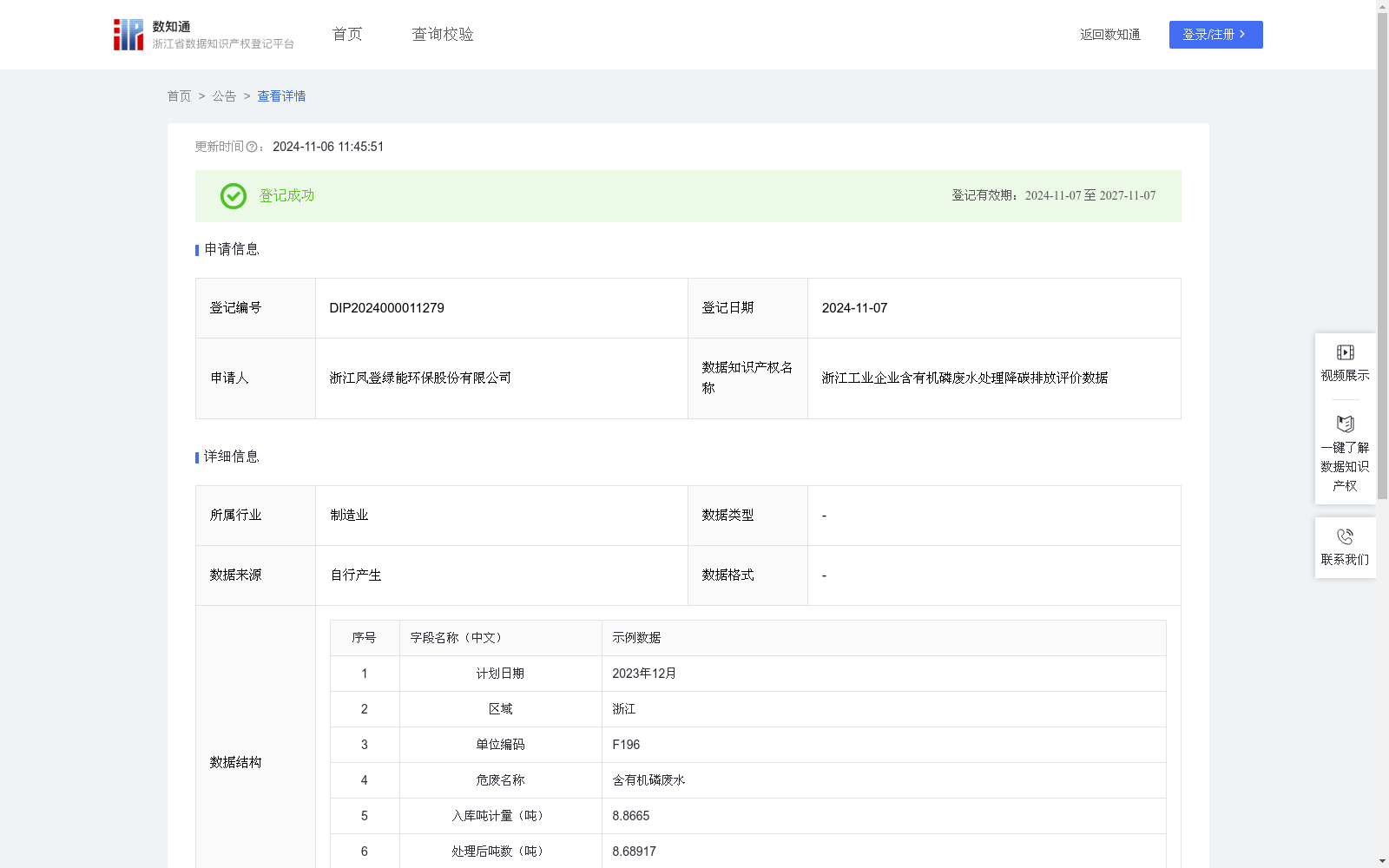
浙江工业企业含有机磷废水处理降碳排放评价数据
收藏资源简介:
通过企业含有机磷废水处理,减少化石能源消耗,提高固碳和碳捕捉技术水平,降低能耗,清洁环保,不产生二次污染,实现了近零排放和废弃物的循环利用。为同行业企业含有机磷废水处理量转化碳排放量提供数据支持。1、数据来源:数据来源于本企业每日入库含有机磷废水,以及处理含有机磷废水的数据 2、废物处理量相关指标系数 :a=Y/X。Y:处理后吨数;X:入库吨计量。采用一元线性回归模型,其中Y是目标变量,X是输入特征,而a是模型需要学习的参数。通过以往采集到的数据,对模型进行训练得到a的值为0.98,使得Y尽可能准确地反映出X的实际影响。3、企业降低二氧化碳排放量指标系数:a=Y/X。Y:降低二氧化碳排放量;X:处理后吨数.本系数采用一元线性回归模型,其中Y是目标变量,X是输入特征,而a是模型需要学习的参数。通过以往采集到的数据,对模型进行训练得到a的值为0.4,使得Y尽可能准确地反映出X的实际影响。降低二氧化碳排放量=0.4*处理后吨数。4、通过对企业危险废弃物的高效处理,减少化石能源消耗,提高固碳和碳捕捉技术水平,降低能耗,实现碳排放达标。
This dataset provides data support for converting organic phosphorus wastewater treatment volume into carbon emissions for enterprises in the same industry. The enterprise treats organic phosphorus wastewater to reduce fossil energy consumption, improve carbon sequestration and carbon capture technology levels, lower energy consumption, achieve clean and environmentally friendly operations without secondary pollution, and realize near-zero discharge and waste recycling. 1. Data Source: The data is derived from the daily inbound organic phosphorus wastewater volume and the organic phosphorus wastewater treatment data of the enterprise. 2. Waste treatment volume-related indicator coefficient: a = Y/X, where Y represents the post-treatment tonnage, and X represents the inbound tonnage measurement. A univariate linear regression model is employed, with Y as the target variable and X as the input feature, while a is the parameter that needs to be learned by the model. Based on previously collected data, the model is trained to obtain a value of 0.98, enabling Y to accurately reflect the actual impact of X. 3. Enterprise carbon dioxide emission reduction indicator coefficient: a = Y/X, where Y represents the reduced carbon dioxide emission amount, and X represents the post-treatment tonnage. A univariate linear regression model is employed, with Y as the target variable and X as the input feature, while a is the parameter that needs to be learned by the model. Based on previously collected data, the model is trained to obtain a value of 0.4, enabling Y to accurately reflect the actual impact of X. The reduced carbon dioxide emission amount = 0.4 * post-treatment tonnage. 4. Through efficient treatment of the enterprise's hazardous waste, fossil energy consumption is reduced, carbon sequestration and carbon capture technology levels are improved, energy consumption is lowered, and carbon emission standards are met.