open-index/open-wikipedia
收藏资源简介:
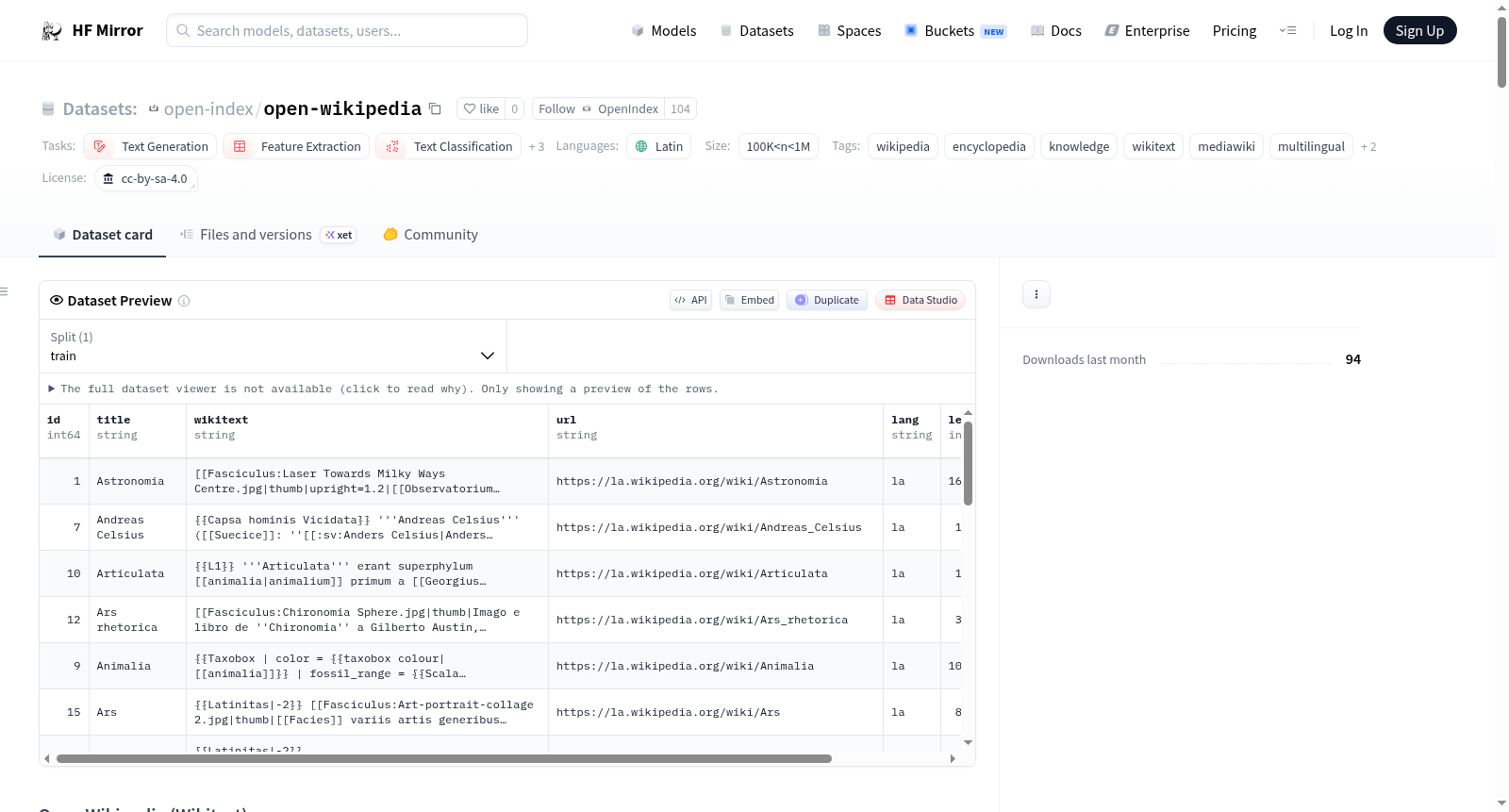
--- language: - la license: cc-by-sa-4.0 task_categories: - text-generation - feature-extraction - text-classification - question-answering - summarization - translation pretty_name: Open Wikipedia (Wikitext) tags: - wikipedia - encyclopedia - knowledge - wikitext - mediawiki - multilingual - wikimedia - open-data size_categories: - 100K<n<1M configs: - config_name: la data_files: - split: train path: data/la/*.parquet dataset_info: - config_name: la features: - name: id dtype: int64 - name: title dtype: string - name: wikitext dtype: string - name: url dtype: string - name: lang dtype: string - name: length dtype: int32 - name: timestamp dtype: string splits: - name: train num_examples: 139421 --- # Open Wikipedia (Wikitext) > Every Wikipedia article in original MediaWiki markup, 139.4K articles across 1 languages ## What is it? This dataset contains every article from every language edition of [Wikipedia](https://www.wikipedia.org/) in its **original MediaWiki wikitext source markup**. Nothing has been converted, stripped, or simplified. Templates, infoboxes, references, tables, categories, file links, and all other MediaWiki constructs are preserved exactly as the Wikipedia editors wrote them. The source data comes from the official [Wikimedia database dumps](https://dumps.wikimedia.org/). Each language's full XML export is streamed, parsed, and stored article by article as sharded Apache Parquet files with Zstandard compression, organized by language. This is the raw source variant of the Open Wikipedia collection. If you want articles converted to clean Markdown, see [open-index/open-wikipedia-markdown](https://huggingface.co/datasets/open-index/open-wikipedia-markdown). If you want plain text with all markup removed, see [open-index/open-wikipedia-text](https://huggingface.co/datasets/open-index/open-wikipedia-text). **139.4K articles** | **1 languages** | **Last updated: 2026-04-03** | **License: [CC BY-SA 4.0](https://creativecommons.org/licenses/by-sa/4.0/)** ## What is being released? The dataset is organized as one directory per language, with sharded Parquet files inside each: ``` data/ en/en-00000.parquet English, shard 0 en-00001.parquet English, shard 1 ... de/de-00000.parquet German fr/fr-00000.parquet French es/es-00000.parquet Spanish ja/ja-00000.parquet Japanese ... la/la-00000.parquet Latin ``` Each Parquet file contains up to 500,000 rows. Languages with fewer articles fit in a single shard. All files use Zstandard compression. ## How to download and use this dataset ### Using DuckDB DuckDB can read Parquet files directly from Hugging Face without downloading anything first. ```sql -- Count articles per language SELECT lang, COUNT(*) as articles FROM read_parquet('hf://datasets/open-index/open-wikipedia/data/*/*.parquet') GROUP BY lang ORDER BY articles DESC; ``` ```sql -- Find articles that use a specific template SELECT title, lang, length, url FROM read_parquet('hf://datasets/open-index/open-wikipedia/data/en/*.parquet') WHERE wikitext LIKE '%{{Infobox country%' LIMIT 20; ``` ```sql -- Count how many articles use infoboxes, per language SELECT lang, COUNT(*) AS with_infobox, ROUND(COUNT(*) * 100.0 / SUM(COUNT(*)) OVER (PARTITION BY lang), 1) AS pct FROM read_parquet('hf://datasets/open-index/open-wikipedia/data/*/*.parquet') WHERE wikitext LIKE '%{{Infobox%' GROUP BY lang ORDER BY with_infobox DESC LIMIT 20; ``` ```sql -- Article size distribution for English SELECT percentile_disc(0.25) WITHIN GROUP (ORDER BY length) AS p25, percentile_disc(0.50) WITHIN GROUP (ORDER BY length) AS p50, percentile_disc(0.75) WITHIN GROUP (ORDER BY length) AS p75, percentile_disc(0.90) WITHIN GROUP (ORDER BY length) AS p90, percentile_disc(0.99) WITHIN GROUP (ORDER BY length) AS p99, AVG(length)::INT AS avg_length, MAX(length) AS max_length FROM read_parquet('hf://datasets/open-index/open-wikipedia/data/en/*.parquet'); ``` ```sql -- Find the longest wikitext articles across all languages SELECT lang, title, length, url FROM ( SELECT *, ROW_NUMBER() OVER (PARTITION BY lang ORDER BY length DESC) AS rn FROM read_parquet('hf://datasets/open-index/open-wikipedia/data/*/*.parquet') ) WHERE rn = 1 ORDER BY length DESC LIMIT 20; ``` ### Using `datasets` ```python from datasets import load_dataset # Load English Wikipedia ds = load_dataset("open-index/open-wikipedia", "en") print(ds["train"][0]["title"]) print(ds["train"][0]["wikitext"][:500]) # Stream the full dataset without downloading everything ds = load_dataset("open-index/open-wikipedia", "en", split="train", streaming=True) for item in ds: print(item["title"], item["length"]) # Load a specific language ds = load_dataset("open-index/open-wikipedia", "de") print(f"German articles: {len(ds['train']):,}") ``` ### Using `huggingface_hub` ```python from huggingface_hub import snapshot_download # Download only English snapshot_download( "open-index/open-wikipedia", repo_type="dataset", local_dir="./wiki-wt/", allow_patterns="data/en/*", ) ``` For faster downloads, install `pip install huggingface_hub[hf_transfer]` and set `HF_HUB_ENABLE_HF_TRANSFER=1`. ### Using the CLI ```bash # Download a single language huggingface-cli download open-index/open-wikipedia \ --include "data/la/*" \ --repo-type dataset --local-dir ./wiki-wt/ ``` ### Template analysis Since the wikitext is unmodified, you can analyze template usage patterns across Wikipedia: ```python import re from collections import Counter from datasets import load_dataset ds = load_dataset("open-index/open-wikipedia", "en", split="train") # Count template usage across all English articles template_counts = Counter() for row in ds: for m in re.finditer(r'\{\{(\w+)', row["wikitext"]): template_counts[m.group(1)] += 1 # Top 20 most-used templates for name, count in template_counts.most_common(20): print(f" {name}: {count:,}") ``` ## Dataset statistics ### Languages | Language | Code | Articles | Shards | |----------|------|----------|--------| | Latin | `la` | 139.4K | 1 | ## Schema Every Parquet file shares the same schema: | Column | Type | Description | |--------|------|-------------| | `id` | `int64` | Wikipedia page ID, unique within each language edition | | `title` | `string` | Article title as it appears on Wikipedia | | `wikitext` | `string` | Full article body in original MediaWiki wikitext markup | | `url` | `string` | Direct URL to the Wikipedia article | | `lang` | `string` | ISO 639 language code (e.g. `en`, `de`, `fr`, `ja`) | | `length` | `int32` | Wikitext body length in bytes | | `timestamp` | `string` | Last revision timestamp in ISO 8601 format | ### Example instance Here is an example row from the English partition, showing the raw wikitext source: ```json { "id": 12, "title": "Anarchism", "wikitext": "{{Short description|Political philosophy and movement}}\n{{pp-semi-indef}}\n{{Use British English|date=August 2021}}\n'''Anarchism''' is a [[political philosophy]] and [[Political movement|movement]] that is against all forms of [[authority]]...", "url": "https://en.wikipedia.org/wiki/Anarchism", "lang": "en", "length": 128934, "timestamp": "2025-12-15T08:22:01Z" } ``` The `wikitext` field contains the complete source markup as stored in the Wikipedia database. This includes templates, references, categories, file links, and all other MediaWiki syntax. ## What is included in the wikitext Unlike the Markdown and plain text variants, this dataset preserves every element of the source markup: | Element | Example | |---------|---------| | Templates | `{{Infobox country\|name=...}}` | | Internal links | `[[United States\|US]]` | | External links | `[https://example.com text]` | | Headings | `== Section ==`, `=== Subsection ===` | | Formatting | `'''bold'''`, `''italic''` | | Tables | `{| class="wikitable" ... \|}` | | References | `<ref name="...">...</ref>` | | Categories | `[[Category:Countries]]` | | File and image links | `[[File:Map.svg\|thumb\|Caption]]` | | HTML tags | `<code>`, `<pre>`, `<syntaxhighlight>` | | Magic words | `__NOTOC__`, `__FORCETOC__` | | Comments | `<!-- editor notes -->` | | Parser functions | `{{#if:...|...|...}}` | | Lua module calls | `{{#invoke:Module\|function}}` | ## How it works The pipeline processes all 1 Wikipedia language editions through the following steps: 1. **Download.** The latest `{lang}wiki-latest-pages-articles.xml.bz2` dump is streamed from [dumps.wikimedia.org](https://dumps.wikimedia.org/). Downloads support HTTP range resumption, so interrupted transfers pick up where they left off. 2. **Parse.** A streaming XML parser processes the bzip2-compressed dump without extracting it to disk. Only namespace-0 pages (articles) are kept. Redirects, talk pages, user pages, and all other namespaces are skipped. 3. **Filter.** Articles shorter than 100 bytes (based on their plain-text equivalent) are excluded. This removes stubs, disambiguation pages, and other pages with minimal content. 4. **Shard.** Articles are written to Zstandard-compressed Parquet files, approximately 500,000 rows per shard. Multiple languages are processed in parallel using a worker pool. 5. **Publish.** Each language's shards are committed to this Hugging Face repository as they complete. Note that no conversion or transformation is applied to the wikitext content. The text you see in this dataset is the same text that Wikipedia's MediaWiki engine processes to render the pages you see in your browser. ## Considerations ### Why preserve the raw wikitext? The Markdown and plain text variants of this dataset apply lossy transformations to the source content. Templates are stripped, tables are removed, and references are discarded. While this produces cleaner output for most NLP tasks, it also throws away structured information. The raw wikitext is useful when you need to: - **Build or benchmark wikitext parsers.** If you are developing a MediaWiki parser or converter, this dataset provides millions of real-world test cases across hundreds of languages. - **Analyze template usage patterns.** Infoboxes, citation templates, and navigation templates encode structured knowledge that is lost in other formats. - **Extract structured data from infoboxes.** Many Wikipedia articles have infobox templates that contain key-value pairs, which can be parsed to build structured knowledge bases. - **Study editing conventions.** The raw markup reveals how different language communities organize and format their articles. - **Train markup-aware models.** Language models trained on wikitext can learn to generate or complete MediaWiki markup, which is useful for editing tools and bots. ### Known limitations - **This is the raw page source, not rendered HTML.** Templates are not expanded, parser functions are not evaluated, and Lua modules are not executed. What you see is the source code, not the output. - **One snapshot in time.** This dataset represents a single snapshot of each language's dump. It does not include edit history or article revisions. - **Dump availability varies.** Not all language editions have their dumps available at all times. - **Some articles are very large.** A small number of articles (lists, timelines, reference pages) can have wikitext bodies exceeding 1 MB. ## Related datasets - [open-index/open-wikipedia-markdown](https://huggingface.co/datasets/open-index/open-wikipedia-markdown) - Same articles converted to clean Markdown. Headings, bold, italic, code blocks, and links are preserved while templates and references are stripped. - [open-index/open-wikipedia-text](https://huggingface.co/datasets/open-index/open-wikipedia-text) - Same articles as pure plain text with all formatting and markup removed. Smallest files, best for embeddings and classification. ## Thanks The content in this dataset was written by millions of Wikipedia editors worldwide and is hosted by the [Wikimedia Foundation](https://www.wikimedia.org/). The raw data comes from the [Wikimedia database dumps](https://dumps.wikimedia.org/), which the Foundation makes freely available for download. Wikipedia is one of humanity's greatest collaborative achievements. All credit for the content goes to the volunteer editors who write, review, and maintain it. This dataset is an independent mirror and is not affiliated with or endorsed by the Wikimedia Foundation. ## Licensing Wikipedia content is released under the [Creative Commons Attribution-ShareAlike 4.0 International License](https://creativecommons.org/licenses/by-sa/4.0/) (CC BY-SA 4.0). This dataset inherits that license. If you redistribute or build upon this data, you must give appropriate credit and share your contributions under the same license. ## Citation ```bibtex @dataset{open_wikipedia, title = {Open Wikipedia (Wikitext)}, author = {Open Index}, year = {2026}, url = {https://huggingface.co/datasets/open-index/open-wikipedia}, license = {CC BY-SA 4.0}, publisher = {Hugging Face} } ``` _Last updated: 2026-04-03_