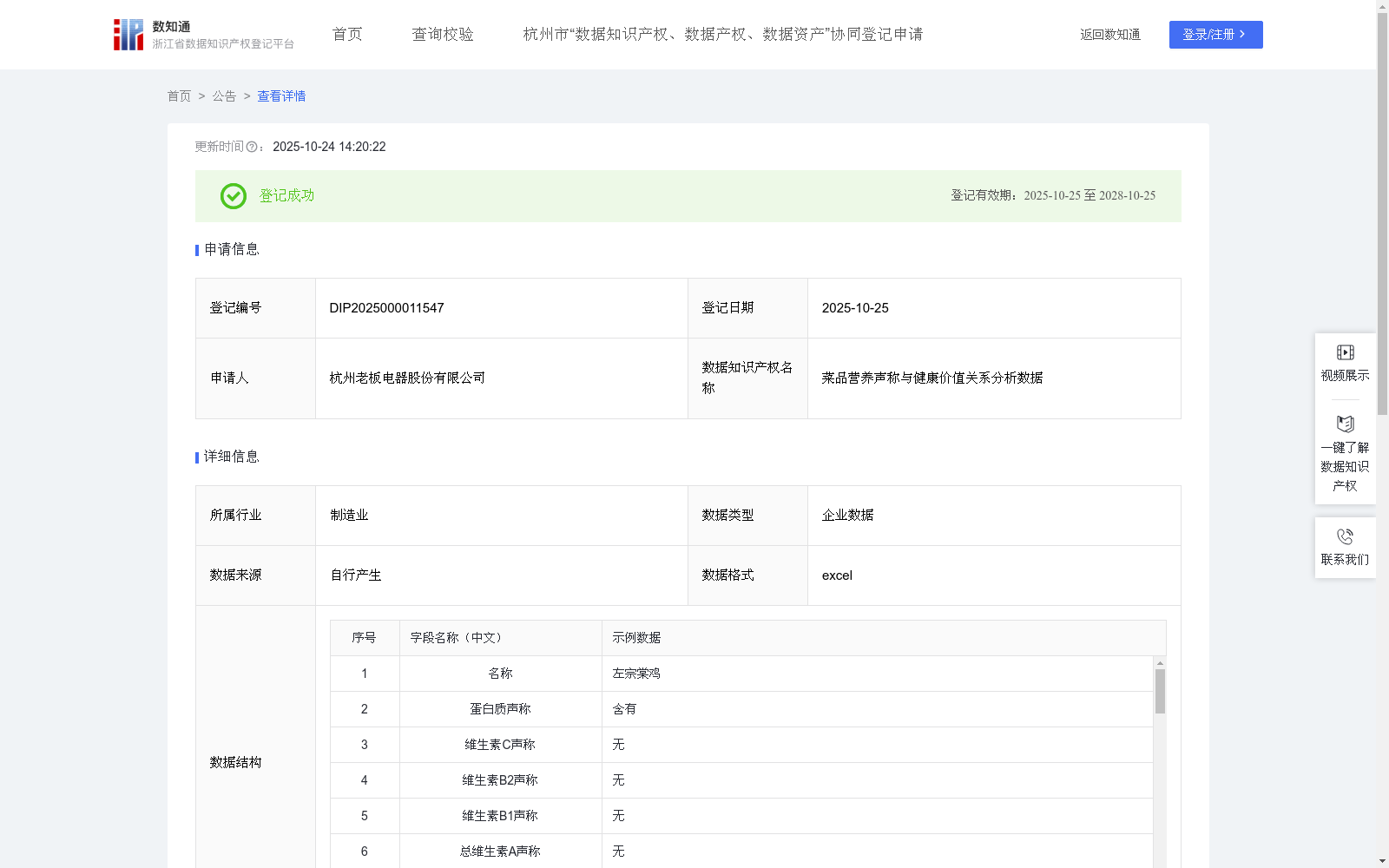
菜品营养声称与健康价值关系分析数据
收藏资源简介:
该数据可应用于烹饪设备制造企业、健康管理企业。 烹饪设备企业可通过对菜品营养声称数据及红黄绿灯结果分析,评判只能菜谱的开发搭配是否合理以及厨电设备烹饪菜品的健康程度,促进厨电设备健康烹饪技术改进升级以及菜品搭配的优化改进。 健康管理企业可通过对菜品进行红黄绿灯分析,调整对于用户的菜品搭配和健康膳食规划管理,通过标识菜品的红绿灯,帮助用户快速识别该菜品的营养状况及推荐食用频率。。如:在必须补充某一营养素时,优选绿灯菜品,避免红灯菜品。1、正负指标区分:根据健康趋向和常见人群摄入的影响程度,将28种营养素声称以含量结果按照正、负指标进行划分,菜品中含负向指标数量为Y,含正向指标数量为X。 2、根据国家倡导的三减政策,确定高脂肪、高能量、高钠为负向指标中的优先指标。菜品中含负向指标中优先指标的数量为m。 3、基于菜品的搭配数据和声称评价标准计算获取该菜品不同营养素的含量声称结果,将菜品分为红黄绿灯。 4、红黄绿灯具体评价标准为:根据含高脂肪/高能量/高钠的数量m、正向指标数量X及负向指标的数量Y之间的关系,对菜品的健康程度进行评价,以红黄绿灯的形式进行展现。 (1)Y=0:X≥4该菜品为绿灯,X≥0该菜品为黄灯;(2)Y=1:X≥5该菜品为绿灯,X≥2该菜品为黄灯,X<2该菜品为红灯;(3)Y=2:m=2时,X≥10该菜品为绿灯,X≥6该菜品为黄灯,X<6该菜品为红灯;m=1时,X≥9该菜品为绿灯,X≥4该菜品为黄灯,X<4该菜品为红灯;m=0时,X≥7时该菜品为绿灯,X≥4该菜品为黄灯,X<4该菜品为红灯;(4)Y=3:m=3时,X≥12该菜品为绿灯,X≥9该菜品为黄灯,X<9该菜品为红灯;m=2时,X≥11该菜品为绿灯,X≥5该菜品为黄灯,X<5该菜品为红灯;m=1时,X≥9该菜品为绿灯,X≥4该菜品为黄灯,X<4该菜品为红灯;m=0时,X≥8该菜品为绿灯,X≥4该菜品为黄灯,X<4该菜品为红灯;(5)Y=4:m=3时,X≥13该菜品为绿灯,X≥10该菜品为黄灯,X<10该菜品为红灯;m=2时,X≥12该菜品为绿灯,X≥8该菜品为黄灯,X<8该菜品为红灯;m=1时,X≥10该菜品为绿灯,X≥6该菜品为黄灯,X<6时该菜品为红灯;(6)Y=5~6:均为红灯。 5、补充说明:红黄绿灯代表含义:红灯菜品多吃可能增加身体健康负担,日常饮食中限量搭配;黄灯菜品营养物质较丰富,日常饮食中适量搭配;绿灯菜品营养物质丰富,日常饮食中可以优先搭配。
This dataset can be applied to cooking appliance manufacturing enterprises and health management enterprises. Cooking appliance enterprises can analyze the nutrient content claim data of dishes and the red-yellow-green light labeling results to evaluate the rationality of smart recipe development and matching, as well as the health level of dishes cooked by kitchen appliances, so as to promote the improvement and upgrading of healthy cooking technologies for kitchen appliances and the optimization of dish matching. Health management enterprises can conduct red-yellow-green light labeling analysis on dishes to adjust user dish matching and healthy diet planning management. By labeling dishes with traffic lights, they can help users quickly identify the nutritional status and recommended consumption frequency of the dishes. For example, when a certain nutrient needs to be supplemented, green light dishes should be preferred and red light dishes should be avoided. 1. Positive and negative indicator distinction: Based on health trends and the impact of intake on the general population, 28 types of nutrient content claims are divided into positive and negative indicators according to their content results. Let Y be the number of negative indicators contained in a dish, and X be the number of positive indicators contained in the dish. 2. According to the national "Three Reductions" policy, high fat, high energy and high sodium are identified as priority indicators among the negative indicators. Let m be the number of priority negative indicators contained in a dish. 3. Calculate the nutrient content claim results of different nutrients of the dish based on the dish matching data and claim evaluation criteria, and classify the dishes into red, yellow and green light categories. 4. Specific evaluation criteria for red-yellow-green light labels: The health level of the dish is evaluated and presented in the form of red, yellow and green lights based on the relationship between the number of priority negative indicators m (high fat/high energy/high sodium), the number of positive indicators X, and the number of negative indicators Y. The details are as follows: (1) When Y=0: The dish is rated green light if X≥4, and yellow light if X≥0; (2) When Y=1: The dish is rated green light if X≥5, yellow light if X≥2, and red light if X<2; (3) When Y=2: - If m=2: The dish is rated green light if X≥10, yellow light if X≥6, and red light if X<6; - If m=1: The dish is rated green light if X≥9, yellow light if X≥4, and red light if X<4; - If m=0: The dish is rated green light if X≥7, yellow light if X≥4, and red light if X<4; (4) When Y=3: - If m=3: The dish is rated green light if X≥12, yellow light if X≥9, and red light if X<9; - If m=2: The dish is rated green light if X≥11, yellow light if X≥5, and red light if X<5; - If m=1: The dish is rated green light if X≥9, yellow light if X≥4, and red light if X<4; - If m=0: The dish is rated green light if X≥8, yellow light if X≥4, and red light if X<4; (5) When Y=4: - If m=3: The dish is rated green light if X≥13, yellow light if X≥10, and red light if X<10; - If m=2: The dish is rated green light if X≥12, yellow light if X≥8, and red light if X<8; - If m=1: The dish is rated green light if X≥10, yellow light if X≥6, and red light if X<6; (6) When Y=5 or 6: All dishes are rated red light. 5. Supplementary explanation: The meanings of red-yellow-green light labels are as follows: Red light dishes may increase the physical health burden if consumed excessively, and should be used in limited portions in daily diet; Yellow light dishes are relatively rich in nutrients and should be used in appropriate portions in daily diet; Green light dishes are rich in nutrients and can be prioritized in daily diet.