LiteFold/FLIP2
收藏资源简介:
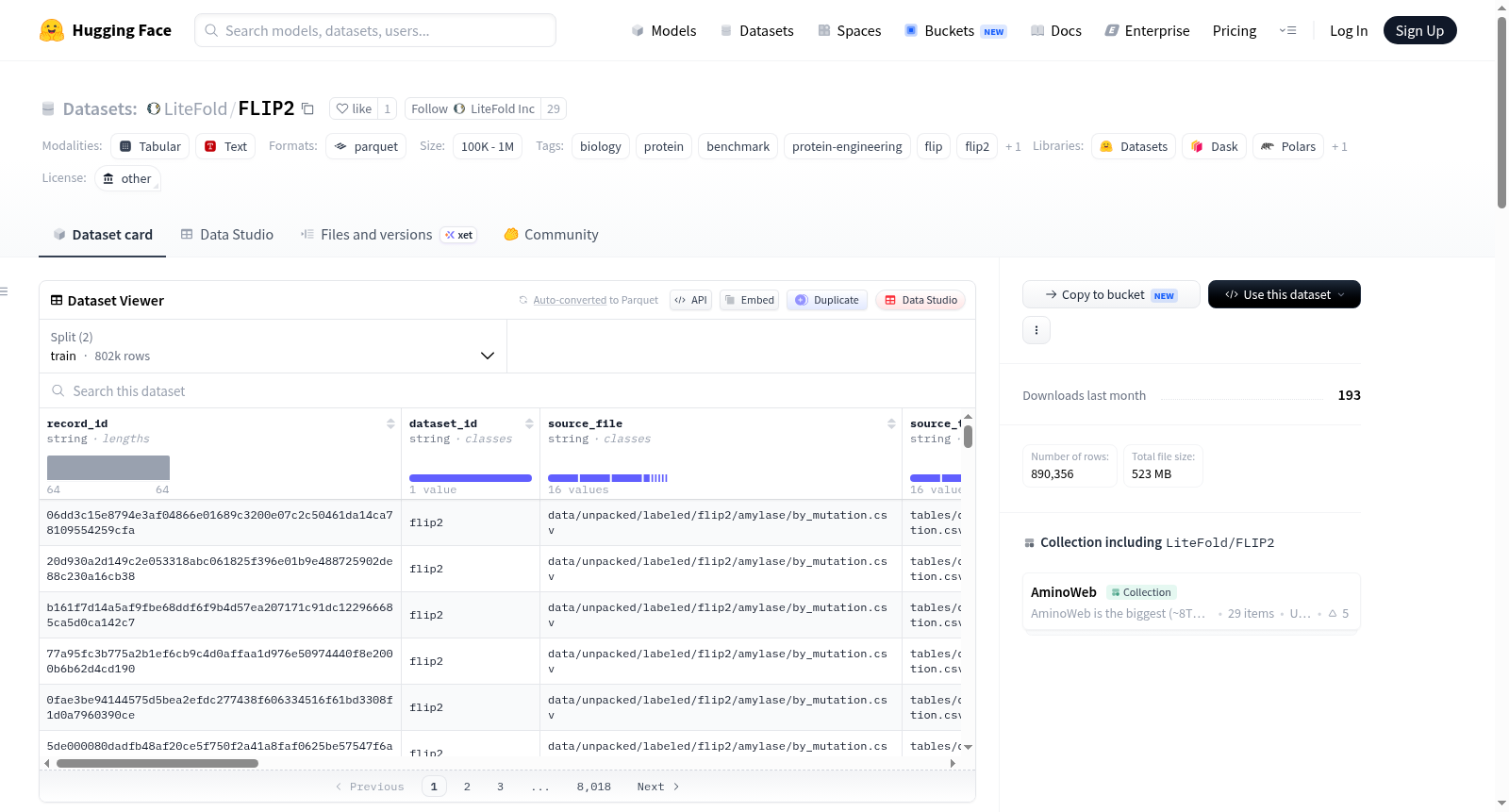
FLIP2是第二代蛋白质适应性景观推断基准,于2026年2月作为bioRxiv预印本发布,由NVIDIA、Microsoft、Caltech、Profluent和Duke等机构合作开发。它扩展了原始FLIP基准的范围,涵盖了七个新数据集,包括酶、蛋白质-蛋白质相互作用和光敏蛋白质等,旨在评估蛋白质语言模型和监督适应性预测器在实际蛋白质工程目标中的表现。数据集提供标准化的训练、验证和测试分割,以探究现实蛋白质工程分布变化(如基于序列相似性的分割、低数据机制、更高突变距离的外推以及保留的相互作用伙伴)下的泛化能力,而不是随机分割。每个数据集包含多个分割协议、序列、适应性标签和参考基线(例如每个分割的最佳零-shot pLM似然、pLM嵌入的岭回归等),所有数据均采用统一格式,与benchmark.protein.properties上的现有FLIP工具兼容。FLIP2旨在与ProteinGym(侧重于DMS景观和临床标签)一起,作为标准评估堆栈中面向蛋白质工程的一半。数据集包含训练集801,710行和测试集88,646行,列包括record_id、task_name、sequence、score_value等,并提供元数据表和引用信息。
FLIP2 is the second-generation Fitness Landscape Inference for Proteins benchmark, released as a bioRxiv preprint in February 2026 by a group spanning NVIDIA, Microsoft, Caltech, Profluent, and Duke. It expands the scope of the original FLIP benchmark to seven new datasets covering enzymes, protein-protein interactions, and light-sensitive proteins, aiming to evaluate protein language models and supervised fitness predictors for real-world protein engineering targets. The dataset provides standardized train, validation, and test splits that probe generalization under realistic protein engineering distribution shifts (such as sequence-similarity-based splits, low-data regimes, extrapolation to higher mutational distance, and held-out interaction partners) rather than random splits. Each dataset includes multiple split protocols, sequences, fitness labels, and reference baselines (e.g., best zero-shot pLM likelihood per split, ridge regression on pLM embeddings), all in a uniform format compatible with existing FLIP tooling at benchmark.protein.properties. FLIP2 is designed to sit alongside ProteinGym (which leans on DMS landscapes and clinical labels) as the protein-engineering-oriented half of the standard evaluation stack. The dataset contains 801,710 rows for training and 88,646 rows for testing, with columns such as record_id, task_name, sequence, score_value, etc., and includes metadata tables and citation information.