SupraLabs/Prompt-Routing-Dataset
收藏资源简介:
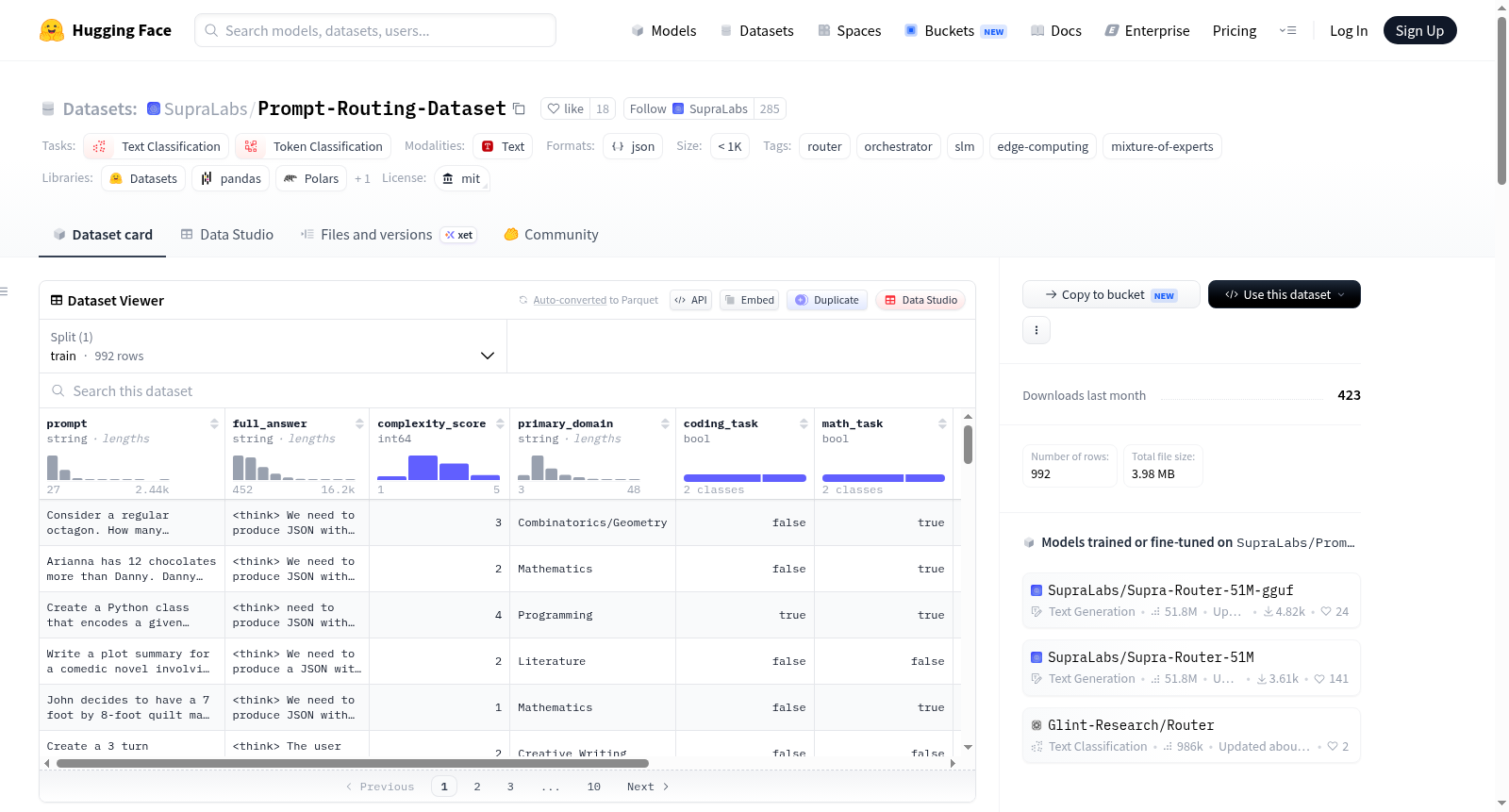
--- license: mit task_categories: - text-classification - token-classification tags: - router - orchestrator - slm - edge-computing - mixture-of-experts dataset_info: features: - name: prompt dtype: string - name: full_answer dtype: string - name: complexity_score dtype: int64 - name: primary_domain dtype: string - name: coding_task dtype: bool - name: math_task dtype: bool - name: requires_reasoning dtype: bool - name: routing_choice dtype: string - name: routing_justification dtype: string splits: - name: train num_bytes: auto num_examples: 992 --- <h1 align="center">Prompt Routing Dataset · Multi-Task Infrastructure Routing</h1>  <h2 align="center">About this dataset</h2> This dataset is a highly dense, premium alignment asset explicitly designed to train **Edge Orchestrators and Routing Models** ranging from 50M to 1.5B parameters. When deploying small language models (SLMs) on consumer hardware or local edge instances, running multi-step mathematical derivations or complex architectural software tasks often causes catastrophic hallucinations or syntax breakdown. This dataset provides clean, deterministic training signals to teach an edge model when to process an input locally (`small model`) and when to triage the request to a cloud-based frontier model (`big model`). ## Dataset Structure & Sample Row Each row in this dataset represents a rich, multi-task schema block wrapped in a single flat JSON object. Instead of providing a naive binary classification token, the dataset maps out structural metadata properties to anchor the attention mechanisms of compact architectures during sequence fine-tuning. ### Schema Fields: * `prompt` (String): The original user request. * `full_answer` (String): The complete reference solution, structurally preserving intermediate chain-of-thought (`<think>...</think>`) reasoning steps and code blocks. * `complexity_score` (Integer): A scalar index from 1 (Factual / Simple text) to 5 (Advanced logic / Nested structures). * `primary_domain` (String): The semantic domain classification (e.g., *Number Theory, Literature, Cryptography*). * `coding_task` (Boolean): Flag indicating if code generation, debugging, or execution parsing is present. * `math_task` (Boolean): Flag indicating if symbolic manipulation, proofs, or multi-step word math constraints are present. * `requires_reasoning` (Boolean): Qualitative indicator from the seed frontier model evaluating cognitive load. * `routing_choice` (String): The programmatic training target (`small model` vs `big model`). * `routing_justification` (String): A clean explanation mapping the logic of the routing decision. --- ## Data Curation & Crystalline Pipeline The data was generated using GPT-OSS-120B via OpenRouter with prompts from an interleaved streaming architecture drawing from two core distributions to maximize domain variance: 1. **`magpie-align/Magpie-Reasoning-150K`**: Seeded for deep algorithmic execution, formal mathematical proofs, and programmatic debugging strings. 2. **`HuggingFaceH4/instruction_dataset`**: Seeded for natural human conversational prompts, creative prose synthesis, factual lookups, and basic professional text writing. ### The Programmatic Rule Override Frontier LLMs exhibit a "Self-Reflection Bias" — because they find complex geometry, algebra, and basic scripts effortless, they natively mislabel them as matching `small model` capabilities. To eliminate this bias, this dataset enforces a strict, programmatic infrastructure rule during generation. The final `routing_choice` token is forced into an automated override based on objective logic: $$\text{If } (\text{complexity\_score} \ge 3 \text{ OR } \text{coding\_task} == \text{True} \text{ OR } \text{math\_task} == \text{True}) \rightarrow \mathbf{\text{big model}}$$ This results in a clean, crisp operational boundary where small models are authorized to handle natural conversation, content summarization, formatting text, and entity lookups, while safely pushing syntax-breaking logic to larger platforms. --- ## Recommended Fine-Tuning Strategy To achieve **90%+ classification accuracy** on sub-500M parameter models, we advise against training the model to emit a naive `small model` or `big model` token out of the blue. Instead, optimize your model using **Multi-Task Sequence Generation** by forcing the SLM to calculate the feature attributes *before* predicting the route. This lets the weight matrix dynamically compute activation vectors based on the keywords it identifies in the user text. ### Target Format Configuration: ```text [Input Prompt] Consider a regular octagon. How many different triangles can be formed... [Expected Model Generation Target] Domain: Combinatorics/Geometry | Complexity: 3 | Math: True | Code: False | Route: big model | Justification: Automated override: Task complexity is high (3) or involves technical logic... ``` By fine-tuning your edge model on this exact linear sequence, the weights naturally lock onto domain-specific syntax strings, leading to high-performance local routing orchestration with negligible computational footprints. ## Model Together with this dataset, we also ship a production-ready model - [https://huggingface.co/SupraLabs/Supra-Router-51M](https://huggingface.co/SupraLabs/Supra-Router-51M) - which you can use in your routing/orchestrator environment.
This dataset is a highly dense, premium alignment asset explicitly designed to train Edge Orchestrators and Routing Models ranging from 50M to 1.5B parameters. When deploying small language models (SLMs) on consumer hardware or local edge instances, running multi-step mathematical derivations or complex architectural software tasks often causes catastrophic hallucinations or syntax breakdown. This dataset provides clean, deterministic training signals to teach an edge model when to process an input locally (small model) and when to triage the request to a cloud-based frontier model (big model). The dataset structure includes multiple fields per sample, such as the original user request (prompt), complete reference solution (full_answer), complexity score (complexity_score), primary domain (primary_domain), etc., with routing choice (routing_choice) and justification (routing_justification) generated based on a programmatic rule override. Data generation combines two core distributions: magpie-align/Magpie-Reasoning-150K (for deep algorithmic execution and mathematical proofs) and HuggingFaceH4/instruction_dataset (for natural conversation and text generation), to maximize domain variance.