Ego2Robot
收藏资源简介:
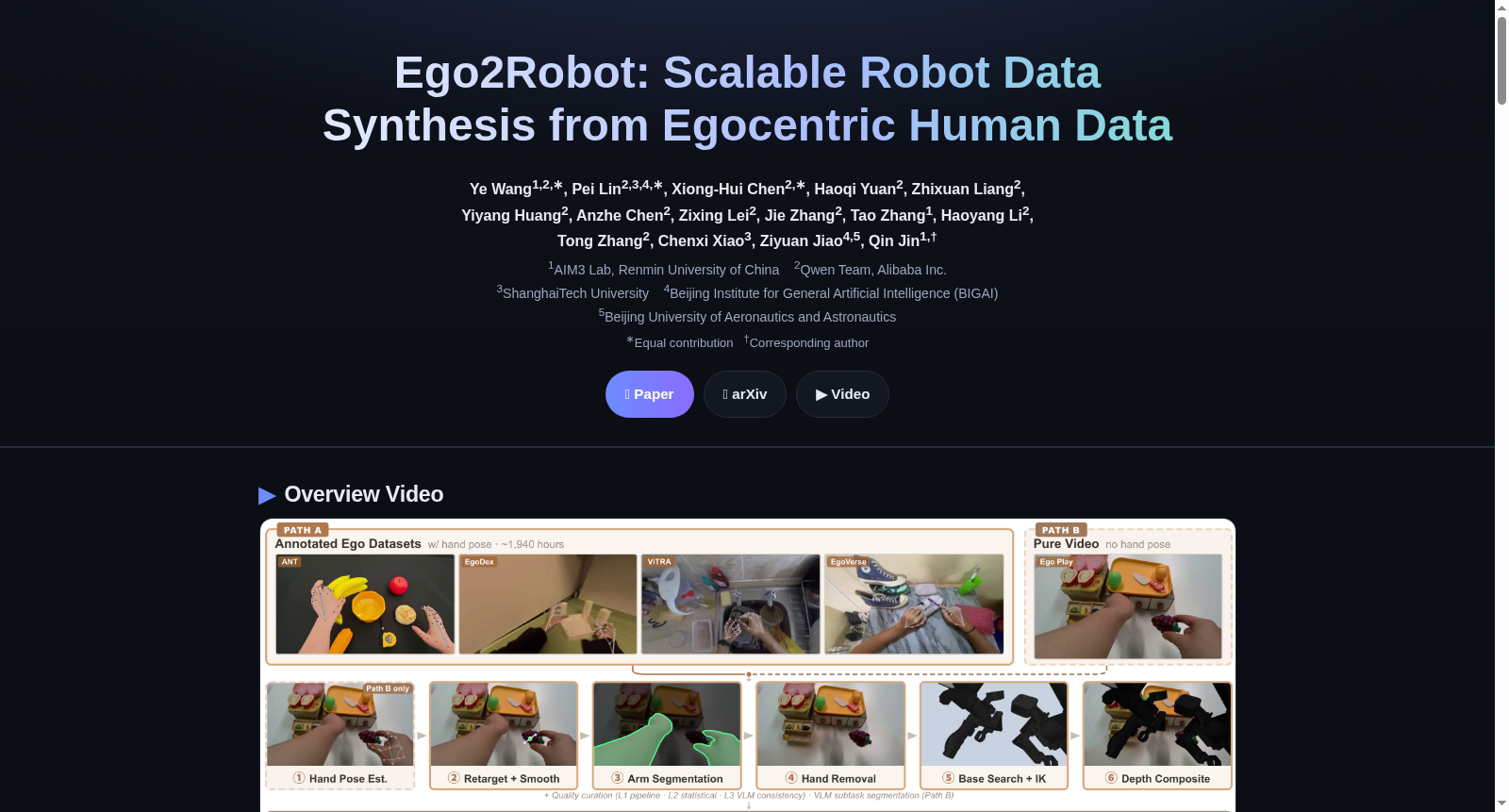
Ego2Robot是由中国人民大学、阿里巴巴等机构联合构建的大规模机器人训练数据集,旨在通过将人类第一人称操作视频转化为机器人格式数据,解决机器人数据采集成本高、多样性不足的问题。该数据集基于约1,940小时的四种第一人称视频源(ANT、EgoDex、ViTRA、EgoVerse),经动作重定向、视觉合成及三级质量筛选后,生成涵盖15种机器人形态的18,561小时有效训练数据,成为目前规模最大的跨形态机器人数据集。创建过程包括手部姿态估计、动作重定向与平滑、机器人基座搜索与逆运动学求解、深度感知合成等步骤,并采用多级质量过滤确保数据可靠性。数据集主要应用于机器人视觉-语言-动作模型的大规模预训练,旨在提升模型在视觉外观、场景布局、形态变化及任务语义等维度上的分布外泛化能力。
Ego2Robot is a large-scale robotic training dataset jointly constructed by Renmin University of China, Alibaba Group and other institutions. Its core goal is to convert human first-person operation videos into robot-compatible data, so as to address the issues of high acquisition cost and insufficient diversity in robotic data collection. This dataset is built upon approximately 1,940 hours of four types of first-person video sources, namely ANT, EgoDex, ViTRA and EgoVerse. After undergoing action retargeting, visual synthesis and three-level quality screening, it yields 18,561 hours of valid training data covering 15 distinct robot morphologies, making it the largest cross-morphology robotic dataset currently available. The construction pipeline of Ego2Robot encompasses multiple steps including hand pose estimation, action retargeting and smoothing, robot base search and inverse kinematics solving, depth perception synthesis, among others. Multi-level quality filtering is employed throughout the process to guarantee the reliability of the dataset. This dataset is primarily intended for large-scale pre-training of robotic vision-language-action (VLA) models, with the objective of enhancing the out-of-distribution (OOD) generalization capability of the models across dimensions such as visual appearance, scene layout, morphological variations and task semantics.
Ego2Robot 数据集详情总结
数据集概览
Ego2Robot 是一个可扩展的管道,用于将第一人称视角(以自我为中心)的人类操作视频转换为机器人训练数据。该数据集通过动作重定向、机器人手臂视觉合成和多层级质量筛选,生成大规模、多样化的仿真机器人数据。
核心数据规模
- 总数据量:18,561 小时的机器人训练数据
- 机器人形态:支持 15 种机器人形态(morphologies)
- 数据来源:四种第一人称视频源,共约 1,940 小时原始人类操作视频
- ANT(7小时,自建)
- EgoDex(732小时)
- ViTRA(249小时)
- EgoVerse(954小时)
- 真实机器人数据:约 6,565 小时(来自 DROID、AgibotWorld、InternData),用于联合预训练
管道三阶段
-
动作对齐(Action Alignment):将手部关键点(拇指、食指/中指指尖、手腕)重定向为夹爪 TCP、宽度和方向;通过 Savitzky–Golay 和 SLERP 进行平滑处理。
-
视觉对齐(Visual Alignment):包括 SAM 3 手臂分割 → ProPainter 手部移除 → 机器人基座姿态搜索 → 逆运动学(IK)求解 → 深度感知合成到修复后的场景中。
-
质量筛选(Quality Curation):三层筛选机制:
- L1:管道内部检查(IK 失败、碰撞、异常值)
- L2:统计分析(极端值、不连续性)
- L3:VLM 视频-动作一致性检查
评估框架
在 RoboTwin 2.0 基础上扩展了 11 个独立扰动设置,外加外部 EBench(更高安装摄像头,更接近第一人称视角),解耦了四个泛化轴:
| 泛化轴 | 扰动类型 |
|---|---|
| 视觉外观 | 背景、光照、机器人颜色 |
| 场景布局 | 桌子高度、干扰物、相机偏移 |
| 具身形态 | 零样本迁移到 UR5、ARX、Franka |
| 任务语义 | 未见物体(50 个任务)、505 条改述指令 |
主要实验结果
核心对比(成功率 %)
| 预训练配置 | Clean | Randomized | Visual | Scene | Embodiment | Task | EBench |
|---|---|---|---|---|---|---|---|
| 仅机器人数据 | 62.2 | 50.9 | 61.4 | 52.9 | 23.8 | 46.2 | 39.6 |
| Ego2R+Robot (1:3) | 61.4 | 51.0 | 61.2 | 52.5 | 21.9 | 49.5 | 47.4 |
| Ego2R+Robot (3:1) | 64.1 | 49.2 | 62.7 | 54.3 | 28.2 | 51.6 | 51.7 |
| Ego2R+Robot (1:1) | 68.1 | 53.5 | 67.3 | 56.9 | 27.2 | 54.1 | 49.8 |
关键发现
- 联合预训练改善 OOD 泛化:Ego2R+Robot (1:1) 在七个指标中的五个领先,RoboTwin Randomized 上达 53.5%(+2.6),同时保持 Clean 68.1%(+5.9)。
- 视觉外观获益最大:背景 +4、光照 +8、机器人颜色 +6。
- 场景布局中等增益:相机偏移鲁棒性提升 +6。
- 具身迁移受益于多形态数据:ARX 从 44 提升至 51(1:1);UR5 在 3:1 时达峰值为 31;Franka 保持低于 7%(大运动学差距)。
- 任务语义持续改善:未见物体从 29% 提至 40%(3:1 时 +11);改述指令鲁棒性在 1:1 时达 69%。
- EBench 确认高视角增益:3:1 时达 51.7(+12.1)。
消融实验结论
- 仅使用原始 Ego 数据预训练:RoboTwin Randomized 上仅达 28.1%
- 经管道处理(单形态):提升至 31.7%(+3.6)
- 扩展到 15 种形态:提升至 33.5%
- 原始 Ego 数据 + 15 形态数据:提升至 37.3%(原始 Ego 数据相当于第 16 种"形态")
真实机器人实验
在 ARX ACone 平台上,五种长时程任务、每任务仅 20 条遥操作演示的少样本设置下:
- 比较了仅机器人数据、混合预训练(Ego2R+Robot 1:1)、以及混合预训练 + Ego2R Play(将管道转换的第一人称"游玩"演示混入微调数据)
- Mix + Ego2R Play 在所有五个任务上表现最佳